Ojos llorosos
Epiphora
Revisado por pares por Dr Colin Tidy, MRCGPÚltima actualización por Dr Hayley Willacy, FRCGP Última actualización 21 Feb 2023
Cumple con las directrices editoriales
- DescargarDescargar
- Compartir
- Language
- Discusión
- Versión en audio
- Agregar a fuentes preferidas en Google
En esta serie:Entropion
Los ojos llorosos son comunes y pueden afectar a cualquiera. Un conducto lagrimal bloqueado es la causa más común, especialmente en bebés y personas mayores, pero hay varias otras causas. Por lo general, mejoran por sí solos.
Puntos clave
Watering eyes (epiphora) happen when too many tears are made or when tears can’t drain away properly because the drainage system is blocked.
Common causes of watery eyes include eye irritation, infections, blocked tear ducts, or eyelid problems (such as entropion or ectropion).
Tests including probing, syringing, or dye injection can be performed at an eye clinic to help find where the tear drainage is blocked or what else is the cause of your watery eyes.
Treatment depends on the cause - mild cases often settle on their own, while blocked ducts may need a small surgical procedure to fix the drainage.
Causes of watering eyes
Overactive tear ducts
Anything that irritates the eye can cause you to produce excess tears. The watering is a protective reflex to help clear irritants away from the eye. For example:
Chemical irritants such as onions or fumes from machines.
Eye infection in the front of the eye (infection conjunctivitis).
Allergy causing inflammation of the front of the eye (allergic conjunctivitis).
A small injury or scratch to the front of the eye, or a piece of dirt or grit which gets stuck in the eye.
Blocked drainage of tears
This is pretty common in babies: their tear ducts tend to be a bit narrow and can't handle all their tears (and babies do cry a lot). Babies' tears are quite thick and if they're blocked, they get a bit gunky. That's why a lot of babies have gunky eyes, even though there's no infection. It usually clears by itself in a few months, or certainly by the age of 1 year. All you need to do is wipe away the gunk with a clean cotton wool pad and warm water. See the separate leaflet called Tear Duct Blockage in Babies para obtener más información sobre esto.
In elderly people their tear ducts often get narrower with age. So the tears can't drain away properly, making their eyes very watery. Occasionally the blocked tear duct gets a mild infection and makes the skin just between the nose and eye red and sore.
Problems with eyelashes or eyelids
In the elderly the eyelashes can turn inwards, scratching the eyeball and making it sore and watery. This is called entropion and can be corrected with surgery.
Because the eyelids can become a bit lax and relaxed with age, the lower eyelids can droop outwards. Then tears just drop out of the eye instead of draining away down the tear ducts. This is called ectropion and can be corrected with surgery.
How tears work
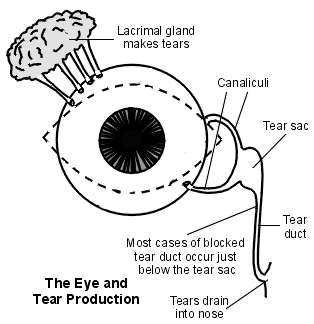
Just above, and to the outer side of, each eye is a small gland called the lacrimal gland. This constantly makes a small amount of tears. When you blink, the eyelid spreads the tears over the front of the eye to keep it moist.
The tears then drain down tiny holes (called canaliculi) on the inner side of the eye into a tear sac. From here they flow down a channel called the tear duct (the nasolacrimal duct) into the nose. This diagram shows how tears usually drain away:
Vista de cerca
What tests do I need for watering eyes?
Usually the cause is easily identified - for example, infections, ectropion, entropion, and conjunctivitis. If there is no obvious cause revealed by a simple examination, further tests may be advised. These may depend on how bad the watering is, and how much it bothers you.
If a drainage problem is suspected, an eye specialist may examine the tear drainage channels, under local anaesthetic. They may push a thin stick (probe) into the small channels (canaliculi) towards the tear sac to see if it is blocked. If the probe goes as far as the tear sac then fluid can be syringed into the tear duct to see if it comes out in the nose.
Syringing may sometimes clear a blockage, but it may only give temporary relief. If there seems to be a blockage then a dye may be injected into the tear duct. An X-ray picture is then taken. You can see the dye in the duct on the X-ray film. It will show exactly where there is any obstruction or narrowing of the tear duct.
Other scans - for example, a tomografía computarizada (TC) o imágenes por resonancia magnética (IRM) scan - may be undertaken in some cases. An eye specialist will be able to advise you.
Treatment for watering eyes (epiphora)
Treating eye irritation
Quite often the cause of watery eyes can be treated. For example:
Eyelashes irritating the front of the eye (entropion) can be removed.
Conjunctivitis can usually be treated with drops.
Pieces of grit, etc, can be removed.
Treating tear drainage problems
Babies with watering eyes usually grow out of it with no treatment.
Blockage of the channels in adults:
You may not need treatment if the watering is mild or does not bother you much.
A blocked tear duct can be treated with an operation. The usual operation is called dacrocystorhinostomy (DCR). A tiny probe is passed through the blocked tear duct and can unblock it.
DCR surgery is worthwhile if the watering is bad enough to interfere with your activities of daily living. It is also recommended if you have had an infection in your tear sac as a result of the blocked tear duct. The surgery may prevent repeated attacks of a red, painful swelling at the corner of your eye.
The surgery is not without its risks and should only be done if you fully understand the pros and cons.
A narrowed small channel (canaliculus) which is not fully blocked may be widened by pushing in a probe.
Preguntas frecuentes
How can I make my eyes stop watering?
You can help stop your eyes from watering by avoiding triggers such as smoke, wind, and allergens, and by using lubricating eye drops if your eyes are dry. Applying a warm compress can also help if blocked tear ducts are the cause. If symptoms don’t improve, speak to your doctor or optician.
What is the best medicine for watery eyes?
The best medicine for watery eyes depends on the cause. Antihistamine eye drops can help if allergies are the cause, while antibiotic drops may be needed for infections. If the problem is due to dryness or blocked tear ducts, lubricating drops or prescription treatments may be more effective.
When should I see a doctor about watery eyes?
You should see a doctor about watery eyes if the problem lasts more than a few days, affects your vision, or is accompanied by pain, redness, or discharge. Persistent or severe symptoms may indicate an infection, blocked tear duct, or another underlying eye condition that needs medical attention.
Selecciones del paciente para Signos y síntomas generales

Signos y síntomas
Hiperhidrosis
La hiperhidrosis significa que sudas mucho más de lo normal. La sudoración excesiva ocurre incluso cuando no tienes calor, no estás ansioso o no estás haciendo ejercicio. Algunas personas con hiperhidrosis pueden sufrir de sudores nocturnos.
por la Dra. Toni Hazell, FRCGP

Signos y síntomas
Picazón en el ano
Un picor en el ano (prurito anal) es una picazón persistente alrededor del ano. Hay muchas causas diferentes, como hemorroides, afecciones de la piel o infecciones. Los tratamientos dependen de la causa, pero incluyen medidas de higiene y cremas o ungüentos para tratar la picazón.
por el Dr. Doug McKechnie, MRCGP
Lecturas adicionales y referencias
- Shams PN, Chen PG, Wormald PJ, et al; Management of functional epiphora in patients with an anatomically patent dacryocystorhinostomy. JAMA Ophthalmol. 2014 Sep 1;132(9):1127-32. doi: 10.1001/jamaophthalmol.2014.1093.
- Nasolacrimal duct obstruction (nasolacrimal drainage dysfunction); College of Optometrists, March 2016
- Alam MS, Kundu D; Is dacryocystectomy effective in reducing epiphora? Indian J Ophthalmol. 2022 Dec;70(12):4416-4418. doi: 10.4103/ijo.IJO_972_22.
Sobre el autorVer biografía completa

Dr Hayley Willacy, FRCGP
Médico General, Autor Médico
MBChB (1992), DRCOG, DFFP, MRCOG (Part 1) MRCGP (2007), DFSRH (2013), MSc - medical education (2020)
La Dra. Hayley Willacy fue una médica general del NHS que trabajaba en el noroeste de Inglaterra, quien se retiró de la práctica clínica en 2022 después de 30 años.
Acerca del revisorVer biografía completa

Dr Colin Tidy, MRCGP
Médico General, Autor Médico
MBBS, MRCGP, MRCP (Paediatrics), DCH
El Dr. Colin Tidy es un médico del NHS, con sede en Oxfordshire.
Historial del artículo
La información en esta página está escrita y revisada por pares por clínicos calificados.
Artículo también disponible en Inglés, Alemán, Español, Francés, Italiano, Portugués, Hindi, Hebreo, Árabe, y Sueco.
Próxima revisión: 20 Feb 2028
21 Feb 2023 | Última versión

Pregunta, comparte, conecta.
Navega por discusiones, haz preguntas y comparte experiencias en cientos de temas de salud.

¿Te sientes mal?
Evalúa tus síntomas en línea de forma gratuita
Suscríbete al boletín de Patient
Tu dosis semanal de consejos de salud claros y confiables, escritos para ayudarte a sentirte informado, seguro y en control.
Al suscribirte aceptas nuestros Política de Privacidad. Puedes darte de baja en cualquier momento. Nunca vendemos tus datos.
Más sobre signos y síntomas
- Masas abdominales
- Angina
- Costillas rotas o magulladas
- Síntomas del cáncer
- Respiración controlada
- Tos
- Tos y resfriados en niños
- Ojos secos
- Sensación de globo
- Sarpullido por calor y sudamina
- Rodilla de sirvienta
- Hipertensión intracraneal idiopática
- Insomnio
- Picazón en el ano
- Náuseas y vómitos
- Bultos y protuberancias en el cuello
- Dolor pélvico en mujeres
- Proteinuria
- Neuritis vestibular y laberintitis
- Sibilancia