Infección urinaria en niños
Revisado por Dr Krishna Vakharia, MRCGPÚltima actualización por Dr Colin Tidy, MRCGPÚltima actualización 26 de agosto de 2022
Cumple con las directrices editoriales
- DescargarDescargar
- Compartir
- Language
- Discusión
- Versión en audio
- Agregar a fuentes preferidas en Google
La infección de orina en los niños es común. Puede causar varios síntomas. Un tratamiento con medicamentos llamados antibióticos generalmente eliminará la infección rápidamente. En la mayoría de los casos, un niño con infección de orina se recuperará por completo. A veces, se recomiendan pruebas para verificar los riñones y/o la vejiga después de que la infección haya desaparecido. Su médico le informará si su hijo necesita estas pruebas. Esto depende de la edad de su hijo, la gravedad de la infección y si ha ocurrido antes.
De un vistazo
Una infección urinaria en niños es causada por gérmenes que entran en la orina.
Los síntomas en niños pequeños incluyen fiebre, vómitos, somnolencia o parecer enfermo.
Los niños mayores pueden tener dolor o frecuencia al orinar, o dolor de barriga/espalda.
Una muestra de orina confirma el diagnóstico, y los antibióticos generalmente eliminan la infección.
Dé al niño abundante líquido y paracetamol para el dolor o la fiebre.
Busque ayuda médica si sospecha que su hijo tiene una infección urinaria.
Prevenga futuras infecciones evitando el estreñimiento y asegurando una buena higiene.
Need treatment for a UTI?
Start a quick NHS Pharmacy First consultation online through Patient.info.
- Online and available 24/7, treatment can often be delivered next day.
- Free service, just pay the NHS prescription charge online if required.
- Just answer a few questions then choose a time for a clinician call.
Powered by Evaro, a UK regulated healthcare service supporting over 2 million patients. Reviewed by UK registered clinicians.

What is a urine infection in children?
El tracto urinario
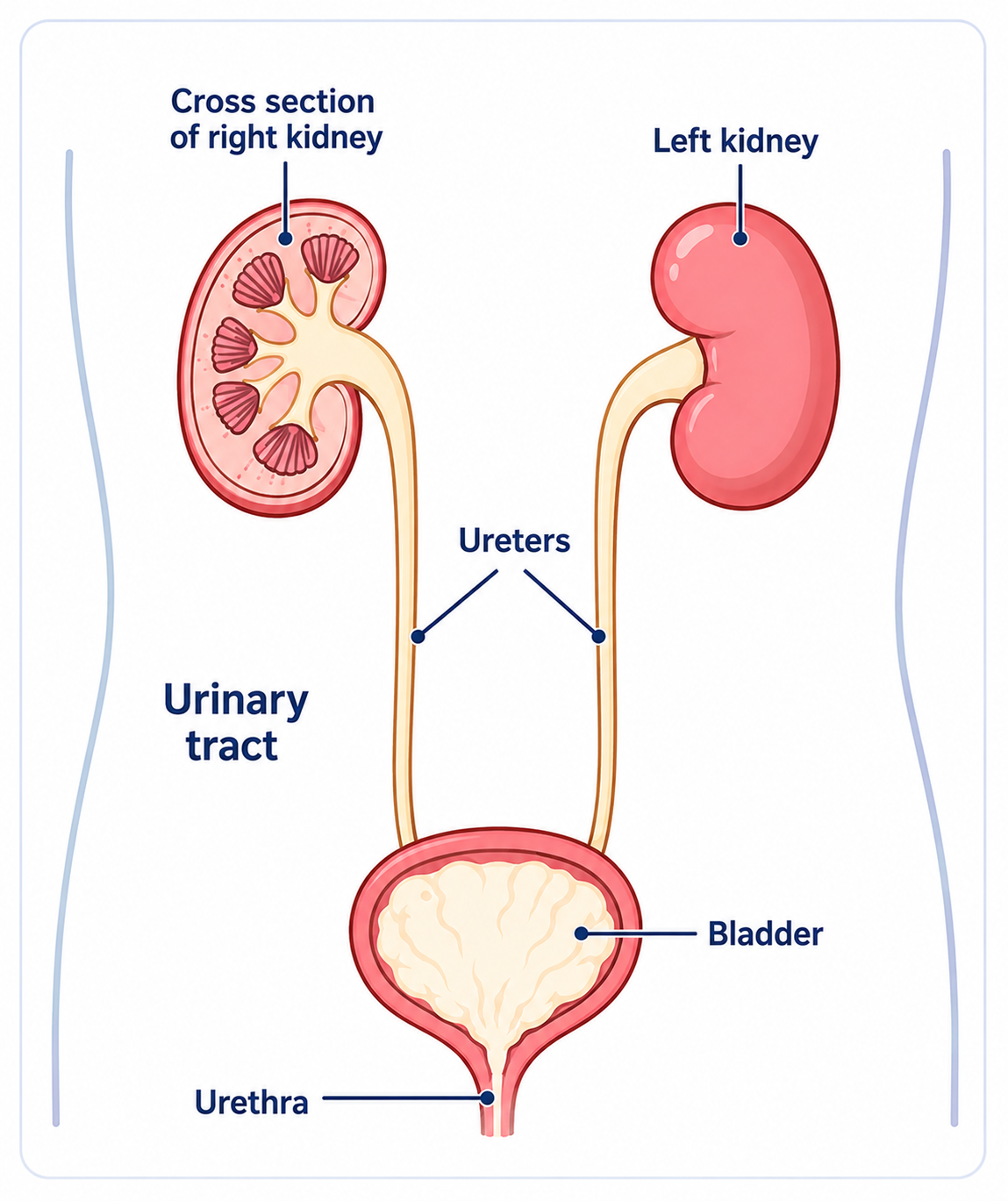
A urine infection is caused by germs (bacteria) that get into the urine. Most urine infections are due to bacteria that normally live in the bowel. They cause no harm in the bowel but can cause infection if they get into other parts of the body. Some bacteria lie around the back passage (anus) after a stool (faeces) has been passed. These bacteria can sometimes travel to the urethra (the tube that passes urine from the bladder) and into the bladder. Some bacteria thrive in urine and multiply quickly to cause infection.
The infection is commonly just in the bladder (when it is called cystitis) but may travel higher up to affect one or both kidneys as well.
Understanding the urinary tract
There are two kidneys, one on each side of the abdomen. They make urine which drains down tubes called ureters into the bladder. Urine is stored in the bladder and is passed out through a tube from the bladder (the urethra) from time to time when we go to the toilet.
Symptoms of a urine infection in children
It can be difficult to tell if a child has a urine infection. If they are very young they may not be able to let you know where the problem is. If they are still wearing nappies, you may not notice them passing urine more often.
Young children, toddlers and babies can have various symptoms which may include one or more of:
Somnolencia.
Crying, going off feeds and generally seeming unwell.
Appearing to be in pain.
Sangre en la orina (uncommon).
Cloudy or smelly urine.
Older children may say that they have pain when they pass urine, and pass urine frequently. If a kidney becomes infected they may also have shivers and complain of tummy (abdominal) pain, back pain, or a pain in a side of the abdomen. Bedwetting in a previously dry child is sometimes due to a children's urine infection. Just being generally unwell may be due to a urine infection.
Nota: a urine infection should be suspected in any child who is unwell or has a fever with no other clear cause. This is why a urine test is commonly done when a child is unwell. It is important to diagnose and treat a urine infection in children promptly.
How is a urine infection in children confirmed?
A muestra de orina is needed to confirm the diagnosis. Urine normally has no germs (bacteria) present, or only very few. A urine infection in children can be confirmed by urine tests which detect bacteria and/or the effects of infection in the urine.
Ideally, the sample of urine should not come into contact with skin or other materials which may contaminate it with other bacteria. Adults and older children can do this by a midstream collection of urine. This is not easy to do in young children and babies. The following are ways to obtain a sample of urine that is not contaminated:
Young children - the usual way is to catch some urine in the specimen bottle whilst they are passing urine. Just be ready with the open bottle as the child passes urine. (Be careful not to touch the open rim of the bottle with your fingers, as this may contaminate the specimen with bacteria from your fingers.)
Bebés - one method is to place a specially designed absorbent pad in a nappy (supplied by a doctor). Urine is sucked into a syringe from the wet pad. Another method is to use a plastic bag that sticks on to the skin and collects urine. If no pad or plastic bag is available, the following might work. Take the nappy off about one hour after a feed. Gentle wiping of the skin over the pubic area, using gauze soaked in cold water, helps trigger peeing.
If you collect a sample at home, take it to the doctor or clinic as soon as possible after collection. If there is a delay, store the urine sample in the fridge.
If you are unable to obtain a sample by the methods above, there are other ways to obtain one. These ways are a little more uncomfortable and are usually done in hospital. A doctor could put a thin, flexible, hollow tube called a catheter into the bladder to get the sample. The tube is then taken out straightaway. Alternatively a doctor can also use a sterile needle to take a sample directly from the bladder, by going through the skin just above the pubic bone. A local anaesthetic is used to avoid hurting the child.
Treatment of a urine infection in children
A course of an medicamento antibiótico will usually clear the infection within a few days. Depending on where the infection is and how severe it is, the antibiotics may be a three-day course up to a ten-day course.
Sometimes, for very young babies or for severe infections in hospital, antibiotics are given directly into a vein through a drip.
Give lots to drink to prevent a lack of fluid in the body (dehydration). Also, give paracetamol if needed to ease any pains and high temperature (fever).
How common is urine infection in children?
Around 1 in 30 boys and 1 in 10 girls have at least one urine infection by the time they are 16 years old.
Some terms used by doctors include:
Urinary tract infection (UTI) - which means a urine infection somewhere in the urinary tract.
Cystitis - which means infection or inflammation in the bladder.
Lower UTI - which means the infection is confined to the bladder and urethra. This is much the same as cystitis.
Upper UTI - the infection affects a kidney and/or a tube called a ureter.
Pielonefritis - a term that means infection of a kidney.
Loin pain - which is a pain in one side of the back, often coming from a kidney.
Does anything increase the risk of developing a urine infection in children?
In most cases
No. In most urine infections in children, there is no underlying problem to account for it.
En algunos casos
Retaining some urine in the urinary tract may play a part. When we pass urine, the bladder should empty completely. This helps to flush out any germs (bacteria) that may have got into the bladder since the last toilet trip. However, some abnormalities or problems that affect the urinary tract can make some urine stay (be retained) in the bladder, kidney or urine tubes. This may allow any bacteria to multiply, as urine is a good food for some bacteria. This increases the chance of developing a urine infection in children. The following are the most common causes of retaining urine.
Estreñimiento - if large hard stools (faeces) collect in the back passage (anus) they can press on the bladder. The bladder may then not empty fully when the child passes urine. Treating severe estreñimiento sometimes prevents recurring urine infections in children.
Dysfunctional elimination syndrome - this is a condition where a child repeatedly holds on to urine and/or stools. That is, they regularly do not fully empty their bladder or bowel when they go to the toilet. There is no physical cause for this (that is, no abnormality in the urinary tract or rectum). The reason why this occurs is often unclear. Stress or emotional problems may be the underlying cause.
An abnormality of the urinary tract - structural abnormalities can cause retention of urine. The most common condition is called vesicoureteric reflux. This is a structural problem at the junction where the ureter tube enters the bladder. In this condition, urine is passed back (refluxes) up the ureter from the bladder from time to time. This should not happen. The urine should only flow downwards out of the bladder when going to the toilet.
This condition makes urine infections in children more likely. Infected urine that refluxes from the bladder back up to the kidneys may also cause kidney infection, scarring and damage. In some cases this leads to severe kidney damage if urine infections recur frequently. Other rare problems that may be found include cálculos renales, or rare abnormalities of parts of the urinary tract.
Nerve (neurological) or spinal cord disorders - anything that affects the bladder emptying or sensation. These are rare in children.
Otras condiciones
Other conditions which increase the risk of a urine infection include having diabetes and having a poorly functioning immune system. For example, children having chemotherapy may have a less effective immune system.
¿Cuál es el pronóstico?
In most cases, this is excellent. Once a child's urine infection is diagnosed and treated, the infection usually clears away and the child recovers fully. In many cases, a urine infection is a one-off event. However, some children have more than one urine infection and some develop several throughout their childhood (recurring UTIs).
In some cases, urine infections in children can be severe, particularly if a kidney becomes badly infected. This can sometimes be serious, even life-threatening in a minority of cases if treatment is delayed. A bad infection, or repeated infections, of a kidney may also do some permanent damage to the kidney. This could lead to kidney problems or high blood pressure later in life.
When are further tests advised?
Urine infection in children is common. In most cases, a child with a urine infection will make a full recovery.
Tests are advised in some cases to check on the kidneys and/or bladder. Your doctor will advise if your child needs further tests. It depends on factors such as the child's age, the severity of the infection and whether it has happened before. For example:
Children over the age of 6 months who have a one-off urine infection which promptly clears with treatment do not usually need any further tests.
Children with a severe infection, or with an infection with unusual features, may need tests.
Children who have two or more infections of any severity may need tests.
The tests that are advised may vary depending on local policies and the child's age. There are various tests (scans, etc) which may be used. These are to check on the structure and function of the urinary tract (the kidneys, the bladder and the tubes which carry urine).
The results of the tests are normal in most cases. However, in some cases, an abnormality such as vesicoureteric reflux may be detected (described above). Depending on whether an abnormality is detected, and how severe it is, a kidney specialist may advise a regular daily low dose of an antibiotic medicine. This treatment is advised in some cases to prevent further urine infections, with the aim of preventing damage to the kidneys.
Nota: the general rules as to which children should have further tests following a urine infection have been laid out for England and Wales in guidelines from the National Institute for Health and Care Excellence (NICE). The guidance may differ in other countries. See the link to the NICE guideline in the Further Reading section below.
General tips following a urine infection in a child
To help to prevent a further infection in the future:
Try not to let your child become estreñido. A good diet will help here. Ask your doctor for advice on this if you are not sure what foods are best to prevent constipation.
Make sure your child has plenty to drink each day.
Make sure your child is clean after going to the toilet, and teach them how to do this when they are old enough to go to the toilet alone.
Make sure your child can go to the toilet promptly when they need to; encourage them to do so. You may need to make a nursery/school teacher aware that your child has had a urine infection.
Also, consult a doctor promptly if you suspect your child has another urine infection. If this is confirmed, remind your doctor that your child has had a previous urine infection. Further tests may be advised.
Need treatment for a UTI?
Start a quick NHS Pharmacy First consultation online through Patient.info.
- Online and available 24/7, treatment can often be delivered next day.
- Free service, just pay the NHS prescription charge online if required.
- Just answer a few questions then choose a time for a clinician call.
Powered by Evaro, a UK regulated healthcare service supporting over 2 million patients. Reviewed by UK registered clinicians.
Selecciones del paciente para Infecciones infantiles
Salud infantil
Tos y resfriados en niños
La tos y los resfriados suelen ser causados por una infección con un germen llamado virus. Normalmente desaparecen por sí solos. Los medicamentos antibióticos no ayudan y pueden causar daños, como diarrea y vómitos. El paracetamol o el ibuprofeno pueden aliviar algunos de los síntomas. Asegúrese de que el niño beba suficiente líquido.
por el Dr. Doug McKechnie, MRCGP

Salud infantil
Paperas
Las paperas son una infección causada por un virus. Afectan principalmente las glándulas salivales, que están alrededor de la cara. A veces, otras partes del cuerpo también se ven afectadas. Las paperas suelen afectar a los niños, pero pueden ocurrir a cualquier edad. Actualmente, las paperas son poco comunes en el Reino Unido, ya que los niños reciben inmunización rutinaria contra ellas.
por la Dra. Philippa Vincent, MRCGP
Preguntas frecuentes
¿Cuál es la diferencia entre una infección urinaria alta y una baja?
Una infección urinaria baja, también conocida como cistitis, significa que la infección está limitada a la vejiga y la uretra (el tubo que lleva la orina fuera del cuerpo). Una infección urinaria alta, por otro lado, significa que la infección ha subido más para afectar un riñón y/o los uréteres (los tubos que conectan los riñones con la vejiga). Cuando un riñón está infectado, se llama pielonefritis.
Si mi hijo ha tenido una infección urinaria, ¿es más probable que tenga otra?
Mientras que muchos niños experimentan una infección urinaria como un evento aislado y se recuperan completamente, algunos niños tienen más de una infección. Las infecciones recurrentes, especialmente si afectan los riñones, a veces pueden llevar a daño renal o presión arterial alta más adelante en la vida. Si su hijo ha tenido una infección urinaria previa y sospecha otra, es importante informar a su médico, ya que podrían considerarse más pruebas o medidas preventivas.
¿Por qué las niñas tienen infecciones urinarias más a menudo que los niños?
Alrededor de 1 de cada 10 niñas tendrá al menos una infección urinaria antes de los 16 años, en comparación con aproximadamente 1 de cada 30 niños. El artículo no explica directamente por qué las niñas se ven más afectadas, pero es un patrón reconocido que a menudo se relaciona con diferencias anatómicas en el tracto urinario.
¿Pueden los alimentos o la dieta ayudar a prevenir infecciones urinarias en niños?
Una buena dieta puede ayudar a prevenir el estreñimiento, lo que a su vez puede reducir el riesgo de infecciones urinarias. Si se trata el estreñimiento severo, a veces puede prevenir infecciones recurrentes. Se recomienda pedirle consejo a su médico sobre los mejores alimentos para prevenir el estreñimiento si no está seguro.
¿Qué debo hacer si mi hijo necesita ir al baño con urgencia en la guardería o la escuela, especialmente después de haber tenido una infección urinaria?
Es importante asegurarse de que su hijo pueda ir al baño rápidamente cuando lo necesite y animarlo a hacerlo. Es posible que deba informar a su maestro de guardería o escuela que su hijo ha tenido una infección urinaria para que estén al tanto y puedan acomodar las necesidades de su hijo.
¿Existen técnicas específicas de limpieza después de usar el inodoro que puedan ayudar a prevenir infecciones urinarias?
Sí, es importante asegurarse de que su hijo esté limpio después de ir al baño. A medida que crecen, debe enseñarles cómo limpiarse adecuadamente cuando puedan ir al baño solos.
Lecturas adicionales y referencias
- Williams G, Craig JC; Long-term antibiotics for preventing recurrent urinary tract infection in children. Cochrane Database Syst Rev. 2019 Apr 1;4:CD001534. doi: 10.1002/14651858.CD001534.pub4.
- Infección del tracto urinario en menores de 16 años: diagnóstico y manejo; Directriz NICE (julio 2022)
- Infección del tracto urinario - niños; NICE CKS, abril 2024 (acceso solo en el Reino Unido)
- Leung AKC, Wong AHC, Leung AAM, et al; Urinary Tract Infection in Children. Recent Pat Inflamm Allergy Drug Discov. 2019;13(1):2-18. doi: 10.2174/1872213X13666181228154940.
- 't Hoen LA, Bogaert G, Radmayr C, et al; Update of the EAU/ESPU guidelines on urinary tract infections in children. J Pediatr Urol. 2021 Apr;17(2):200-207. doi: 10.1016/j.jpurol.2021.01.037. Epub 2021 Feb 2.
Sobre el autorVer biografía completa
Actualizado por

Dr Colin Tidy, MRCGP
Médico General, Autor Médico
MBBS, MRCGP, MRCP (Paediatrics), DCH
El Dr. Colin Tidy es un médico del NHS, con sede en Oxfordshire.
Acerca del revisorVer biografía completa

Dr Krishna Vakharia, MRCGP
Director Médico de Salud, Optum UK
MBChB, MRCGP(2013), BMedSci (hons), DFSRH, DRCOG, PGDipDerm (Distn)
La Dra. Krishna Vakharia es una médica general del NHS. También es examinadora habitual del Diploma de Posgrado en Dermatología Práctica en la Universidad de Cardiff, además de ser la Directora Médica de salud en Optum UK.
Historial del artículo
Artículo también disponible en Inglés, Alemán, Español, Francés, Italiano, Portugués, Hindi, Hebreo, Árabe, y Sueco.
Siguiente revisión prevista: 25 de agosto de 2027
26 de agosto de 2022 | Última versión
Únete a la conversación
Comparte tus pensamientos o experiencias con otros en nuestro comunidades de pacientes.

Pregunta, comparte, conecta.
Navega por discusiones, haz preguntas y comparte experiencias en cientos de temas de salud.

¿Te sientes mal?
Evalúa tus síntomas en línea de forma gratuita
Suscríbete al boletín de Patient
Tu dosis semanal de consejos de salud claros y confiables, escritos para ayudarte a sentirte informado, seguro y en control.
Al suscribirte aceptas nuestros Política de Privacidad. Puedes darte de baja en cualquier momento. Nunca vendemos tus datos.