Mordeduras de araña
Revisado por Dr Adrian Bonsall, MBBSÚltima actualización por Dr Roger Henderson, MBBSÚltima actualización 24 Sept 2015
Cumple con las directrices editoriales
- DescargarDescargar
- Compartir
- Language
- Discusión
- Ask Patient
- Versión en audio
- Agregar a fuentes preferidas en Google
Aviso sobre el contenido
Esta página no se ha revisado recientemente, por lo que es posible que haya cambiado parte de la información o que algunos enlaces externos ya no funcionen.
Profesionales Médicos
Los artículos de Referencia Profesional están diseñados para ser utilizados por profesionales de la salud. Están escritos por médicos del Reino Unido y se basan en evidencia de investigación, así como en guías del Reino Unido y Europa. Puede encontrar el Picaduras y mordeduras de insectos artículo más útil, o uno de nuestros otros artículos de salud.
Introducción1
There are over 34,000 species of spider worldwide (except Antarctica). Almost all are fanged and venomous; however, fewer than 0.5% are able to bite through human skin and, of these, only a handful are considered dangerous. Most spiders are shy and not naturally aggressive, with most bites occurring when the spider is provoked or trapped. In the UK the chance of a significant spider bite is very low; however, risk can increase with:
Travelling overseas.2
Keeping an exotic pet spider.
Handling fruit shipments.
The vast majority of spider bites, despite the myths and hype, are not medically significant. The few that are, give rise to neurotoxic or necrotic arachnidism envenomation toxidromes described below.
Spiders to avoid
Widow spiders (Latrodectus spp.), including the American black widow (L. mactans), and the Australian redback (L. hasselti) - these have distinctly marked abdomens with red/orange dorsal stripe and ventral hourglass patterns.
REDBACK (1)
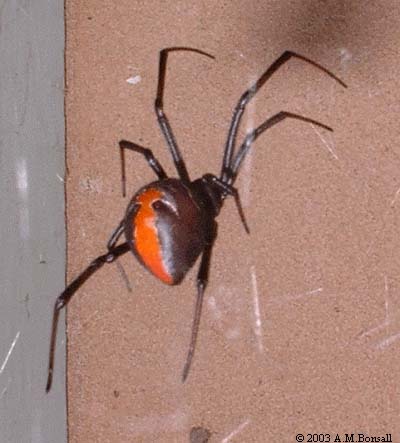
Image 1.
Redback Spider - Image © Dr A M Bonsall -
Used with Permission
REDBACK (2)
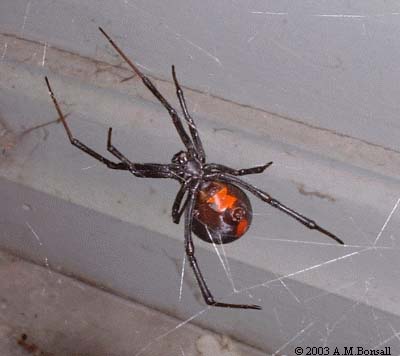
Image 2.
Redback Spider - Image © Dr A M Bonsall -
Used with Permission
Funnel-web spiders of Australia - the Sydney funnel-web (Atrax robustus); mouse spiders and relatives - fairly large, black and aggressive.
Necrotising arachnids - includes the American brown recluse (Loxosceles reclusa), South American brown spider (L. laeta) - these have a violin pattern on their backs. Others have been accused, including the black window or house spider (Badumna spp.).
BLACK HOUSE WINDOW SPIDER
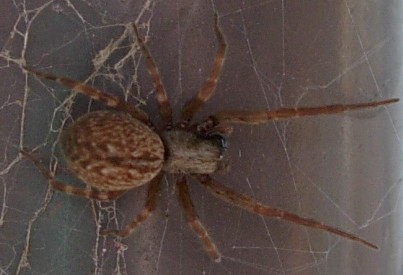
Image 3.
Black House/Window Spider - Image © Dr A M Bonsall -
Used with Permission
The South American armed, banana or wandering spider (Phoneutria nigriventer, P. fera and other spp.).
Other large spiders such as the Huntsman spiders (Sparassidae spp., formerly Heteropodidae spp.) or the many varied orb weavers may look fearsome but are generally timid and not venomous to humans.
HUNTSMAN
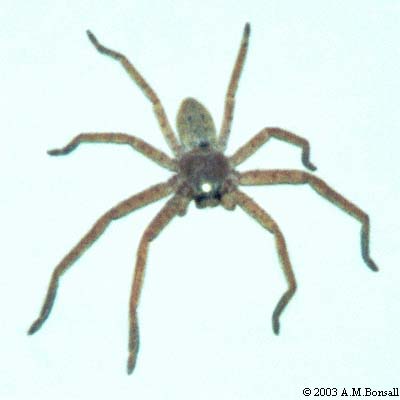
Image 4.
Huntsman Spider - Image © Dr A M Bonsall -
Used with Permission
GOLDEN ORB WEAVING SPIDER
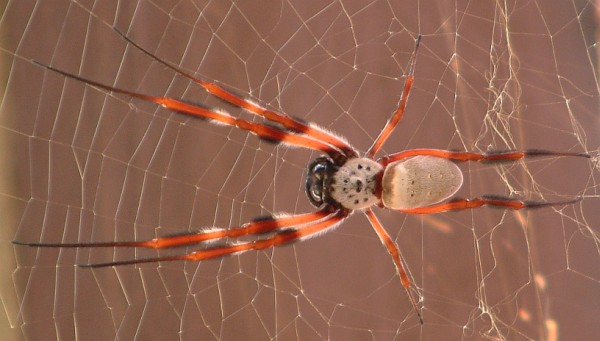
Image 5.
Golden Orb Weaving Spider - Image © Dr A M Bonsall -
Used with Permission
Presentación
Local pain, swelling and pruritus.
Nausea, vomiting, sweating and dizziness may sometimes occur.
Severe allergic reactions are rare but potentially life-threatening.
Instead of biting, tarantulas can also defend themselves by flicking fine barbed abdominal hairs using their legs. These can cause significant irritation of the eyes, skin and respiratory tract.
Even with the most venomous spiders, often more than 80% of the bites may be 'dry' or with insufficient venom for systemic envenomation.
Neurotoxic arachnidism
The most important include the widow spiders, funnel-web spiders and Phoneutria spp.
Widow spiders, some Steatoda ('false widow') species
The widow neurotoxin, active against vertebrates, opens cation channels (including calcium channels) presynaptically, causing increased release and then depletion of multiple neurotransmitters affecting somatic and autonomic nerves.
Brown house, or false widow, spiders - Steatoda grossa in Australia and Steatoda nobilis in the UK, have caused mild neurotoxic arachnidism and, in the case of the former, have been treated successfully with redback antivenom.
A characteristic feature is pain. Initially the bite can go unnoticed or be perceived as a sharp pinprick. The pain can be local or spread proximally from a bite on the limb to the torso, causing chest or abdominal pain.
Nonspecific systemic features (nausea, vomiting, headache, lethargy and malaise).
Local and regional diaphoresis and, less commonly, other autonomic and neurological effects.
El facies latrodectismica from a widow bite is a painful grimace caused by facial spasm and trismus associated with swollen eyelids, congested conjunctivae, flushing and sweating.
Full latrodectism may also include tachycardia, hypertension, irritability, psychosis, priapism, acute kidney injury, respiratory compromise and cardiac failure.
If a spider bite is not considered, the diagnosis may be missed, especially in younger patients where communication is limited.
Funnel-web and related spiders
Primates are particularly sensitive to funnel-web venom. It contains a distinctive peptide with hyaluronidase and other components and causes rapid massive release of neurotransmitters at autonomic and neuromuscular junctions.
The bite is usually immediately painful from larger fangs and acidic venom.
There are rapid systemic signs: vomiting, agitation, headache.
Autonomic hyper-reactivity (tachycardia, hypertension, sweating, piloerection).
Muscle twitching, tongue fasciculation, oral paraesthesiae.
Pulmonary oedema, hypotension and coma can ensue.
The Australian mouse spider (Missulena occatoria) may have a similar venom to the funnel-web spider but currently only a few serious envenomations have been reported.
Phoneutria spiders
The venom is a complex mixture of amino acids, hyaluronidase, serotonin and other kallikrein-kinin activating factors that stimulate peripheral and central nervous system neurons.
The bite is very painful.
Localised sweating and piloerection appears at the bite site, with pain radiating up the bitten extremity to the trunk.
Following this, tachycardia, hypertension, profuse diaphoresis, hypothermia, salivation, nausea, vomiting, vertigo, visual disturbances, priapism (especially in young boys) and (rarely) death.
Necrotic arachnidism
This should probably be called loxoscelism as only Loxosceles spp. have good evidence for causing ulcers.3 There are a number of enzymes that may be involved in the necrotic process; sphingomyelinase D appears to be critical.4 Other spiders have gained notoriety for causing dermonecrosis (eg, hobo spiders (Tegenaria agrestis), white-tailed spider (Lampona cylindrata), wolf spider (Lycosa spp.), the yellow sac spiders (Cheiracanthium spp., and black window or house spider) but the anecdotal reports of necrotic bites with these spiders often do not stand up to scrutiny and evidence is generally lacking. It must be remembered that any spider bite has the potential to become infected and that may lead to secondary necrosis.
With regard to the brown recluse spider:
The bite site burns, swells.
A characteristic macular erythematous halo lesion develops.
This either resolves over a few days or becomes purple and then a dark eschar that sloughs off over week, sometimes leaving a necrotic ulcer that can be recurrent and slow to heal.
More rarely, a systemic loxoscelism can give rise to fever, morbilliform rash, jaundice, intravascular haemolysis associated with spherocytosis, haemoglobinuria/acute kidney injury, seizures and, uncommonly, disseminated intravascular coagulopathy (DIC).
Diagnóstico diferencial
General: other bites and stings, anafilaxia.
Necrotic bites: eritema multiforme, toxic epidermal necrolysis, herpes infections.
Neurotoxic bites: causes of shock/hypertensive crises/acute abdomen, priapism, back pain, coronary heart disease, hypocalcaemia.
Tarantula hairs: conjuntivitis, uveítis, corneal abrasion, dermatitis.
Manejo
First aid treatment
Funnel-web and other rapidly acting venoms: pressure immobilisation bandaging and splinting of the bitten limb may delay venom spread.
Widow and brown recluse: ice-pack.
Reassure the patient. If possible, take the spider (dead or alive) to hospital for identification.
Tratamiento de apoyo
Analgesia (non-steroidal anti-inflammatory drugs, opioids) as required, tetanus prophylaxis, and local wound care.
Antihistamines, anti-emetics and (rarely) benzodiazepines, beta-blockers or atropine may also be useful for more significant local and systemic symptoms.
Antibiotics are not advocated unless there is evidence of secondary infection.
Specific treatment
Antivenom (side-effects include anaphylaxis and serum sickness) is available in some countries for widow, funnel-web, Loxosceles y Phoneutria spp. bites.5
Neurotoxic arachnidism seems more responsive to antivenom than does the necrotic type.
Redback antivenom can be given several days after the bite but the evidence that it produces consistent benefit is poor.
Many therapies for necrotic lesions have been advocated but there is little clear evidence of their effectiveness and spider bites are often incorrectly asumed to be the cause of necrotic ulcers.6
Pronóstico
Antivenom has dramatically cut mortality and almost no deaths now occur where it is readily available.
Accurate data on the morbidity and mortality are difficult to find, as spider bites are not a reportable condition in most countries and simple tests to determine envenomation are not available.
Most fatalities are in children and the elderly and are likely to be related to the faster-acting neurotoxic venoms.
Funnel-web fatalities (all before introduction of antivenom in 1982) died between 15 minutes to 6 days after the envenomation.
Actualizaciones exclusivas para profesionales de la salud
Mantente informado con las últimas actualizaciones clínicas, perspectivas profesionales y orientación basada en evidencia. El boletín de Patient Pro selecciona contenido esencial para profesionales de la salud, entregado directamente en tu bandeja de entrada.
Al suscribirte aceptas nuestros Política de Privacidad. Puedes darte de baja en cualquier momento. Nunca vendemos tus datos.
Lecturas adicionales y referencias
- Araneae - Spiders; International Society of Arachnology (ISA)
- CSL Antivenom
- Vetter RS, Isbister GK; Medical aspects of spider bites. Annu Rev Entomol. 2008;53:409-29.
- Ni Chroinin D, Cummins F, O'Connor P; Australian immigrant of the arachnid variety? Eur J Emerg Med. 2009 Jun;16(3):159-62.
- Isbister GK; Necrotic arachnidism: the mythology of a modern plague. Lancet. 2004 Aug 7-13;364(9433):549-53.
- Swanson DL, Vetter RS; Loxoscelism. Clin Dermatol. 2006 May-Jun;24(3):213-21.
- Hoyte CO, Cushing TA, Heard KJ; Anaphylaxis to black widow spider antivenom. Am J Emerg Med. 2012 Jun;30(5):836.e1-2. doi: 10.1016/j.ajem.2011.03.017.
- Isbister GK, Whyte IM; Suspected white-tail spider bite and necrotic ulcers. Intern Med J. 2004 Jan-Feb;34(1-2):38-44.
Sobre el autorVer biografía completa
Actualizado por

Dr Roger Henderson, MBBS
Médico General, Autor Médico
MBBS, LMSSA
Dr Roger Henderson qualified as a GP in 1985 and has authored for EMIS since early 2013.
Acerca del revisorVer biografía completa

Dr Adrian Bonsall, MBBS
Autor Médico
MA (Química), MBBS (Hons), DCH
Desde el año 2000, Adrian ha trabajado en pediatría de emergencia y cuidados críticos en Sídney, con intereses particulares en toxicología, trauma y reanimación.
Acceso sencillo a tratamientos y servicios de salud confiables en línea.
Common conditions
Get help with common conditions through the NHS, without a GP appointment.
 Sinusitis aguda
 Amigdalitis bacteriana
 Impetigo
 Picaduras de insectos
 Herpes zósterInfección del tracto urinario (ITU)
Más en medicina de emergencia y trauma
- Intoxicación aguda
- Crisis suprarrenal
- Lesiones de vejiga y uretra
- Examen de la columna vertebral
- Lesiones oculares (evaluación, tratamiento y manejo)
- Lesiones y fracturas del antebrazo
- Lesión en la cabeza
- Intoxicación por metales pesados
- Transporte en helicóptero
- Enfermedad de altitud
- Emergencias hipertensivas
- Síndrome del marcapasos y complicaciones del marcapasos
- Infarto de miocardio posterior
- Analgésia prehospitalaria
- Sepsis
- Luxación de hombro
- Fracturas de tibia y peroné
- Torsión del testículo
- Triaje y puntuación de trauma