Ataque isquémico transitorio
Revisado por Dr Colin Tidy, MRCGPÚltima actualización por Dr Doug McKechnie, MRCGPÚltima actualización 5 Sept 2024
Cumple con las directrices editoriales
- DescargarDescargar
- Compartir
- Language
- Discusión
- Versión en audio
- Agregar a fuentes preferidas en Google
En esta serie:Accidente cerebrovascular
A transient ischaemic attack (TIA) causes symptoms similar to a stroke. Some people call a TIA a mini-stroke. With a TIA, the symptoms go completely within 24 hours (whilst with a stroke, the symptoms are usually more permanent). The most common cause is a tiny blood clot in a blood vessel in the brain.
Call 999/112/911 if you have symptoms of a stroke or TIA - act FAST. Unless the symptoms get better within a few minutes you need emergency treatment, as the cause might be a stroke rather than a TIA.
It is important that you don't wait to see if the symptoms get better on their own. Even if the symptoms have got better quickly and completely, you need to see a doctor urgently for further tests and treatment.
De un vistazo
Un ataque isquémico transitorio (AIT) es causado por una falta temporal de sangre en una parte del cerebro.
Los síntomas son similares a un derrame cerebral, pero son de corta duración y desaparecen por completo.
Los síntomas comunes incluyen debilidad, dificultades para hablar o pérdida repentina de la visión.
Una AIT es una advertencia seria de que un derrame cerebral podría ocurrir pronto.
Si sospechas de un AIT o un derrame cerebral, utiliza la prueba FAST y llama al 999 inmediatamente.
Explore anticoagulant care options
Reciba asesoramiento sanitario experto desde la comodidad de su hogar. Complete una consulta rápida en línea, disponible las 24 horas del día, los 7 días de la semana, y un profesional sanitario colegiado en el Reino Unido revisará su solicitud. Hay entrega al día siguiente disponible para los tratamientos que cumplan los requisitos.

What is a transient ischaemic attack?
A transient ischaemic attack (TIA) is a set of symptoms that lasts a short time and occurs because of a temporary lack of blood to part of the brain.
The symptoms are the same as those of a accidente cerebrovascular but, unlike a stroke, the symptoms are short-lived and soon go away completely. This means that you recover fully, back to normal. (The word ischaemic means a reduced supply of blood and oxygen to a part of the body.)
TIAs are important because they are a warning sign that someone might go on to have a stroke in the next few days or weeks. Rapid treatment can greatly reduce the risk of this happening.
TIAs are sometimes called 'mini-strokes'.
How common is a transient ischaemic attack (TIA)?
In the UK, about 1 in every 2000 people get a TIA for the first time, each year.
The true number might be higher, though. It's likely that some people have a TIA, but don't recognise it as one, or don't report it to their doctor.
Symptoms of a transient ischaemic attack (TIA)
The symptoms that develop depend on which part of the brain is affected. Different parts of the brain control different parts of the body.
Symptoms may include one or more of the following:
Weakness or clumsiness of a hand, arm, or leg.
Difficulties with speech.
Difficulties with swallowing.
Numbness or hormigueo of a part of the body.
Sudden loss of vision in one or both eyes, or double vision.
Nota: headache is reportado a typical feature of a TIA (or of a stroke).
How long do symptoms of a TIA last?
Symptoms of a TIA are temporary. They develop suddenly and usually peak in less than a minute. The duration of symptoms varies; however, symptoms usually go within an hour (typically within 2-15 minutes). Sometimes symptoms last up to 24 hours.
Causes of a transient ischaemic attack (TIA)
In most cases, a TIA is caused by a tiny blood clot that becomes stuck in a small blood vessel (artery) in the brain. This blocks the blood flow, and a part of the brain is starved of oxygen.
In a TIA, the blood clot rapidly breaks up on its own, allowing blood flow to return to normal, and the brain to recover.
The blood clot usually starts elsewhere in the body, travelling through blood vessels until it reaches an artery in the brain and gets stuck. The two most common causes of this are:
Fibrilación auricular, a heart condition. This can cause blood clots to form in the heart, which can then travel through blood vessels to reach other parts of the body, including the brain.
Atherosclerosis (thickening and hardening) and stenosis (narrowing) of the arteries in the neck that supply blood to the brain. Areas of thickening inside the arteries, called plaques, can sometimes burst, causing a blood clot to form. This blood clot, or part of it, can then travel up to the brain.
Cross-section diagram showing main arteries of the brain and a TIA blood clot
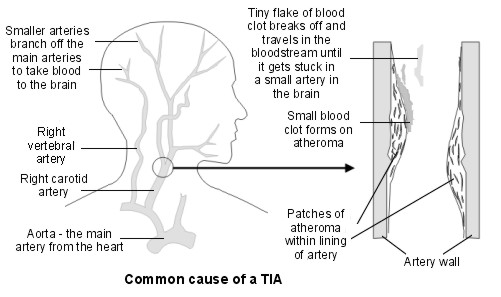
There are other rarer causes of a TIA. These include:
Blood clotting problems.
Tiny bleeds into the brain.
Blood disorders such as polycythaemia y anemia de células falciformes where the blood is very thick.
Spasm of a small artery in the brain.
A blood clot from the veins of the leg (a trombosis venosa profunda) that travels through a hole in the heart to reach the arteries that supply the brain.
Other uncommon problems of the brain or its blood vessels.
However, these are not dealt with further in this leaflet.
How serious is a transient ischaemic attack (TIA)?
A TIA is serious and needs emergency medical attention.
In the early stages of a TIA, when the symptoms are still present, it's not possible to tell if the symptoms are due to a TIA or a stroke.
A TIA is also a warning sign that a stroke might happen within the next few days, but prompt treatment can significantly reduce the risk of this happening.
El FAST test can help you identify signs of a stroke or TIA:
Facial weakness. Has their face fallen on one side? Can they smile?
Arm weakness. Can the person raise both arms and keep them there?
Speech disturbance. Is their speech slurred?
Time. Time to call 999/112/911 if you see any single one of these signs.
The FAST checklist does not cover every possible symptom of stroke or TIA. However, it is easy to remember. It is estimated that about 8 or 9 in 10 people with a stroke or TIA will have one or more FAST symptoms.
If you have symptoms of a stroke, you need to be seen in a hospital immediately (even if you later turn out to have a different problem, or a TIA).
Diagnosing a transient ischaemic attack (TIA)
TIAs are usually diagnosed on the basis of your symptoms, although this can be difficult sometimes, because other conditions can cause similar symptoms. The diagnosis is usually confirmed by a stroke specialist.
Tests are usually done to look for other conditions, and to find the cause of the TIA.
The main aim of these tests is:
To check for any underlying problems that might have caused the TIA.
To check if you have a problem that increases your risk of blood clots forming.
To make sure that you haven't had a stroke rather than a TIA.
Brain scan
A special type of resonancia magnética can look for signs of damage to the brain from reduced blood flow, as well as for other problems like bleeding into the brain, or a brain tumour.
MRI scans are increasingly used because they can pick up very small areas of brain damage, which may mean that someone has had a small stroke instead of a TIA. In someone who has had a TIA with no lasting injury to the brain, the MRI scan may be normal.
Sometimes, a tomografía computarizada is done first, if someone is taking blood-thinning drugs (anticoagulants) or has a condition that makes them more likely to bleed. A CT scan can quickly rule out bleeding inside the brain (a haemorrhagic stroke). It isn't as good as an MRI at picking up small strokes, though.
Análisis de sangre
Blood tests are usually done to look for any risk factors for TIA and stroke that could be treated, such as diabetes y colesterol alto.
Blood glucose (sugar) is checked as well, as low blood glucose can cause similar symptoms to a stroke or TIA.
Ecografía
If you have had a TIA, you are likely to be offered an ultrasound scan of your carotid arteries. This is to see if you have severe narrowing of one of these arteries, caused by atheroma. Atheroma plaques are like fatty lumps that develop within the inside lining of arteries.
Narrowing (stenosis) of the carotid arteries is a risk factor for TIA and stroke. If one or both of your carotid arteries are more than 50% furred up, you may be referred urgently for surgery to unblock them. You can find out more from the section on surgery below.
ECG
An electrocardiogram (ECG) is done to check for abnormal heart rhythms such as an irregular heartbeat (atrial fibrillation).
If the initial ECG is normal, you might be offered an ECG monitor that you wear continuously for 24 hours or more, to see if you are having intermittent episodes of abnormal heart rhythms.
Blood pressure measurement
Although this is not strictly speaking a test, it is important that your blood pressure should be checked. High blood pressure is a risk factor for TIA and, if present, you should be offered treatment.
Treatment for a transient ischaemic attack (TIA)
The aim of treatment after a TIA is to reduce your risk of having a stroke, heart attack, or further TIAs. Aspects of treatment include the following:
Medication to reduce the risk of blood clots forming.
To reduce any risk factors that you may have.
Surgery (but this is only suitable in some cases).
Medicamento
Medication reduces the risk of further blood clots forming.
Antiplatelet medication
Platelets are tiny particles in the blood which help blood to clot. Antiplatelet medication is usually advised if you have had a TIA. Antiplatelet medication reduces the stickiness of platelets. This helps to prevent blood clots forming inside arteries, which helps to prevent a further TIA or a stroke.
Immediately after a TIA, you should be started on a daily dose of aspirin until your hospital investigations have been completed. If you were already taking low-dose (75 mg) aspirin, you may be advised to increase this to 300 mg a day.
Aspirina is usually given immediately if a TIA or stroke is suspected. The most commonly used long-term antiplatelet medicine following a stroke or TIA is clopidogrel.
Sometimes, once a TIA or minor stroke has been diagnosed, people are offered a short course of two antiplatelet medications together (aspirin and clopidogrel, or aspirin and ticagrelor) for two to three weeks, and then stopping the aspirin and continuing on the clopidogrel or ticagrelor long-term.
Sometimes medication to protect your stomach lining may be used alongside aspirin or clopidogrel. This might be the case if you have a lot of indigestion, especially with anti-inflammatory medicines (such as aspirin and ibuprofen). It may also be the case if you are considered as being at high risk for stomach problems caused by aspirin.
Anticoagulantes orales
An oral anticoagulant medicine (warfarina, dabigatran, apixabán, edoxaban o rivaroxaban) is usually advised if you have a TIA where the source of the blood clot is from your heart (usually if you have the condition atrial fibrillation).
Oral anticoagulant medicines work by reducing some of the chemicals in the blood that are needed to make blood clot. The aim is to get the dose just right so the blood is 'thinner' than normal (less able to form clots) but not so much as to cause bleeding problems.
See the separate leaflet called Preventing Stroke for more information.
Cirugía
Surgery to remove a narrowing of the carotid artery (carotid stenosis) caused by atheroma may be an option in some people. It depends on several factors, such as:
How bad the narrowing is.
Whether you have had symptoms (such as a TIA or stroke).
What your general fitness is like (in terms of the risks of having major surgery).
The main surgical procedure is called carotid endarterectomy (another procedure called carotid artery angioplasty and stenting is sometimes used for blocked carotid arteries).
Endarterectomy is an open operation. This means the surgeon has to open up the artery (via a cut in the skin) to remove the atheroma inside the artery.
Angioplasty is a less invasive operation. Usually it is done by threading a small wire up to the neck from a puncture in the groin (in the femoral artery). In simple terms, it is a bit like using a pipe cleaner to clean and unblock a blocked pipe. A stent is a tiny mesh tube that folds up telescopically. It can be inserted into the carotid artery to hold the walls of the artery open and to prevent blockage.
At present, only carotid endarterectomy is recommended after TIA or stroke.
Successful surgery reduces the risk of a future stroke by about a half. However, like all operations, there is a small risk from the operation itself. One of these risks is of causing a stroke. A specialist (vascular surgeon) will advise on the pros and cons of the different operations if you are found to have severe narrowing of a carotid artery.
Preventing a transient ischaemic attack (TIA)
To try to lessen the chances of having a TIA or stroke, it is important to reduce your risk factors. The risk factors are the things that make the build-up of atheroma in blood vessels (arteries) happen more readily.
Atheroma is a bit like the scale that furs up the inside of your kettle. Atheroma increases your risk of having serious problems such as TIA, stroke and heart attacks. The risk factors that can be changed are:
Dejar de fumar
If you smoke, you should make every effort to stop. The chemicals in tobacco are carried in your bloodstream and can damage your arteries. If you smoke, stopping smoking can greatly cut your risk of having a stroke (and also many other diseases such as heart attacks and lung cancer).
Monitor high blood pressure
Make sure your blood pressure is checked at least once a year. If it is high it can be treated. Presión arterial alta usually causes no symptoms but can be damaging to the arteries.
If you have high blood pressure, treatment of the blood pressure is likely to have the greatest effect on reducing your risk of having a stroke.
If you have diabetes, good blood pressure control is even more essential.
Baja de peso
If you are overweight or obese losing weight is advised. This can be achieved by eating fewer calories, eating more healthily and exercising more.
If you are obese and you are finding it difficult to lose weight through these lifestyle measures, it is worth discussing this further with your GP. Some areas have weight loss programmes, some people benefit from seeing a dietician and others lose weight by taking weight loss medication.
In extreme cases, weight loss (bariatric) surgery may be advised if all other methods have failed.
Lower cholesterol levels
High cholesterol levels can be lowered with medication, usually a statin. If you have had a stroke, a statin should be started whether or not your cholesterol level is high. This is because it reduces your overall risk of blood vessel (vascular) diseases - such as stroke, TIA and heart attack, even if your cholesterol levels are normal.
Consulte los folletos separados llamados Colesterol alto y Estatinas y otros medicamentos para reducir lípidos para más detalles.
Ejercicio
Lack of physical activity increases your risk of developing atheroma. You should aim to do some moderate physical activity on most days of the week for at least 30 minutes. Examples of suitable activities include brisk walking, swimming, cycling, dancing and gardening.
Ask your doctor or nurse if you are not sure which exercises and how much exercise would be best for you.
Sigue una dieta saludable
You should aim to eat a healthy diet. Briefly, a healthy diet means:
At least five portions, or ideally 7-9 portions, of a variety of fruit and vegetables per day.
A third of most meals should be starch-based foods (such as cereals, wholegrain bread, potatoes, rice, pasta), plus fruit and vegetables.
Not much fatty food such as fatty meats, cheeses, full-cream milk, fried food, butter, etc. Use low-fat, mono-unsaturated or polyunsaturated spreads.
Include 2-3 portions of fish per week. At least one of these should be oily (such as herring, mackerel, sardines, kippers, pilchards, salmon, or atún tuna).
If you eat meat it is best to eat lean meat, or poultry such as chicken.
Si fríes, elige un aceite vegetal como el de girasol, colza u oliva.
Trata de no añadir sal a la comida. Limita los alimentos que son salados.
Reduce alcohol intake
Do not drink more than the recommended safe limits. That is, men should drink no more than 14 units of alcohol per week, no more than four units in any one day, and have at least two alcohol-free days a week.
Women should drink no more than 14 units of alcohol per week, no more than three units in any one day, and have at least two alcohol-free days a week. Pregnant women should not drink at all.
One unit is in about half a pint of normal-strength beer, or two thirds of a small glass of wine, or one small pub measure of spirits.
Manage diabetes
Diabetes is a risk factor. If you have diabetes, treatment to keep your blood sugar as near normal as possible is important.
See the separate leaflet called Cardiovascular disease (Atheroma) for more details.
Transient ischaemic attack (TIA) and driving
If you've had, or currently have, a medical condition or disability that may affect your driving you must tell the Driver and Vehicle Licensing Agency (DVLA). The DVLA has a guide to the 'Medical Standards of Fitness to Drive'. This includes a TIA.
Following a TIA you will have to stop driving for a month if you have a Group 1 (car and motorcycle) licence. You do not need to inform the DVLA.
If you have a Group 1 licence and have multiple TIAs, you must stop driving and must inform the DVLA. If you have several TIAs over a short period, you will have to stop driving until at least three months after your last TIA.
The rules are different if you drive lorries or buses. So-called 'Group 2' drivers have much higher medical standards to reach. Return to driving depends on a satisfactory recovery to normal or minimal nerve (neurological) impairment. Every individual case is different. This is why it is important to obtain advice directly from the DVLA.
You should also contact your motor insurance company for advice.
Otros consejos
If you have had a TIA or stroke and plan to travel, you need to ensure that you have adequate medical cover on your travel insurance. This will mean informing your insurer of your pre-existing medical conditions.
Never withhold medical information or fail to declare medical illnesses - if you do so, your insurance may be invalidated. Invalid insurance leaves you open to having to pay full costs (often extremely high) if you need to seek medical attention when abroad.
Explore anticoagulant care options
Reciba asesoramiento sanitario experto desde la comodidad de su hogar. Complete una consulta rápida en línea, disponible las 24 horas del día, los 7 días de la semana, y un profesional sanitario colegiado en el Reino Unido revisará su solicitud. Hay entrega al día siguiente disponible para los tratamientos que cumplan los requisitos.
Selecciones del paciente para Accidente cerebrovascular

Preguntas frecuentes
¿Puede ocurrir un AIT sin síntomas perceptibles?
El artículo afirma que algunas personas podrían tener un AIT sin reconocerlo o informarlo a su médico, sugiriendo que los síntomas podrían ser leves o pasados por alto. Sin embargo, también aclara que un AIT es un conjunto de síntomas, por lo que implica que siempre hay algunos síntomas, incluso si son sutiles.
¿Cuánto tiempo después de un AIT debo comenzar a tomar medicación?
Inmediatamente después de un AIT, se debe comenzar con una dosis diaria de aspirina hasta que se completen las investigaciones hospitalarias. Si ya estaba tomando aspirina en dosis baja, se le puede aconsejar aumentar esto a 300 mg al día. Otros medicamentos, como clopidogrel o anticoagulantes orales, pueden ser recomendados después del diagnóstico, dependiendo de la causa.
¿Existen cambios específicos en el estilo de vida que sean más importantes para prevenir otro AIT?
El artículo enumera varios cambios importantes en el estilo de vida. Si fumas, dejar de hacerlo se destaca como una gran reducción de tu riesgo. Tratar la hipertensión también se menciona como teniendo el mayor efecto en la reducción del riesgo de accidente cerebrovascular. Manejar la diabetes y reducir el colesterol alto con medicación también son cruciales.
¿Puede el estrés causar un AIT?
El artículo no menciona directamente el estrés como una causa de AIT. Las principales causas discutidas son pequeños coágulos de sangre que generalmente se originan por fibrilación auricular o aterosclerosis en las arterias del cuello, y otras causas más raras como problemas de coagulación sanguínea o trastornos de la sangre. El estrés no se menciona en este contexto.
¿Qué significa si mi ECG es normal después de un AIT?
Si su ECG inicial es normal después de un AIT, es posible que se le ofrezca un monitor de ECG para usar de forma continua durante 24 horas o más. Esto se hace para detectar episodios intermitentes de ritmos cardíacos anormales, como la fibrilación auricular, que podrían no capturarse durante un ECG único y breve.
¿Qué debo hacer si tengo múltiples AIT en un corto período?
Si tienes varios AIT en un corto período, debes dejar de conducir e informar al DVLA de inmediato. Tendrás que dejar de conducir hasta al menos tres meses después de tu último AIT. El artículo también aconseja contactar a tu compañía de seguros de automóvil para obtener asesoramiento.
Lecturas adicionales y referencias
- Stroke and transient ischaemic attack in over 16s: diagnosis and initial management; NICE Guidance (May 2019 - last updated April 2022)
- Stroke and TIA; NICE CKS, diciembre 2023 (acceso solo en el Reino Unido)
Sobre el autorVer biografía completa
Actualizado por

Dr Doug McKechnie, MRCGP
Redactor Médico
MA, MBBS, MSc, DRCOG, MRCP(UK), MRCGP(2021), FHEA
El Dr. Doug McKechnie es un médico de cabecera del NHS que trabaja en Londres. Trabaja a tiempo completo en la práctica clínica y también es el Subdirector del módulo de Práctica Clínica y Profesional en la Escuela de Medicina del University College London.
Acerca del revisorVer biografía completa

Dr Colin Tidy, MRCGP
Médico General, Autor Médico
MBBS, MRCGP, MRCP (Paediatrics), DCH
El Dr. Colin Tidy es un médico del NHS, con sede en Oxfordshire.
Únete a la conversación
Comparte tus pensamientos o experiencias con otros en nuestro comunidades de pacientes.

Pregunta, comparte, conecta.
Navega por discusiones, haz preguntas y comparte experiencias en cientos de temas de salud.

¿Te sientes mal?
Evalúa tus síntomas en línea de forma gratuita
Suscríbete al boletín de Patient
Tu dosis semanal de consejos de salud claros y confiables, escritos para ayudarte a sentirte informado, seguro y en control.
Al suscribirte aceptas nuestros Política de Privacidad. Puedes darte de baja en cualquier momento. Nunca vendemos tus datos.