Eritema tóxico del recién nacido
Baby acne
Revisado por pares por Dr Doug McKechnie, MRCGPÚltima actualización por Dr Hayley Willacy, FRCGP Last updated 20 Dec 2023
Cumple con las directrices editoriales
- DescargarDescargar
- Compartir
- Language
- Discusión
- Versión en audio
- Add to preferred sources on Google
El eritema tóxico del recién nacido (ETN) es una erupción cutánea común que afecta a los bebés recién nacidos sanos. No es grave, no causa daño al bebé y desaparece sin ningún tratamiento. A veces se conoce como eritema tóxico, acné del bebé o eritema tóxico del recién nacido.
En este artículo:
Video picks for Bebé y niño pequeño
Continúa leyendo abajo
What is erythema toxicum neonatorum?
Baby acne is small, inflamed bumps that can appear on a baby's neck, face, back and chest shortly after birth. The name erythema toxicum neonatorum is confusing because the condition is not toxic. It is also not the same as the acne that affects young people and adults.
Erythema is the medical word for redness. Neonatorum refers to the fact that the rash occurs in the neonatal period. The neonatal period is the time between birth and 28 days after birth. A baby in this age range is called a neonate.
What does baby acne look like?
Volver al contenidoErythema toxicum neonatorum: baby acne
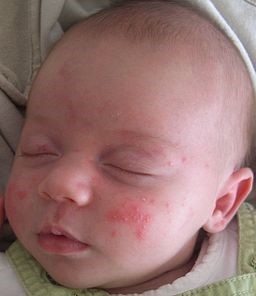
© Own image [selbst erstellt] (Fragegeist), Public domain, via Wikimedia Commons
The rash of ETN generally looks like red blotches, mainly affecting the face and body (trunk). It does occur on the arms and legs too (but is rare on the palms and soles of the feet). Characteristics of baby acne include:
Little, raised spots called papules are common.
Little pus-filled spots (pustules) or fluid-filled small blisters (vesicles).
There may be many spots or very few.
The different spots vary in size.
The spots blanch with light pressure (this means that they become pale and fade when pressed).
The rash can be temporary (very transient) and sometimes individual spots can disappear within hours while new ones will appear somewhere else.
The baby appears well and the rash does not seem to cause any bother.
Nota: if there is any doubt as to the cause of a skin rash in any baby or child, it is essential that you seek medical advice and a firm diagnosis for any other potential skin conditions. This is especially important if your baby seems unwell in any way. For example, if your baby has a temperature (fever), is not feeding, is lacking in energy (lethargic) or is inconsolable and not the same as normal. Other rashes can occur in babies and may be the sign of serious illness.
Continúa leyendo abajo
What causes baby acne?
Volver al contenidoThe exact cause is unknown. It is not due to an infection, even though pus-filled spots (pustules) are often present.
Various ideas have been suggested, including the possibility that it is a normal effect of a baby's immune system reacting to the first microbes from the skin travelling down the hair follicles. It is reportado thought to be an allergic problem. It is also not related to whether the baby is breast-fed or bottle-fed.
How common is baby acne?
Volver al contenidoErythema toxicum neonatorum is a very common rash. Up to 4 or 5 in every 10 babies develop baby acne. It seems to be more common in full term newborn babies(between 37 and 40 weeks of gestation) compared with premature babies.
Continúa leyendo abajo
Which babies get baby acne?
Volver al contenidoOn average, baby acne occurs in healthy babies born at full term, between 3 and 14 days of life. The rash can occur in the first 48 hours of life but 9 out of 10 cases are in babies more than 2 days old.
Overall, it seems to be more common in babies who are heavier at birth, in babies born in the summer or autumn and in babies who are fed milk powder substitute or a mixed diet.
Diagnosing baby acne
Volver al contenidoUsually, no tests are needed to diagnose baby acne. The rash is generally easily recognisable by doctors and midwives. Tests may be needed if there is any uncertainty as to the cause of the rash, particularly if your baby is unwell.
What is the treatment for baby acne?
Volver al contenidoThere is no specific treatment needed for baby acne. The rash settles completely without any treatment.
What should I do?
Volver al contenidoIf your baby develops erythema toxicum neonatorum, there is no need to worry. Your baby will not be in any discomfort or have any distress related to the rash. The skin may look red and angry (and your baby may look less than perfect temporarily) but do your best to ignore it.
Avoid over-washing the baby - babies have delicate skin that can dry out easily with detergents (soaps) so continue to wash as normal using warm water. Resist any temptation to pick, squeeze or burst any pus-filled spots (pustules). This would make a skin infection more likely to occur and may lead to scarring.
Creams and lotions are not required for the rash. If you are already using products to moisturise and wash your baby it is fine to continue them but ensure they are fragrance-free and designed for use in babies.
How long does baby acne last?
Volver al contenidoTypically, baby acne lasts for a few days only. In almost all cases it has completely gone within two weeks of life. Very occasionally the rash can return (recur). This can happen up to 6 weeks of age. Usually recurrences are mild.
Are there any long-term effects?
Volver al contenidoThere are no long-term problems associated with ETN. The rash settles spontaneously, leaving normal skin. Of course, some babies develop dry skin, eccema or other skin problems but these are not related to ETN.
Patient picks for Bebé y niño pequeño
Salud infantil
Labio y paladar hendido
El labio y el paladar hendido son anomalías faciales que pueden afectar a los bebés al nacer. Son comunes en todo el mundo y pueden afectar el labio, el paladar o ambos. Si no se tratan, pueden causar dificultades para alimentarse en las primeras etapas y dificultades psicológicas a medida que su hijo crece. Sin embargo, el tratamiento moderno comienza temprano en la vida de su bebé, con cirugía para corregir el defecto, y continúa a medida que su bebé crece. La naturaleza experta de la cirugía moderna significa que la salud, el desarrollo y la apariencia de un bebé con labio y paladar hendido no deberían verse afectados.
por la Dra. Rosalyn Adleman, MRCGP

Salud infantil
Reflujo gastroesofágico en la infancia
El reflujo gastroesofágico es muy común en bebés y niños pequeños. La regurgitación de una pequeña cantidad de leche después de una alimentación sin otros síntomas (regurgitación) es inofensiva en los lactantes y no requiere investigaciones ni tratamiento. El reflujo puede ser más severo y estar asociado con otros síntomas. Esta condición generalmente se diagnostica sin necesidad de pruebas, pero algunos bebés con síntomas más problemáticos pueden ser referidos para investigaciones adicionales. Hay varios tratamientos disponibles, incluyendo espesantes de alimentos, leches antirregurgitantes, Gaviscon® y varios medicamentos. Sin embargo, en la mayoría de los casos, el reflujo gastroesofágico es una condición autolimitada y, con el tiempo, mejora sin complicaciones.
por el Dr. Doug McKechnie, MRCGP
Lecturas adicionales y referencias
- Toxic erythema of the newborn; DermNet NZ
- Roques E, Ward R, Mendez MD; Erythema Toxicum. StatPearls, Jan 2023.
Continúa leyendo abajo
About the author

Dr Hayley Willacy, FRCGP
Médico General, Autor Médico
MBChB (1992), DRCOG, DFFP, MRCOG (Part 1) MRCGP (2007), DFSRH (2013), MSc - medical education (2020)
Dr Hayley Willacy was an NHS GP working in northwest England, who retired from clinical practice in 2022 after 30 years.
About the reviewerView full bio

Dr Doug McKechnie, MRCGP
Medical Writer
MA, MBBS, MSc, DRCOG, MRCP(UK), MRCGP(2021), FHEA
Dr Doug McKechnie is an NHS GP working in London. He works full-time clinically and is also the Deputy Lead for the Clinical and Professional Practice module at University College London Medical School.
Historial del artículo
La información en esta página está escrita y revisada por pares por clínicos calificados.
Próxima revisión: 18 Dic 2028
20 Dec 2023 | Última versión

Pregunta, comparte, conecta.
Navega por discusiones, haz preguntas y comparte experiencias en cientos de temas de salud.

¿Te sientes mal?
Evalúa tus síntomas en línea de forma gratuita
Suscríbete al boletín de Patient
Tu dosis semanal de consejos de salud claros y confiables, escritos para ayudarte a sentirte informado, seguro y en control.
By subscribing you accept our Política de Privacidad. Puedes darte de baja en cualquier momento. Nunca vendemos tus datos.