Roséola
Revisado por Dra. Rachel Hudson, MRCGPÚltima actualización por Dr Rosalyn Adleman, MRCGPÚltima actualización 23 Mar 2023
Cumple con las directrices editoriales
- DescargarDescargar
- Compartir
- Language
- Discusión
- Versión en audio
- Agregar a fuentes preferidas en Google
La roséola es una infección viral. Es común y afecta principalmente a niños pequeños entre los 6 meses y los 3 años de edad. Generalmente es una infección leve que no causa problemas a largo plazo. La recuperación completa es habitual.
De un vistazo
La roséola es una enfermedad infantil común que generalmente afecta a niños de entre 6 meses y 3 años.
Por lo general, comienza con una fiebre alta repentina que dura de 3 a 4 días, seguida de una erupción rosada con manchas.
La erupción a menudo comienza en el cuerpo y se extiende a los brazos y piernas, pero no suele afectar la cara.
Roseola is contagious and spreads through saliva.
El tratamiento se centra en mantener al niño cómodo, por ejemplo, administrando paracetamol o ibuprofeno para la fiebre.
Asegúrese de que su hijo beba muchos líquidos para evitar la deshidratación.
Busque ayuda médica si le preocupa la deshidratación de su hijo.
What is roseola?
Roseola is also known as roseola infantum, exanthem subitum, sixth disease and three-day rash. The disease is most common in those aged 6 months to 3 years. It is rare in adults, probably because childhood infection gives lifelong immunity to most people. It is usually caused by a virus called human herpesvirus type 6 (HHV-6). It may also be caused by human herpesvirus type 7 (HHV-7).
Symptoms of roseola
Children infected with the roseola virus will typically develop the following symptoms:
A high temperature (fiebre) suddenly develops. The child can be flushed, irritable, and unwell with the fever. The temperature can be as high as 40°C. The fever typically lasts 3-4 days and then drops quickly back to normal.
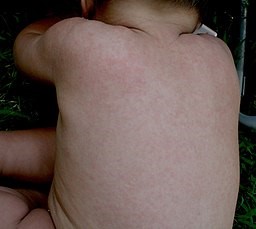
A rash usually appears when the fever subsides, when the child is getting better. Small pink spots appear. They usually start on the body and then spread to the arms and legs. The rash does not usually develop on the face. The rash is not itchy or painful and does not blister. The rash usually lasts for about 1-2 days, but sometimes fades within hours.
Some children get similar spots in their mouth (on the soft palate and the uvula).
A sore throat, seca and runny nose may develop and the child may go off their food.
Some glands in the neck may swell.
Roseola is often diagnosed when the child is getting better. At first the high fever may cause concern to parents and doctors if it is not clear what is causing it. Other more serious illnesses may need to be ruled out. The sudden drop in fever and the appearance of the typical rash are reassuring. This indicates that the fever has been caused by the roseola virus and nothing more serious.
Roséola
Is roseola contagious?
Roseola is contagious. The spread of the virus is from person to person via saliva. The time from infection to symptoms appearing (incubation period) is 9 to 15 days. The chid is probably infectious during the whole period of the disease and maybe even before the high temperature (fever) appears.
Treatment for roseola
There is no treatment that kills the virus. Treatment aims to keep the child as comfortable as possible until the illness goes.
Dealing with a high temperature (fever)
A fever can make a child feel uncomfortable and irritable. There are things that you can do that may bring the temperature down and make your child feel more comfortable.
You can give paracetamol or ibuprofen to lower a temperature and help ease headaches, and aches and pains. You can buy paracetamol y ibuprofeno in liquid form, or as melt-in-the-mouth tablets, for children. Both these medicines come in various brand names. The dose for each age is shown on the medicine packet.
Do not use more than advised on the packet or bottle. Do not use ibuprofen in children in whom attacks of asma have been triggered by ibuprofen in the past.
Keep your child cool. Take extra layers of clothes off your child if the room is normal room temperature. Use light cotton clothes or bedding. Open windows or use a fan in the room where appropriate. Do not cold-sponge a child who has a fever. This used to be popular but it is now not advised.
This is because the blood vessels under the skin become narrower (constrict) if the water is too cold. This reduces heat loss, and can trap heat in deeper parts of the body. The child may then get worse. Many children also find cold-sponging uncomfortable.
Ofrece mucha bebida. This helps to prevent a lack of fluid in the body (dehydration). You might find that a child is more willing to have a good drink if they are not so irritable. So, if they are not keen to drink, it may help to give some paracetamol first. Then, try to give the child a drink 30 minutes or so later when their temperature is likely to have come down.
Encourage your child to have plenty to drink if they have a fever. Signs of dehydration include:
A boca seca.
No tears
Ojos hundidos.
Somnolencia.
Generally becoming more unwell.
Passing less urine or having fewer wet nappies.
Seek medical help if you suspect that your child is becoming dehydrated.
Complications from roseola
Sometimes the high temperature (fever) can cause a fit (also known as a convulsión febril or febrile seizure). This can be alarming but is usually not serious. Other reported complications are very rare. Full recovery is normally expected. People who have a weakened immune system (immunocompromised) may suffer from more serious complications such as encefalitis, miocarditis y hepatitis.
Once a person has had this condition then they will be immune from having it again.
Selecciones del paciente para Infecciones infantiles

Salud infantil
Enfermedad mano-pie-boca
La enfermedad de manos, pies y boca suele ser una enfermedad leve y de corta duración que afecta principalmente a los niños. La mayoría de los niños se recuperan completamente en diez días, y generalmente en menos tiempo. Las complicaciones graves ocurren raramente. Esta enfermedad no está relacionada con la enfermedad de nombre similar que afecta a los animales.
por la Dra. Toni Hazell, FRCGP

Salud infantil
Exclusión escolar por infecciones
Este folleto ofrece información breve sobre las infecciones infantiles más comunes y si los niños deben asistir o no a la escuela, guardería u otro cuidado infantil.
por el Dr. Colin Tidy, MRCGP
Preguntas frecuentes
¿Durante qué período es más probable que un niño propague el virus de la roséola a otros?
El niño probablemente sea contagioso durante toda la duración de la enfermedad y potencialmente incluso antes de que aparezca la fiebre (temperatura alta).
¿Hay lugares específicos en el cuerpo donde típicamente no aparece el sarpullido de la roséola?
El sarpullido de la roséola generalmente no se desarrolla en la cara.
Si mi hijo tiene fiebre alta, ¿es seguro usar esponjas frías o baños para bajarle la temperatura?
No, no se recomienda esponjar con agua fría a un niño con fiebre. Esto puede causar que los vasos sanguíneos debajo de la piel se contraigan, reduciendo la pérdida de calor y atrapando el calor en el cuerpo. También puede hacer que el niño se sienta incómodo.
¿Cuáles son algunos de los síntomas menos comunes que un niño podría experimentar con la roséola, además de la fiebre y el sarpullido evidentes?
Además de la fiebre y el sarpullido, algunos niños pueden experimentar dolor de garganta, tos, secreción nasal, pérdida de apetito y tener glándulas inflamadas en el cuello. Algunos también pueden desarrollar pequeñas manchas en la boca, específicamente en el paladar blando y la úvula.
¿Cuál es el período típico desde que un niño se infecta con roséola hasta que comienzan a aparecer los síntomas?
El período de incubación, o el tiempo desde la infección hasta la aparición de los síntomas, suele ser de entre 9 a 15 días.
Lecturas adicionales y referencias
- Wolz MM, Sciallis GF, Pittelkow MR; Herpesvirus humanos 6, 7 y 8 desde una perspectiva dermatológica. Mayo Clin Proc. 2012 Oct;87(10):1004-14. doi: 10.1016/j.mayocp.2012.04.010. Epub 2012 Jul 21.
- Roséola; DermNet NZ
- Stone RC, Micali GA, Schwartz RA; Roseola infantil y sus herpesvirus humanos causales. Int J Dermatol. 2014 Abr;53(4):397-403.
- Allmon A, Deane K, Martin KL; Common Skin Rashes in Children. Am Fam Physician. 2015 Aug 1;92(3):211-6.
- Mullins TB, Krishnamurthy K; Roseola Infantum (Exanthema Subitum, Sixth Disease)
Sobre el autorVer biografía completa
Actualizado por

Dr Rosalyn Adleman, MRCGP
MRCGP
La Dra. Rosalyn Adleman es una médica de cabecera del NHS que trabaja en el norte de Londres.
Acerca del revisorVer biografía completa

Dra. Rachel Hudson, MRCGP
Médico General y Autor Médico
MBChB, MRCGP (2008), BSc (Medical Science), DFSRH, DRCOG, DCH
La Dra. Rachel Hudson es una médica de cabecera del NHS que trabaja en el noroeste de Inglaterra.
Únete a la conversación
Comparte tus pensamientos o experiencias con otros en nuestro comunidades de pacientes.

Pregunta, comparte, conecta.
Navega por discusiones, haz preguntas y comparte experiencias en cientos de temas de salud.

¿Te sientes mal?
Evalúa tus síntomas en línea de forma gratuita
Suscríbete al boletín de Patient
Tu dosis semanal de consejos de salud claros y confiables, escritos para ayudarte a sentirte informado, seguro y en control.
Al suscribirte aceptas nuestros Política de Privacidad. Puedes darte de baja en cualquier momento. Nunca vendemos tus datos.