Eczema varicoso
Gravitational eczema
Revisado por pares por Dr Toni Hazell, FRCGPÚltima actualización por Dr Hayley Willacy, FRCGP Última actualización 21 Feb 2023
Cumple con las directrices editoriales
- DescargarDescargar
- Compartir
- Language
- Discusión
- Versión en audio
- Agregar a fuentes preferidas en Google
Varicose eczema is a tightened skin condition that affects the lower legs, mainly occurring in the elderly. It initially causes your skin on the lower legs to become pale red, and then darker red, often becoming stained brown. With varicose eczema the skin on your lower legs also gets slightly thicker and bumpy. It may be very painful but there may be no pain. Itchiness is also variable from mild to severe. Because your skin is red with varicose eczema, it is often mistaken for an infection. The treatment is to keep your legs up when you're sitting down, to stay active and to apply moisturisers. Occasionally steroid ointments are used, which are prescribed by a doctor.
De un vistazo
El eccema varicoso es una afección cutánea causada por el aumento de presión en las venas de las piernas.
Los síntomas incluyen piel roja, escamosa, a menudo oxidada o marrón, que puede sentirse dura o tensa.
Afecta principalmente a las personas mayores, especialmente a aquellas con venas varicosas o antecedentes de trombosis venosa profunda (TVP).
Treatment involves elevating legs, regular walking, moisturising the skin, and sometimes steroid creams.
Las medias de compresión se utilizan a menudo para ayudar a reducir la presión en las venas.
Siempre consulte con su médico antes de volar si tiene esta condición, ya que aumenta el riesgo de TVP.
Si el tratamiento no está funcionando, su médico puede considerar realizar pruebas de parche o derivarlo a un especialista.
What is varicose eczema?
This is the term used for skin changes that happen when the pressure in the veins of the legs increases. You may also hear it called gravitational eczema, stasis eczema or venous eczema.
What does varicose eczema look like?
This is a photo of varicose eczema in an elderly man. It's an example of long-standing varicose eczema, as seen by the thickened, dark-stained skin:
Eczema varicoso
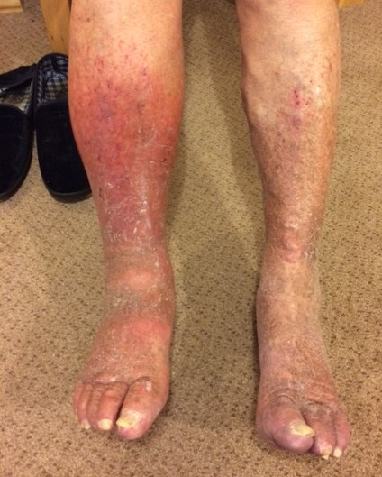
Image featured here with full consent from patient for use by Patient.info
Varicose eczema symptoms
Symptoms of varicose eczema may include:
The skin looks red and can be slightly shiny (which is why some people mistake varicose eczema for an infection).
The skin should feel cool to the touch, not warm.
The skin gets flaky and scaly.
The skin may also look 'rusty' or brown in colour.
The skin, particularly the skin around your ankle, may feel hard or tight.
You can get little raised bumpy 'blisters' in the skin. Sometimes these are hard; other times they might leak a drop of clear fluid if you press them.
Pain and itchiness are variable, ranging from absent to severe.
It can feel like your legs are warm, although they are not warm to the touch.
Generally it all starts in the skin around the inside of your calf, above your ankle.
Some skin may 'break down' into an ulcer. See the separate leaflet called Venous Leg Ulcers for more information on this condition. If the ulcer is small and heals up, it can leave a star-shaped white mark.
Who gets varicose eczema?
Varicose eczema mainly affects older people. As many as one in five people over the age of 70 develop varicose eczema. People most at risk are those who have las venas varicosas, who have had varicose vein surgery, or who have had a thrombosis in a deep leg vein (deep vein thrombosis - a DVT). Varicose eczema is more common in women.
What causes varicose eczema?
Varicose eczema is caused when pressure increases in the veins running under the skin and in the deep muscles of the legs. This raised pressure is due to leaky valves in the veins. When the valves are not working well, it is difficult for the blood to flow back up the legs against gravity. So they are more full of blood than they should be, which means the pressure inside them is higher.
The increased pressure in the veins makes them leak. Fluid and blood cells leak out of the veins and under the skin. This can sometimes be triggered when you have had surgery or injury to your legs.This sets off a reaction under the skin. The effect of this is inflammation of the skin and then eczema. Over time the affected skin becomes harder and discoloured. Because skin with eczema is scaly and can become broken, it is more prone to developing úlceras.
Other causes of varicose eczema
Estas incluyen:
Pregnancy - this can increase the pressure in your leg veins.
Obesity - more weight can also increase pressure in your leg veins.
Health conditions - varicose eczema can also occur after a blood clot (thrombosis) forms in the deep veins.
What is the best treatment for varicose eczema?
General advice for treating varicose eczema
The most important thing is to put your legs up as high as possible when sitting. Most pouffes or footstools just aren't high enough: it's best to have your feet as high as your hips, or even a bit higher! (When your legs are up, gravity helps the blood flow back up the legs.)
Try to avoid injuring the skin (for example, against furniture).
Keep active and go for regular walks. (When the muscles in your legs are active, they help push the blood in the veins back up the legs.)
Avoid standing still for a long period of time. (In this position there is more pressure on the veins in the legs. The muscles are not squeezing the veins, as they do when you are walking.)
Make sure the skin does not become too dry, by using regular moisturising creams (emollients). See the separate leaflet called Moisturisers (Emollients) for Eczema for more details.
Steroid applied to the skin
If the skin becomes very inflamed, your doctor may prescribe a esteroide tópico (steroid creams or ointments applied to the skin). Topical steroids work by reducing inflammation in the skin. The steroid is applied as an ointment rather than a cream if the skin is very dry. A moderate-strength steroid is usually prescribed unless the skin is very inflamed, in which case a very strong ointment may be needed.
Topical steroids are usually applied once a day (sometimes twice a day - your doctor will advise). Rub a small amount thinly and evenly just on to areas of skin which are inflamed. (This is in contrast to emollients described earlier which are applied generously.)
To work out how much you should use for each dose, squeeze out some ointment from the tube on to the end of an adult finger - from the tip of the finger to the first crease. This is called a fingertip unit. One fingertip unit is enough to treat an area of skin twice the size of the flat of an adult's hand with the fingers together. Gently rub the cream or ointment into the skin until it has disappeared. Then wash your hands.
Medias de compresión
Compression stockings are also known as compression hosiery. The stockings work by applying pressure from outside the veins. This helps squeeze the blood in the veins back up the legs. This then makes the pressure inside the veins less. In turn this prevents leakage of blood into the surrounding tissues.
Before compression stockings are advised you will need to have a test to check that the circulation through the arteries of your legs is normal. This is usually done by the practice nurse, with a handheld machine called a Doppler. This measures the pressure in your arteries.
Compression stockings come in light, medium or strong material (class 1, 2 or 3) and are worn below the knee. Most people can tolerate class 2. If class 2 is too uncomfortable or difficult, class 1 is prescribed. If class 2 stockings do not work, it may be necessary to try class 3, although many people find these difficult to wear for any length of time.
These can be prescribed by your doctor and obtained at the chemist. People often do not like wearing these stockings because they are uncomfortable, or difficult to put on, or don't look very nice. But they really help your circulation and can prevent serious problems such as ulcers.
Consejos adicionales sobre medias de compresión
Están disponibles en diferentes colores, así que pide el que mejor te convenga. De esa manera, es más probable que los uses.
Deben quitarse a la hora de acostarse y ponerse a primera hora de la mañana. Es importante ponérselos antes de que las piernas comiencen a hincharse por la mañana.
Hay opciones de punta abierta o cerrada. Las medias de punta abierta pueden ser útiles si:
Tienes dolor en los dedos de los pies debido a la artritis o una infección.
Tienes pies grandes.
Quieres usar calcetines sobre tus medias de compresión.
Las prefieres.
Las medias deben ser reemplazadas cada 3-6 meses. Cada vez debes ser medido nuevamente, por si acaso es necesario cambiar la talla.
Siempre debes tener al menos dos pares prescritos para que un par pueda ser lavado y secado mientras el otro se usa.
No seque las medias de compresión en secadora, ya que esto puede dañar el elástico.
They can be made to measure if the standard sizes don't fit you. This can still be done with a prescription.
Existen ayudas para aplicar medias de compresión si no puedes ponértelas. Puedes discutir esto con tu farmacéutico o enfermera.
Can you fly with varicose eczema?
Varicose eczema is seen in people who have las venas varicosas, or have had a deep venous thrombosis (DVT). These conditions are an increased risk for forming a (further) deep venous thrombosis. This is a blood clot in the leg which can have serious consequences. During a flight this risk increases because you are relatively immobile for long periods of time. It is estimated your risk of having a DVT increases 2-3 times from a long-haul flight.
You can fly but if there is an alternative way to travel where you can walk about more, it would be safer to do so. If you have to fly you should take sensible precautions, such as:
Remaining adequately hydrated.
Exercising the calves.
Spending time out of the seat.
Evitando el exceso de alcohol.
Avoiding tight-fitting socks or stockings.
Perhaps using graduated compression stockings.
Does varicose eczema go away?
If your condition does not seem to be responding to treatment, your doctor may consider patch testing to check if you have developed dermatitis de contacto. This is a sensitivity to any of the creams, ointments or dressings you have applied to the skin. Patch testing involves putting various chemicals in patches on to the skin to see whether a reaction develops. This is usually done by a skin specialist (dermatologist).
You may also be referred to a dermatologist for more specialised advice about your skin problem.
Lack of progress sometimes means that infection has set in. Antibiotic tablets, such as flucloxacillin, may be needed if this is the case.
You may need to be referred to a surgeon who specialises in arteries and veins (a vascular surgeon). You may require an operation if:
Your varicose eczema will only get better if underlying varicose veins are treated.
You have a leg ulcer which is not responding to medical treatment.
You have a blockage in the arteries of the leg.
Can you treat varicose eczema naturally?
Herbal preparations applied to the skin have been known to cause allergic reactions and are best avoided. It may be that a herbal treatment made from horse chestnut seed extract and taken by mouth can help. However, more tests are needed on this to decide on the best dose to take. It cannot be prescribed by your doctor, but may be available from health food shops, etc.
Selecciones del paciente para Trastornos de los vasos sanguíneos

Salud del corazón y vasos sanguíneos
Embolia pulmonar
< p>Una embolia pulmonar (émbolo) es una condición grave y potencialmente mortal. Se debe a una obstrucción en un vaso sanguíneo de los pulmones. Una embolia pulmonar (EP) puede causar síntomas como dolor en el pecho o dificultad para respirar. También puede no presentar síntomas y ser difícil de detectar. Una EP masiva puede causar colapso y muerte. La EP generalmente ocurre debido a un coágulo de sangre subyacente en la pierna: trombosis venosa profunda (TVP). El tratamiento rápido es importante y puede salvar vidas. El embarazo, varias condiciones médicas y medicamentos, la inmovilidad y las cirugías mayores aumentan el riesgo de una EP. La anticoagulación, inicialmente con heparina y luego con warfarina, u otros medicamentos orales anticoagulantes, es el tratamiento habitual para la EP.
.por la Dra. Rachel Hudson, MRCGP

Salud del corazón y vasos sanguíneos
Trombosis venosa profunda
Una trombosis venosa profunda (TVP) es un coágulo de sangre en una vena. Los coágulos de sangre en las venas ocurren con mayor frecuencia en las piernas, pero pueden ocurrir en otras partes del cuerpo, incluidos los brazos. Este folleto trata sobre los coágulos de sangre en las venas de las piernas. La causa más común de que se desarrolle un coágulo de sangre en una vena es la inmovilidad. En algunos casos, puede ocurrir una complicación donde parte del coágulo de sangre se desprende y viaja al pulmón (embolia pulmonar). Esto generalmente se previene si se le administra tratamiento anticoagulante.
por la Dra. Toni Hazell, FRCGP
Preguntas frecuentes
¿Desaparece por completo el eccema varicoso?
El eccema varicoso puede no desaparecer completamente sin abordar la causa subyacente. Si la condición no mejora con el tratamiento, su médico podría considerar realizar pruebas de parche para verificar la dermatitis de contacto, o derivarlo a un dermatólogo o a un cirujano vascular. La cirugía en las venas varicosas subyacentes puede ser necesaria si su eccema varicoso o úlcera en la pierna no responde al tratamiento médico, o si hay un bloqueo arterial en su pierna.
¿Qué causa específicamente que el eccema varicoso se agrave?
El eccema varicoso es causado por un aumento de presión en las venas de las piernas debido a válvulas con fugas, lo que provoca que el líquido y las células sanguíneas se filtren bajo la piel, desencadenando inflamación y eccema. Esto a veces puede ser desencadenado o empeorado por una cirugía o una lesión en las piernas, el embarazo, la obesidad o una trombosis venosa profunda pasada.
¿Es el eccema varicoso una condición peligrosa?
Aunque incómodo, el eccema varicoso en sí mismo generalmente no se considera peligroso. Sin embargo, indica problemas subyacentes en las venas, como venas varicosas o un historial de trombosis venosa profunda (TVP), que conllevan riesgos como la formación de úlceras en las piernas o un mayor riesgo de desarrollar otra TVP, especialmente durante largos períodos de inmovilidad, como en un vuelo de larga distancia.
¿Cómo puedo prevenir que el eccema varicoso se desarrolle o empeore?
Para prevenir que el eccema varicoso se desarrolle o empeore, es importante mantener las piernas elevadas lo más alto posible al sentarse, realizar caminatas regulares y evitar estar de pie durante largos períodos. También debe mantener la piel hidratada con emolientes y evitar lesionar la piel.
¿Qué es una unidad de yema de dedo para aplicar crema con esteroides y por qué es importante?
Una unidad de yema del dedo es una forma de medir la cantidad correcta de crema esteroide tópica para aplicar. Es la cantidad de ungüento que se exprime del tubo desde la punta del dedo de un adulto hasta el primer pliegue. Esta unidad es importante porque asegura que apliques una capa pequeña, delgada y uniforme solo en las áreas inflamadas, ya que los esteroides no deben aplicarse tan generosamente como los emolientes.
Lecturas adicionales y referencias
- Venous Eczema; DermNet
- Venous eczema and lipodermatosclerosis; NICE CKS, marzo 2022 (acceso solo en el Reino Unido)
- Medias de compresión; NICE CKS, mayo 2022 (acceso solo en el Reino Unido)
- Yao P, Mukhdomi T; Varicose Vein Endovenous Laser Therapy.
Sobre el autorVer biografía completa
Dr Laurence Knott
Médico General, Autor Médico
Licenciatura (Hons) en Bioquímica, MBBS
El Dr. Laurence Knott se graduó en 1973 y tiene una amplia experiencia como Médico General.
Acerca del revisorVer biografía completa

Dr Toni Hazell, FRCGP
MBBS, BSc, FRCGP, DFSRH, Dip GU med, DRCOG, DCH (London, UK, 2000)
La Dra. Toni Hazell se graduó de la Escuela de Medicina del Hospital St. Mary y realizó su VTS en el Hospital Northwick Park.
Historial del artículo
La información en esta página está escrita y revisada por pares por clínicos calificados.
Artículo también disponible en Inglés, Alemán, Español, Francés, Italiano, Portugués, Hindi, Hebreo, Árabe, y Sueco.
Próxima revisión: 20 Feb 2028
21 Feb 2023 | Última versión
28 Sept 2011 | Publicado originalmente
Escrito por:
Dr Laurence Knott

Pregunta, comparte, conecta.
Navega por discusiones, haz preguntas y comparte experiencias en cientos de temas de salud.

¿Te sientes mal?
Evalúa tus síntomas en línea de forma gratuita
Suscríbete al boletín de Patient
Tu dosis semanal de consejos de salud claros y confiables, escritos para ayudarte a sentirte informado, seguro y en control.
Al suscribirte aceptas nuestros Política de Privacidad. Puedes darte de baja en cualquier momento. Nunca vendemos tus datos.
Más sobre la salud del corazón y los vasos sanguíneos
- Aneurisma aórtico abdominal
- Síndrome coronario agudo
- Bloqueadores alfa
- Disección aórtica
- Estenosis aórtica
- Betabloqueantes
- Bloqueadores de los canales de calcio
- Insuficiencia cardíaca congestiva
- Espasmo de la arteria coronaria
- Diabetes e hipertensión arterial
- Electrocardiograma
- Sobrecarga de líquidos
- Recuperación de un ataque al corazón
- Enfermedad del corazón
- Presión arterial alta en el embarazo
- Diuréticos de asa
- Embolia pulmonar
- Tromboflebitis superficial
- Venas varicosas
- Úlceras venosas en las piernas