Hemorragia subconjuntival
Revisado por pares por Dr Doug McKechnie, MRCGPÚltima actualización por Dr Toni Hazell, MRCGPÚltima actualización 27 Apr 2025
Cumple con las directrices editoriales
- DescargarDescargar
- Compartir
- Language
- Discusión
- Versión en audio
En esta serie:Problemas ocularesConjuntivitis infecciosaConjuntivitis alérgicaOjos secosEpiscleritis y escleritisUveítis
A subconjunctival haemorrhage is one common cause of a red eye. It is caused by a small bleed behind the covering of the eye. It can look alarming but it usually causes no symptoms and is usually harmless. The redness usually clears within two weeks.
En este artículo:
Videos seleccionados para Eye injuries
Continúa leyendo abajo
What is a subconjunctival haemorrhage?
Subconjunctival haemorrhage: "Red eye"
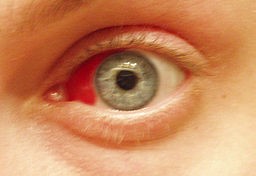
© Standardissue at en.wikipedia,CC BY-SA 3.0, via Wikimedia Commons
The conjunctiva is like a thin 'skin' on the front of the eyeball. It covers the white part of the eye (the sclera) but does not cover the central part of the eye (the cornea).
In between the conjunctiva and the sclera run tiny blood vessels. If you look closely at the sclera you may just be able to see a few tiny blood vessels.
If one of these tiny blood vessels bursts, it bleeds in between the conjunctiva and the sclera. This bleed is called a subconjunctival haemorrhage.
What causes a subconjunctival haemorrhage?
Volver al contenidoIn the vast majority of cases there is no apparent cause. They occur more often in older people and also happen frequently in healthy newborn babies.
Occasionally, a subconjunctival haemorrhage can be caused by an injury to the eye or a head injury. Sometimes they occur after a bout of coughing or being sick (vomiting). They are associated with other medical conditions such as presión arterial alta (hipertensión),diabetes mellitus and coronary heart disease. If you have a bleeding disorder, such as haemophilia, or if you take anticoagulant medication (blood thinners such as warfarina), you may be more prone to getting a subconjunctival haemorrhage (or other bleeding such as nosebleeds or easy bruising).
Continúa leyendo abajo
What are the symptoms of a subconjunctival haemorrhage?
Volver al contenidoUsually none. You often do not notice it until someone points it out to you, or you see it in a mirror. It can be alarming, as sometimes a large part of the white of the eye (sclera) appears bright red. This is because the tiny bleed (haemorrhage) spreads between the thin 'skin' on the front of the eyeball (the conjunctiva) and the sclera in a thin film. It looks a lot worse than it really is! Your eye might feel mildly irritated but your vision should be entirely normal. It is not uncommon for it to happen again at a later date.
What is the treatment for a subconjunctival haemorrhage?
Volver al contenidoUnless there is an underlying medical problem, no treatment is required. It will usually fade and disappear within two weeks. (Like any other bruise, the red colour will go a yellow/brown colour before it fades away.) If your eye feels irritated, you can use artificial tears. It is best to avoid drugs like ibuprofen, which can make bleeding worse. Do mention to your doctor if:
You have not had your blood pressure checked recently.
You suspect an injury to your eye is the cause (for example, a small bit of flying metal from a hammer, chisel, etc).
You have noticed any other unusual bleeding or bruising on your body for no good reason.
Continúa leyendo abajo
How to prevent a subconjunctival haemorrhage
Volver al contenidoThere are some steps you can take to help prevent subconjunctival haemorrhage or indeed, eye injury. Estas incluyen:
Wear protective eyewear during sports or DIY where debris may enter your eye.
Insert and remove your contact lenses properly and keep them clean.
Get medical advice from your doctor if you suspect you have a bleeding disorder.
Avoid rubbing your eyes.
Selecciones del paciente para Eye injuries

Salud ocular
Dealing with eye injuries
This leaflet is created from first aid advice provided by St John Ambulance, the nation's leading first aid charity. This advice is no substitute for first aid training - find a training course near you. Eye injuries vary from something very minor, such as getting shampoo in your eye, to something quite serious, such as a cut, which could cause permanent loss of vision.
by St John Ambulance

Salud ocular
Lesiones corneales y cuerpos extraños
Las pequeñas raspaduras o abrasiones de la córnea son comunes. Pueden ser extremadamente dolorosas, pero generalmente sanan en 24-48 horas. Se suele prescribir un curso de gotas o ungüentos antibióticos para prevenir una infección ocular. Las lesiones más graves en el ojo pueden ocurrir por objetos afilados y por pequeñas partículas voladoras que golpean el ojo a alta velocidad. Las lesiones graves también pueden resultar de quemaduras químicas. Siempre consulte a un médico para un examen ocular adecuado si sospecha que su ojo ha sido lesionado por una pequeña partícula voladora o por un químico.
por la Dra. Mary Elisabeth Lowth, FRCGP
Lecturas adicionales y referencias
- Cronau H, Kankanala RR, Mauger T; Diagnosis and management of red eye in primary care. Am Fam Physician. 2010 Jan 15;81(2):137-44.
- Tarlan B, Kiratli H; Subconjunctival hemorrhage: risk factors and potential indicators. Clin Ophthalmol. 2013;7:1163-70. doi: 10.2147/OPTH.S35062. Epub 2013 Jun 12.
- Doshi R, Noohani T; Subconjunctival Hemorrhage. StatPearls, Jan 2023.
Continúa leyendo abajo
Historial del artículo
La información en esta página está escrita y revisada por pares por clínicos calificados.
Next review due: 26 Apr 2028
27 Apr 2025 | Última versión

Pregunta, comparte, conecta.
Navega por discusiones, haz preguntas y comparte experiencias en cientos de temas de salud.

¿Te sientes mal?
Evalúa tus síntomas en línea de forma gratuita
Suscríbete al boletín de Patient
Tu dosis semanal de consejos de salud claros y confiables, escritos para ayudarte a sentirte informado, seguro y en control.
Al suscribirte aceptas nuestros Política de Privacidad. Puedes darte de baja en cualquier momento. Nunca vendemos tus datos.