Bowen's disease
Peer reviewed by Dr Hayley Willacy, FRCGP Last updated by Dr Doug McKechnie, MRCGPLast updated 9 Jan 2024
Meets Patient’s editorial guidelines
- DownloadDownload
- Share
- Language
- Discussion
- Audio Version
- Add to preferred sources on Google
Bowen's disease is a very early form of skin cancer. It causes one or more small patches of scaly red skin. It occurs when skin cancer cells grow in the outer layer of the skin, but don't spread any deeper into the skin, or elsewhere in the body. Because these cancer cells stay in the outer layer of the skin, they don't cause serious problems in themselves. However, over time, there is a chance that these cells can develop into a different type of skin cancer, which can cause problems. So, Bowen's disease is generally treated to stop this happening. Close follow-up is needed after treatment to check for any return (recurrence) of Bowen's disease.
At a glance
Bowen's disease is an early form of skin cancer where cancer cells stay in the skin's outer layer.
It usually appears as a red, scaly patch with an irregular outline, often on sun-exposed skin.
Bowen's disease itself is not usually serious, but it can sometimes develop into a more advanced skin cancer.
Causes include long-term sun exposure, a weakened immune system, and HPV infection.
Treatments vary and can include creams, freezing, scraping, surgery, or light therapy.
See a doctor for any new or changing skin patches, especially if they bleed or develop a lump.
What is Bowen's disease?
Bowen's disease occurs when there is a growth of cancer cells in the outer layer of the skin (epidermis). These cancer cells stay within the outer layer of the skin. Unlike most forms of cancer, these cells can't spread elsewhere. So, Bowen's disease itself is not serious. However, there is a small risk that, over time, it can develop into a more advanced form of skin cancer, which does cause problems.
Is Bowen's disease skin cancer?
Bowen's disease is a very early form of skin cancer. In Bowen's disease, skin cancer cells grow in the outer layer of the skin, but do not grow (or 'invade') deeper into the skin.
Bowen's disease is also called "cutaneous squamous cell carcinoma in situ". Cutaneous squamous cells are cells that make up the outer part of the skin. (Different types of squamous cells are also found in other organs). Carcinoma means cancer, and 'in situ' means 'in place'. In Bowen's disease, squamous cell cancer cells are found in the outer layer of the skin (the epidermis), which is where they originally started growing, but don't spread elsewhere.
Sometimes, Bowen's disease is called a 'pre-cancer', because a key feature of cancers is that they invade other tissues and spread elsewhere in the body - which Bowen's disease doesn't do. Bowen's disease can, however, develop into a squamous cell carcinoma - a 'true' form of skin cancer. This happens to about 3 out of every 100 people with Bowen's disease, over time.
What are the symptoms of Bowen's disease?
Bowen's disease is typically a red-looking patch of skin that has an irregular outline.
The patch can also be:
Crusty or scaly.
Cracked or ulcerated.
Flat or raised.
Bleeding.
Patches can slowly enlarge. Patches of Bowen's disease may be a few millimetres in diameter but, in some cases, can grow to several centimetres.
Sometimes, in its early stages, Bowen's disease can be mistaken for other skin problems such as ringworm, psoriasis or discoid eczema.
The picture shows a typical patch of Bowen's disease.
Bowen's disease skin patch

© Crop by Mikael Häggström, from original by Klaus D. Peter, Gummersbach, Germany, CC BY 3.0 DE, via Wikimedia Commons
Bowen's disease more commonly appears on areas of the skin that have been exposed to the sun. In the UK in about three quarters of cases, it occurs on the leg, below the knee. It may also appear on the neck or face, which is more common in Australia and the USA.
It may also be found:
Under or around nails.
On the palms of hands.
On the soles of feet.
Around the back passage (anus).
In the genital area.
Bowen's disease-type skin patches that occur on the genital areas may be given some different names. For example, Bowen's disease that occurs on the penis is called 'erythroplasia of Queyrat'.
Most people just have one patch of Bowen's disease but 1 to 2 people in 10 can have more than one patch at the same time
When to see a doctor
See a doctor if you think you might have Bowen's disease. If it is, they can offer you treatment to get rid of it.
If a patch of Bowen's disease starts to become ulcerated, bleeds, or if a small bump appears, this could possibly be a sign that it has started to change into a skin cancer. See your doctor as soon as possible if this happens.
Bowen's disease affecting the genitals or anus may be more likely to develop into a skin cancer than Bowen's disease in other places.
What causes Bowen's disease?
A patch of Bowen's disease can appear for no apparent reason and can affect anyone. However, there are a number of different things that are thought to increase your risk of developing Bowen's disease. These include:
Long-term sun exposure. Also, use of sunbeds.
Previous radiotherapy treatment - for example, for cancer.
Immunosuppression. If you have a weak immune system for any reason, this can increase your risk of Bowen's disease. For example, if you have AIDS, if you are undergoing treatment for cancer, have had an organ transplant, or have had medicines to suppress your immune system.
Infection with the human papillomavirus (HPV). It is thought that HPV may be involved in the development of both genital Bowen's disease and Bowen's disease affecting other parts of the skin. HPV type 16 is most commonly associated.
A previous injury to the skin. If you have had an injury to your skin that has caused persistent (chronic) skin damage or scarring, this may increase your risk of developing Bowen's disease in that area.
Inflammatory skin conditions. Rarely, people with chronic skin inflammation problems such as eczema can develop Bowen's disease.
How common is Bowen's disease?
Around 15 per 100,000 people in the UK are thought to develop Bowen's disease each year.
It tends to be more common in:
Women more than men.
People aged in their 60s.
People with white skin.
On parts of the body where the skin has been exposed to the sun.
You may also be more likely to develop Bowen's disease if you have previously had one of a group of skin cancers called non-melanoma skin cancers. These are skin cancers that are not malignant melanoma. They include basal cell carcinoma and squamous cell carcinoma. See the separate leaflet called Non-melanoma Skin Cancer for more details.
You are also more likely to develop a non-melanoma skin cancer if you have had Bowen's disease. This is probably due to excessive sun exposure being a risk factor for both Bowen's disease and non-melanoma skin cancers.
How is Bowen's disease diagnosed?
Bowen's disease is usually suspected by its typical appearance on the skin. Sometimes, to make a diagnosis, a small sample of skin (a biopsy) may be taken. This is then examined in a laboratory. Bowen's disease will have a typical appearance when examined under a microscope.
What is the treatment for Bowen's disease?
Treatment can depend on a number of different things, including the site of the patch of Bowen's disease, its size and thickness and how many Bowen's disease patches you have.
The treatment options include:
Observation ('watch and wait')
This may be an option in some people. For example, this may be advised if you have a slowly growing, thin patch of Bowen's disease on an area of your body where skin healing may be difficult (such as your shin). The skin on your shins is very thin and delicate which means that healing can take longer.
Creams applied to the skin
Certain creams may be used in the treatment of Bowen's disease. These can help to kill and get rid of the abnormal cells in some cases. Such creams include 5-fluorouracil (5-FU), a type of chemotherapy cream.
5-FU cream may need to be applied once or twice a day for around three to four weeks and sometimes for longer. The cream is easy to apply yourself. The problem is that it can be quite an irritant to the skin. Your skin may become red and may actually look worse when you are using the treatment.
Treatment may need to be repeated at a later date if the patch of Bowen's disease comes back. 5-FU treatment may be particularly useful in large patches of Bowen's disease or in areas where skin healing may be poor, such as your shin (as explained above). It may also sometimes be used in people who have a number of different patches of Bowen's disease.
Imiquimod cream is also sometimes used to treat Bowen's disease.
Cryotherapy
Cryotherapy may be a treatment option in some cases. It is a type of 'freezing' treatment and usually liquid nitrogen is used. Treatment can sometimes be uncomfortable and ulceration of your skin is a possible side-effect.
Curettage treatment
Curettage means that the patch of Bowen's disease is 'scraped' off your skin. A local anaesthetic is used to numb your skin for curettage to be done. Your skin is left to heal naturally and usually a scab forms after treatment and then drops off. There may be less pain during curettage treatment than with cryotherapy.
Surgery
In some cases, surgery to remove the patch of Bowen's disease may be suggested. For example, surgery is usually carried out for Bowen's disease around the back passage (anus).
The patch of Bowen's disease is cut out from your skin under local anaesthetic and stitches are used to close up your skin again afterwards. Skin healing may sometimes be difficult, especially when surgery is used to remove patches of Bowen's disease on the leg below the knee.
Photodynamic therapy
This has been used with some success to treat Bowen's disease. Photodynamic therapy is carried out by applying a special chemical to the patch of Bowen's disease. The chemical is photosensitive, which means it reacts to light.
A special light source is then directed at the affected patch of skin to activate the photosensitive chemical. This then makes it burn and destroy the patch of Bowen's disease.
Sometimes burning and stinging of the area of skin being treated can occur and your skin may become irritated. Rarely, skin colour may be lost or, in some cases, become darker in the treatment area.
Radiotherapy
Radiotherapy is treatment with X-rays. It is another treatment option for Bowen's disease but it is less commonly used than other treatments, and usually only used if other treatments haven't worked. Again, radiotherapy may not be suitable to treat Bowen's disease below the knee because of problems with skin healing after treatment.
Laser treatment
This is also sometimes used to treat patches of Bowen's disease.
Can Bowen's disease be prevented?
Because excessive sun exposure is the most important risk factor for developing Bowen's disease, we should all limit our sun exposure in the summer months (or all year when in hot countries nearer the equator) by:
Staying indoors or in the shade as much as possible between 11 am and 3 pm.
Covering up with clothes and a wide-brimmed hat when out in the sunshine.
Applying sunscreen of at least SPF 15 (SPF 30 for children or people with pale skin) which also has high UVA protection.
If you have had Bowen's disease, you should make sure that you check your own skin regularly for any changes.
What is the outlook (prognosis)?
With most treatments for Bowen's disease, there is probably about a 1 in 10 chance that Bowen's disease will come back (recur) after treatment. Therefore, regular follow-up is needed to look for any signs of recurrence. Further treatment may be needed if this happens.
The outlook for most people with Bowen's disease is very good. The vast majority of people who have Bowen's disease that is recognised and treated will not develop a skin cancer.
Understanding the skin
The skin has two layers - the outer layer (epidermis) and the inner layer (dermis). Beneath the dermis is a layer of fat and then the deeper structures such as muscles and tendons.
Skin diagram cross-section view
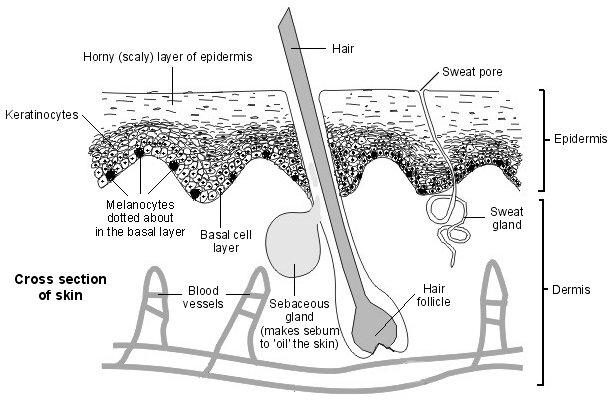
The epidermis has three main types of cell:
Basal cells. These are the bottom layer of cells in the epidermis.
Keratinocytes. These cells are in layers above the basal layer. They make a substance called keratin which is a hard waxy material. Keratinocytes are constantly dividing and a certain number are dying at any given time. The top (horny) layer of the epidermis is made of dead keratinocytes which contain keratin. The top of the skin is constantly being shed and replaced by new dead cells which contain keratin.
Melanocytes. These cells are dotted about at the bottom of the epidermis. They make a pigment called melanin when skin is exposed to sun. The melanin is passed to the nearby skin cells to protect them from the sun's rays. Melanin causes the skin to tan in fair-skinned people. Dark-skinned people have more active melanocytes.
Patient picks for Skin rashes

Skin, nail and hair health
Bullous pemphigoid
Bullous pemphigoid is a skin disease that can cause a rash, itching and blisters. It mainly affects people aged over 70. Treatment usually works well to control symptoms. Treatment is usually with steroid creams or medicines, but sometimes other medicines may be used. The condition tends to go away after 3-6 years and then treatment can be stopped. Sometimes the disease persists.
by Dr Caroline Wiggins, MRCGP

Skin, nail and hair health
Polymorphic light eruption
Polymorphic light eruption is a skin rash that can happen when you go out in the sun.
by Dr Hayley Willacy, FRCGP
Frequently asked questions
Can Bowen's disease spread to other parts of the body?
No, Bowen's disease itself doesn't spread to other parts of the body. The cancer cells remain within the outer layer of the skin (epidermis). However, there is a small risk that it could develop into a more advanced form of skin cancer over time, which would then have the potential to spread.
Does having Bowen's disease increase my risk of other health problems?
While Bowen's disease itself is not usually serious, having it means you are also more likely to develop a non-melanoma skin cancer. This is thought to be because excessive sun exposure is a risk factor for both Bowen's disease and these other skin cancers.
How often should I check my skin if I have had Bowen's disease?
If you have had Bowen's disease, you should regularly check your skin for any changes. This is important because there is about a 1 in 10 chance that the Bowen's disease will return after treatment, and you may also be at higher risk for other types of skin cancer.
Is Bowen's disease painful or itchy?
The article describes Bowen's disease as typically being a red patch of skin, which can also be crusty, scaly, cracked, ulcerated, or bleeding. While it doesn't explicitly state if it's painful or itchy, the characteristics described, particularly ulceration or cracking, could suggest discomfort. Symptoms like bleeding might also indicate irritation.
Are older people more likely to get Bowen's disease?
Yes, Bowen's disease tends to be more common in people aged in their 60s. It also appears more often in women than men and in people with white skin.
What is 'in situ' and how does it relate to Bowen's disease?
In 'cutaneous squamous cell carcinoma in situ', 'in situ' means 'in place'. This refers to the fact that the squamous cancer cells are found in the outer layer of the skin (the epidermis) where they began growing, but they have not spread deeper or elsewhere in the body.
Further reading and references
- Photodynamic therapy for non-melanoma skin tumours (including premalignant and primary non-metastatic skin lesions); NICE Interventional procedure guidance, February 2006
- Bowen's Disease - non-genital; DermNet NZ
- Bath-Hextall FJ, Matin RN, Wilkinson D, et al; Interventions for cutaneous Bowen's disease. Cochrane Database Syst Rev. 2013 Jun 24;(6):CD007281. doi: 10.1002/14651858.CD007281.pub2.
- Sharma A, Birnie AJ, Bordea C, et al; British Association of Dermatologists guidelines for the management of people with cutaneous squamous cell carcinoma in situ (Bowen disease) 2022. Br J Dermatol. 2023 Feb 10;188(2):186-194. doi: 10.1093/bjd/ljac042.
About the authorView full bio

Dr Doug McKechnie, MRCGP
Medical Writer
MA, MBBS, MSc, DRCOG, MRCP(UK), MRCGP(2021), FHEA
Dr Doug McKechnie is an NHS GP working in London. He works full-time clinically and is also the Deputy Lead for the Clinical and Professional Practice module at University College London Medical School.
About the reviewerView full bio

Dr Hayley Willacy, FRCGP
General Practitioner, Medical Author
MBChB (1992), DRCOG, DFFP, MRCOG (Part 1) MRCGP (2007), DFSRH (2013), MSc - medical education (2020)
Dr Hayley Willacy was an NHS GP working in northwest England, who retired from clinical practice in 2022 after 30 years.
Article history
The information on this page is written and peer reviewed by qualified clinicians.
Article also available in English, German, Spanish, French, Italian, Portuguese, Hindi, Hebrew, Arabic, and Swedish.
Next review due: 7 Jan 2029
9 Jan 2024 | Latest version
Join the conversation
Share your thoughts or experiences with others in our patient communities.

Ask, share, connect.
Browse discussions, ask questions, and share experiences across hundreds of health topics.

Feeling unwell?
Assess your symptoms online for free
Sign up to the Patient newsletter
Your weekly dose of clear, trustworthy health advice - written to help you feel informed, confident and in control.
By subscribing you accept our Privacy Policy. You can unsubscribe at any time. We never sell your data.