Lesiones del lóbulo temporal
Revisado por pares por Dr Caroline Wiggins, MRCGP Última actualización por Dra. Rachel Hudson, MRCGPÚltima actualización 29 de abril de 2022
Cumple con las directrices editoriales
- DescargarDescargar
- Compartir
- Language
- Discusión
- Versión en audio
- Agregar a fuentes preferidas en Google
The temporal lobe of the brain is involved in understanding and remembering what we see (vision), understanding speech and language, and understanding emotions. The temporal lobe can be affected by various conditions, particularly a stroke, brain tumour or head or brain injury.
Investigations will usually include an MRI scan to identify the underlying cause of the temporal lobe lesion. The treatment and outcome (prognosis) will depend on the underlying cause.
De un vistazo
The cerebrum is the main part of the brain, involved in thought and memory.
The temporal lobe, part of the cerebrum, helps with vision, speech, memory, and emotions.
Temporal lobe lesions are uncommon but can be caused by strokes, tumours, or infections.
Symptoms of a temporal lobe lesion can include forgetfulness, speech problems, or seizures.
Symptoms vary depending on the cause and whether other brain areas are also affected.
An MRI scan is often used to diagnose temporal lobe lesions.
Treatment depends on the cause, and young people may recover function more easily.
Understanding the brain
Cross-section diagram of the brain
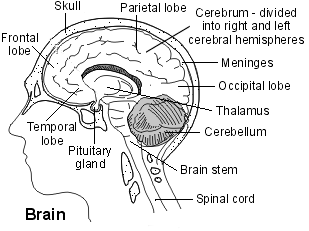
The cerebrum is the main part of the brain. It lies inside your skull and the surface resembles a walnut. It is divided into the right side (right hemisphere) which controls the left side of the body, and the left hemisphere which controls the right side of the body.
The cerebrum is also where you think and store your memory (especially long-term memory). Each hemisphere is subdivided into parts that are associated with certain functions. The main divisions are the frontal lobe, temporal lobe, parietal lobe and occipital lobe.
What does the temporal lobe do?
The temporal lobe is involved in:
Understanding and remembering what we see (vision).
Understanding speech and language.
Understanding and managing emotions.
Storing and recalling memories.
What causes temporal lobe lesions?
There are many possible causes of temporal lobe lesions. The most common causes include:
A accidente cerebrovascular. A stroke usually affects other parts of the brain but may occur in the temporal lobe. Strokes can be caused by a blood clot, or a bleed.
Tumores cerebrales may affect the temporal lobe of the brain.
A serious lesión grave en la cabeza or a surgical operation to remove a brain tumour may may also cause damage or injury to the temporal lobe.
Progressive worsening of language can be part of a type of dementia llamado frontotemporal dementia.
The temporal lobe can be affected by an infection of the brain (encephalitis), especially encephalitis due to herpes simplex virus.
Other conditions affecting the brain, such as multiple sclerosis, can also affect the temporal lobes of the brain.
How common are temporal lobe lesions?
Temporal lobe lesions are uncommon but not rare. However, some temporal lobe lesions may be very small and don't cause any obvious symptoms. Therefore, it is not known exactly how common temporal lobe lesions are.
What symptoms do temporal lobe lesions cause?
The symptoms caused by temporal lobe lesions are usually much less obvious than when other parts of the brain are affected. For example, many strokes will cause muscle weakness (paralysis), often affecting one side of the body. However, the symptoms caused by a stroke affecting the temporal lobe will be much less obvious.
A temporal lobe lesion may cause various symptoms which may not be noticed by other people. These symptoms may include:
Olvido.
Problems with speech and language (especially understanding what is being said by others).
Problems with vision.
Temporal lobe lesions may also cause fits (seizures).
Problems with hearing.
Identifying objects.
Learning new information and being unable to identify emotions in others.
Temporal lobe lesions may also cause problems with memory and cause changes in your personality.
The symptoms you experience will depend on what is causing the problem in the temporal lobe. A stroke will usually cause a sudden onset of symptoms, but a brain tumour will often cause a slow onset and progression of symptoms.
The symptoms will also depend on whether only the temporal lobe is affected or whether other parts of the brain are also affected by the underlying condition.
Epilepsia del lóbulo temporal
Seizures which begin in the temporal lobe can cause a wide variety of symptoms.
These symptoms may include different feelings, emotions, thoughts and experiences.
These feelings may be familiar to you or you may have these feelings for the first time.
You may suddenly remember something from your past or feel that everything around you is strange and unknown to you.
You may feel that you have already experienced something that is actually happening for the first time (this is called déjà vu).
You may also imagine voices, music, smells or tastes that are not really there (hallucinations).
The symptoms of the seizure may be very mild and hardly noticed or may be very severe and cause you to be very frightened. The seizure may also cause nice sensations and be enjoyable.
Temporal lobe epilepsy can be treated with medicines that are used for epilepsy, but treatment will also depend on any underlying temporal lobe lesion. See the separate leaflet called Epilepsy with focal seizures for more details.
How are temporal lobe lesions diagnosed?
The most important part of making the diagnosis of a temporal lobe problem is a thorough history of your symptoms. A history of your symptoms from someone close to you who has seen what happens when you have the symptoms is also very helpful.
The symptoms may be very complicated and sometimes an assessment with a psychologist is needed to identify exactly what symptoms are due to the suspected temporal lobe lesion.
Temporal lobe lesions may cause you to be unable to see one area in your field of vision (this is called a visual field defect). Your visual fields will therefore also be tested.
The best way to find the cause of a temporal lobe lesion is by having an MRI scan of your brain. Any further investigations will depend on the underlying cause of the temporal lobe lesion. If an infection (for example, HSV encephalitis) is suspected, then blood tests and a lumbar puncture (where a sample of fluid is taken from around the spinal cord in your back) may be performed.
Are there any treatments for temporal lobe lesions?
A psychologist can often help you to overcome some of the symptoms caused by a temporal lobe lesion.
The treatment will otherwise depend on the cause of the temporal lobe lesion.
¿Cuál es el resultado (pronóstico)?
The outcome will depend on the underlying cause and whether any other parts of the brain are also affected.
Young people, especially children, are able to use another part of the brain to take over the function of a damaged part of the brain, but this ability is lost as we become older. Therefore young people are more likely than older people to regain some of the brain function lost as a result of a temporal lobe lesion.
Can temporal lobe lesions be prevented?
There is a great deal we can do to reduce our risk of a stroke. See the separate leaflet called Enfermedad cardiovascular (Atheroma) para más detalles.
Selecciones del paciente para Trastornos nerviosos

Cerebro y nervios
Neuralgia del trigémino
La neuralgia del trigémino se define como un dolor nervioso (neuralgia) que involucra una o más de las ramas de los nervios trigéminos. El nervio trigémino lleva la sensación de tu cara a tu cerebro.
por el Dr. Doug McKechnie, MRCGP

Cerebro y nervios
Síndrome del túnel carpiano
Carpal tunnel syndrome is a set of symptoms thought to be caused by squashing (compression) of the median nerve in the carpal tunnel.
por el Dr. Colin Tidy, MRCGP
Preguntas frecuentes
How common are temporal lobe lesions?
Temporal lobe lesions are considered uncommon but not rare. However, it's difficult to know the exact prevalence because some lesions can be very small and may not cause any noticeable symptoms, meaning they go undetected.
What is the cerebrum and where is it located?
The cerebrum is the main and largest part of the brain, situated inside your skull. Its surface has a wrinkled appearance, similar to a walnut. It is divided into two hemispheres, the right and the left, and is responsible for thought and memory storage.
What specifically does the frontal temporal lobe control?
The article describes the temporal lobe's functions, including understanding and remembering what we see, understanding speech and language, managing emotions, and storing and recalling memories. It also mentions the frontal lobe as a separate division of the cerebrum, but does not specifically detail what the 'frontal temporal lobe' controls as a combined entity.
Can problems with the temporal lobe affect one's personality?
Yes, temporal lobe lesions can lead to changes in your personality. They can also cause problems with memory.
Is it possible to recover from temporal lobe damage?
The ability to recover from temporal lobe damage depends on the underlying cause and if other parts of the brain are affected. Young people, especially children, have a greater capacity to adapt, as other parts of their brain can take over the functions of the damaged area. This ability decreases with age.
Lecturas adicionales y referencias
- Faust K, Schmiedek P, Vajkoczy P; Approaches to temporal lobe lesions: a proposal for classification. Acta Neurochir (Wien). 2014 Feb;156(2):409-13. doi: 10.1007/s00701-013-1917-4. Epub 2013 Nov 8.
- Zhao F, Kang H, You L, et al; Neuropsychological deficits in temporal lobe epilepsy: A comprehensive review. Ann Indian Acad Neurol. 2014 Oct;17(4):374-82. doi: 10.4103/0972-2327.144003.
- Patel A, Biso GMNR, Fowler JB; Neuroanatomy, Temporal Lobe
Sobre el autorVer biografía completa

Dra. Rachel Hudson, MRCGP
Médico General y Autor Médico
MBChB, MRCGP (2008), BSc (Medical Science), DFSRH, DRCOG, DCH
La Dra. Rachel Hudson es una médica de cabecera del NHS que trabaja en el noroeste de Inglaterra.
Acerca del revisorVer biografía completa

Dr Caroline Wiggins, MRCGP
Médico General, Autor Médico
MBBS Honores (con Distinción), MRCGP (2016), MSc.SEM (con Distinción), BSc (Hons)
La Dra. Caroline Wiggins es una médica de cabecera suplente actualmente en el suroeste de Inglaterra.
Historial del artículo
La información en esta página está escrita y revisada por pares por clínicos calificados.
Artículo también disponible en Inglés, Alemán, Español, Francés, Italiano, Portugués, Hindi, Hebreo, Árabe, y Sueco.
Siguiente revisión prevista: 28 de abril de 2027
29 de abril de 2022 | Última versión

Pregunta, comparte, conecta.
Navega por discusiones, haz preguntas y comparte experiencias en cientos de temas de salud.

¿Te sientes mal?
Evalúa tus síntomas en línea de forma gratuita
Suscríbete al boletín de Patient
Tu dosis semanal de consejos de salud claros y confiables, escritos para ayudarte a sentirte informado, seguro y en control.
Al suscribirte aceptas nuestros Política de Privacidad. Puedes darte de baja en cualquier momento. Nunca vendemos tus datos.
Más sobre el cerebro y los nervios
- Neurinoma acústico
- TDAH en niños
- Afasia
- - el daño cerebral causa problemas con las funciones musculares.
- Síndrome de dolor regional complejo (CRPS)
- Dislexia
- Epilepsia
- Epilepsia y planificación del embarazo
- Hematoma extradural
- Crisis focales
- Cefalea por uso excesivo de medicamentos
- Migraña
- Migraña desencadenada por la menstruación
- Dolor neuropático
- Neuropatía periférica
- Herpes zóster
- Tartamudez
- Hemorragia subaracnoidea
- Convulsiones tónico-clónicas
- Temblores