Cardiotocografía
Revisado por Dr Colin Tidy, MRCGPÚltima actualización por Dr Doug McKechnie, MRCGPÚltima actualización 10 Oct 2024
Cumple con las directrices editoriales
- DescargarDescargar
- Compartir
- Language
- Discusión
- Versión en audio
- Agregar a fuentes preferidas en Google
Cardiotocography is usually called a 'CTG' by doctors and midwives. It can be used to monitor a baby's heart rate and a mother's contractions during labour.
Nota: la información a continuación es solo una guía general. Los arreglos y la forma en que se realizan las pruebas pueden variar entre diferentes hospitales. Siempre siga las instrucciones dadas por su médico o hospital local.
De un vistazo
La cardiotocografía (CTG) mide la frecuencia cardíaca de tu bebé y las contracciones de tu útero.
Se utiliza antes y durante el parto para verificar signos de un bebé en peligro.
El monitoreo externo utiliza sensores en tu abdomen, mientras que el monitoreo interno utiliza un electrodo en el cuero cabelludo del bebé.
Los profesionales de la salud observan la frecuencia cardíaca del bebé, su variabilidad y los cambios durante las contracciones.
Se suele aconsejar un CTG regular si hay preocupaciones sobre el embarazo o el bebé.
El CTG es una prueba segura, pero a veces puede sugerir un problema cuando no lo hay.
El monitoreo interno puede no ser aconsejable si tienes ciertas infecciones.
¡Inscríbete en nuestro curso gratuito de 8 semanas sobre Embarazo Saludable!
Cada semana compartiremos información útil y consejos esenciales sobre temas como nutrición, ejercicio, salud mental, síntomas a tener en cuenta y preparación para el parto, para ayudarte a navegar tu viaje de embarazo en cualquier etapa en la que te encuentres.
Al suscribirte aceptas nuestros Política de Privacidad. Puedes darte de baja en cualquier momento. Nunca vendemos tus datos.
What is cardiotocography?
Cardiotocography (CTG) measures your baby's heart rate. At the same time it also monitors the contractions in the womb (uterus). CTG is used both before birth (antenatally) and during labour, to monitor the baby for any signs of distress.
By looking at various different aspects of the baby's heart rate, doctors and midwives can see how the baby is coping.
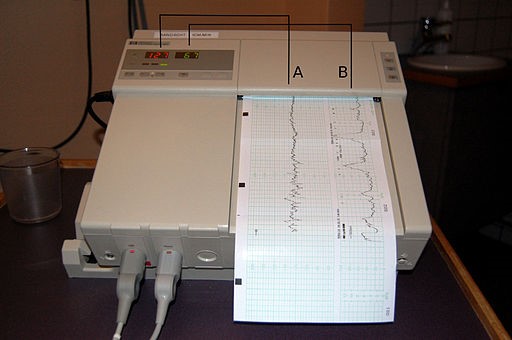
The image below shows the equipment used to do a CTG. It normally stands by your bedside whilst you are being monitored.
CTG machine with printout
What happens during cardiotocography?
External monitoring
CTG is most commonly carried out externally. This means that the equipment used to monitor the baby's heart is placed on the tummy (abdomen) of the mother.
An elastic belt is placed around the mother's abdomen. It has two round, flat plates about the size of a tennis ball which make contact with the skin. One of these plates measures the baby's heart rate. The other assesses the pressure on the tummy. In this way it is able to show when each contraction happens and an estimate of how strong it is. The midwife may put some jelly on the skin to help get a strong signal.
The CTG belt is connected to a machine which interprets the signal coming from the plates. The baby's heart rate can be heard as a beating or pulsing sound which the machine produces. Some mothers can find this distracting or worrying but it is possible to turn the volume down if the noise bothers you.
The machine also provides a printout which shows the baby's heart rate over a certain length of time. It also shows how the heart rate changes with your contractions.
If you have CTG before you are in labour you may be asked to press a button on the machine every time the baby moves. At this time you will not be having any contractions so the CTG will only monitor the baby's heart rate.
Internal monitoring
Occasionally during labour, if a signal can't be found using the external monitor, or when monitoring is more important, internal monitoring can be used.
For internal monitoring, a small, thin device called an electrode is used. This is inserted through the vagina and neck of the womb (which will be opening during labour) and placed on the baby's scalp. This device records the baby's heart rate.
If you have a twin (or higher multiples) pregnancy, internal monitoring can only be used on the baby closest to the neck of the womb.
Additionally internal monitoring can only be used when the baby is going to be delivered head first. Internal monitoring will not work on a breech (bottom or foot first) presentation.
How does cardiotocography work?
CTG continually monitors the baby's heart rate and the mother's contractions.
External CTG monitoring uses ultrasound to detect the baby's heart rate. Ultrasound is a high-frequency sound that you cannot hear but it can be sent out (emitted) and detected by special machines.
In external CTG monitoring, a special type of ultrasound, called Doppler®, is used. This type of ultrasound is used to measure structures that are moving, making it useful for monitoring heart rate.
Internal CTG monitoring is slightly different. This uses a wire electrode, attached to the baby's scalp, to detect the electrical signals from the baby's heartbeat, measuring the heart rate that way.
The other plate on the CTG measures how tense the mother's tummy (abdomen) is. This measurement is used to show when the uterus is contracting.
What can cardiotocography show?
CTG is used to detect signs that the baby is in distress - for example, if it's not getting enough oxygen.
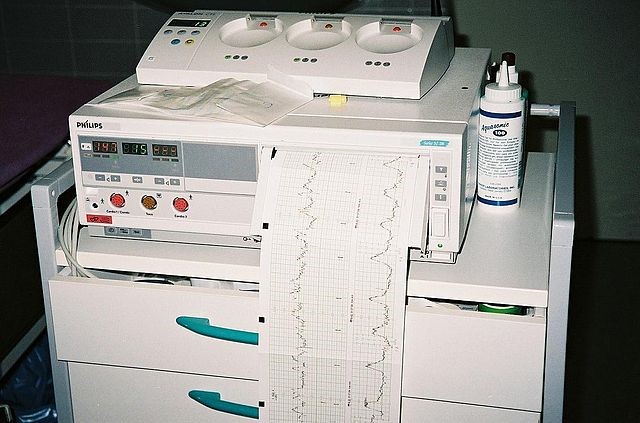
Many different things can be recorded on a CTG; your baby's heart rate, the baby's movements and your contractions. These are all shown on the image below.
CTG: electronic fetal monitoring machine
Healthcare professionals look at different things on the CTG to get an overall picture of how the baby is doing. There are several different things for them to consider, including:
The baby's heart rate. A normal heart rate for a baby during labour is between 110 to 160 beats a minute. If the baby's heart rate is persistently low or high, this can suggest a problem.
The variability, or fluctuations, in the baby's heart rate. It's a good sign if the baby's heart rate changes slightly between beat-to-beat - this suggests that their brain is working well. If their heart rate stays very similar for a long time, this can suggest a problem.
Patterns of heart rate changes in the baby, in response to contractions.
The baby's heart rate increasing for a short time, and then going back to normal (called an acceleration) is a reassuring sign.
The baby's heart rate can also decrease for short periods (called a deceleration). This is normal if it happens during the beginning of contraction, and goes back to normal straight after the contraction. However, if they are happening without contractions, happening late in a contraction or are lasting a long time after the contraction finishes, they can be a sign that the baby is in difficulty.
Healthcare professionals will use all of this information to interpret the CTG results. They will decide if the CTG results are:
Reassuring - no signs of problems with the baby.
Suspicious - some signs that the baby is in distress.
Pathological - signs that strongly suggest the baby is in distress.
If the results are suspicious or pathological, clinicians will assess further and try to correct anything that could be affecting the baby. If this doesn't work, or if the CTG suggests that the baby is in serious distress, they are likely to recommend delivering the baby straight away for its safety. This might be using forceps or a ventouse (vacuum cup), or via a Cesárea.
What is cardiotocography used for?
In a low-risk delivery, CTG is not usually needed. The midwife will listen to your baby's heart rate from time to time to check it is normal. However, in certain situations, continual monitoring with CTG is advised.
There are a lot of different possible reasons why CTG monitoring might be recommended. Generally, they are situations when close monitoring of the baby is thought to be needed to detect any problems.
The following are some examples:
Your baby is coming early or seems smaller than expected.
You have presión arterial alta.
Tienes un temperatura alta (fiebre).
You have an infection.
You pass fresh blood whilst in labour.
You are expecting more than one baby (twins or more).
The baby has opened its bowels (passed meconium) into the amniotic fluid.
The midwife thinks there may be a problem, having listened with a Pinard® or Doppler® machine.
If your membranes have ruptured more than 24 hours before your labour starts.
If your baby is in an unusual position.
You have labour speeded up with Syntocinon® or need an epidural for pain relief.
If you have an epidural for pain relief during labour, CTG may be used for half an hour after an epidural has been put in, or after top-ups for the epidural.
There are other reasons as well.
Depending on the exact situation, some women may have continuous (ongoing) CTG monitoring. In other cases, women might have the CTG on for a short time only, and have it removed if the trace is normal.
Are there any side-effects or complications from cardiotocography?
CTG does not use any radiation; it is considered a very safe test. Depending on the machine used, it may prevent you from being able to move around freely during labour. Waterproof machines can be used in a water birth, but may not be available.
The aim of using CTG is to pick up signs that the baby is in trouble, allowing doctors and midwives to deliver the baby sooner, to prevent the baby from coming to harm.
However, like any test, CTG can sometimes be wrong. It can give 'false positives' - signs that the baby is in trouble, when it's actually not - leading to interventions (such as a forceps or Caesarean section) which are not really needed.
For this reason, CTG monitoring is usually not recommended for women who have no risk factors for birth complications, and no other signs that the baby is in trouble, as it's more likely to give false positives in this situation. Other forms of monitoring, like checking the baby's heartbeat every 15 minutes, is often recommended instead. It's a better test when used in women with higher-risk pregnancies.
Women who have infections such as herpes, hepatitis B o C o VIH do not usually have internal monitoring, as it may increase the chance of passing the infection on to the baby.
Selecciones del paciente para Información general sobre el embarazo

Embarazo
Dieta y estilo de vida durante el embarazo
El embarazo puede ser un momento muy emocionante para la mayoría de las personas. También puede hacer que algunas personas se sientan ansiosas sobre lo que deberían (o no deberían) estar haciendo para su propia salud y la de su bebé.
por la Dra. Hayley Willacy, FRCGP

Embarazo
Embarazo múltiple
En un embarazo múltiple, hay más de un bebé creciendo en el útero al mismo tiempo. Estar embarazada de gemelos es el ejemplo más común. Tanto la madre como los bebés necesitan un monitoreo adicional durante el embarazo, ya que los riesgos son mayores que en un embarazo único.
por la Dra. Toni Hazell, FRCGP
Preguntas frecuentes
¿Puedo solicitar un CTG si no soy considerado de alto riesgo?
El monitoreo CTG generalmente no se recomienda para mujeres sin factores de riesgo de complicaciones en el parto. En estos casos, se suelen sugerir otras formas de monitoreo, como verificar periódicamente el latido del corazón del bebé. Esto se debe a que el CTG puede producir 'falsos positivos' en situaciones de bajo riesgo, lo que lleva a intervenciones innecesarias.
¿Qué hago si encuentro el sonido del latido del corazón de mi bebé en la máquina CTG distractor?
La máquina CTG produce un sonido de latido o pulso del ritmo cardíaco de su bebé. Si encuentra esto molesto o preocupante, generalmente es posible bajar el volumen a un nivel más cómodo.
¿Puedo moverme si estoy bajo monitoreo CTG continuo?
Dependiendo de la máquina CTG específica que se esté utilizando, el monitoreo continuo puede limitar tu capacidad de moverte libremente durante el parto. Existen algunas máquinas impermeables que se pueden usar durante un parto en agua, pero estas podrían no estar siempre disponibles.
How do healthcare professionals interpret the CTG results?
Los profesionales de la salud consideran varios factores para obtener una imagen general del bienestar del bebé. Observan la frecuencia cardíaca del bebé, su variabilidad (fluctuaciones) y cómo cambia la frecuencia cardíaca en respuesta a las contracciones. Basándose en estas observaciones, los resultados se clasifican como 'tranquilizadores', 'sospechosos' o 'patológicos'.
Si mis resultados de CTG son 'sospechosos' o 'patológicos', ¿qué sucede a continuación?
Si los resultados del CTG son sospechosos o patológicos, los médicos realizarán evaluaciones adicionales para comprender y abordar cualquier problema potencial. Si estas medidas no mejoran la situación, o si el CTG indica un malestar severo, pueden recomendar el parto del bebé de inmediato por su seguridad. Esto podría implicar métodos como el parto con fórceps, ventosa (copa de vacío) o una cesárea.
Lecturas adicionales y referencias
- Atención durante el parto; Estándar de Calidad NICE, diciembre de 2015 - última actualización en febrero de 2017
- Grivell RM, Alfirevic Z, Gyte GM, et al; Antenatal cardiotocography for fetal assessment. Cochrane Database Syst Rev. 2015 Sep 12;(9):CD007863. doi: 10.1002/14651858.CD007863.pub4.
- Alfirevic Z, Devane D, Gyte GM, et al; Continuous cardiotocography (CTG) as a form of electronic fetal monitoring (EFM) for fetal assessment during labour. Cochrane Database Syst Rev. 2017 Feb 3;2:CD006066. doi: 10.1002/14651858.CD006066.pub3.
- Fetal monitoring in labour; National Institute for Health and Care Excellence (NICE) [NG229]. December 2022.
Sobre el autorVer biografía completa
Actualizado por

Dr Doug McKechnie, MRCGP
Redactor Médico
MA, MBBS, MSc, DRCOG, MRCP(UK), MRCGP(2021), FHEA
El Dr. Doug McKechnie es un médico de cabecera del NHS que trabaja en Londres. Trabaja a tiempo completo en la práctica clínica y también es el Subdirector del módulo de Práctica Clínica y Profesional en la Escuela de Medicina del University College London.
Acerca del revisorVer biografía completa

Dr Colin Tidy, MRCGP
Médico General, Autor Médico
MBBS, MRCGP, MRCP (Paediatrics), DCH
El Dr. Colin Tidy es un médico del NHS, con sede en Oxfordshire.
Únete a la conversación
Comparte tus pensamientos o experiencias con otros en nuestro comunidades de pacientes.

Pregunta, comparte, conecta.
Navega por discusiones, haz preguntas y comparte experiencias en cientos de temas de salud.

¿Te sientes mal?
Evalúa tus síntomas en línea de forma gratuita
Suscríbete al boletín de Patient
Tu dosis semanal de consejos de salud claros y confiables, escritos para ayudarte a sentirte informado, seguro y en control.
Al suscribirte aceptas nuestros Política de Privacidad. Puedes darte de baja en cualquier momento. Nunca vendemos tus datos.