Presbicia
Age-related long sight
Revisado por Dr Philippa Vincent, MRCGPÚltima actualización por Dr Colin Tidy, MRCGPÚltima actualización 15 de enero de 2024
Cumple con las directrices editoriales
- DescargarDescargar
- Compartir
- Language
- Discusión
- Versión en audio
- Agregar a fuentes preferidas en Google
En esta serie:Hipermetropía
La vista de lejos relacionada con la edad (presbicia) es una parte normal del envejecimiento y no es una enfermedad. A medida que envejeces, te resulta más difícil ver (enfocar en) objetos cercanos. El problema puede corregirse usando gafas de lectura o lentes de contacto. La presbicia es un tipo de problema de visión llamado error de refracción.
De un vistazo
Presbyopia is a type of long-sightedness that happens as you get older.
It is caused by the lens in your eye becoming stiffer and less elastic.
Symptoms often include difficulty reading small print and eye strain, especially in dim light.
Presbyopia usually becomes noticeable around age 40 and most people need reading glasses by 45.
It can be treated with glasses, contact lenses, or surgery.
If you notice any changes in your vision, you should have your eyes checked.
What is presbyopia?
Presbyopia is a long-sight (hypermetropia) eye condition, caused by age.
As part of the ageing process the lens becomes more stiff and less elastic. This makes it more difficult for the lens to change shape - the ciliary muscles have to work harder to make it do so.
Eventually they are unable to do this at all and the lens cannot be thickened. With the lens in its normal resting position you are still able to focus on objects in the distance. However, because the lens cannot thicken, it cannot manage the extra degree of focus (accommodation) which is needed for near objects.
In order to see close-up objects, our eyes have to accommodate. This means that the lens has to change its thickness. Its thickness is adjusted by the ciliary muscles that attach to the suspensory ligaments at either end.
As these muscles tighten, the ligaments lengthen and the lens becomes more thickened and curved. Light rays entering your eye from close objects are brought into sharp focus on the retina.
At what age does presbyopia start?
Presbyopia is a normal part of the ageing process and usually becomes noticeable at around age 40.
By the age of 45 years, most people will need reading glasses. If you already wear glasses or contact lenses, your prescription may alter as a result of age-related long sight.
Types of presbyopia
There are five types of presbyopia:
Incipient presbyopia. This is the very earliest stage, when it may be a bit more difficult to read small print.
Functional presbyopia. This occurs when you begin to notice more problems with near sight.
Absolute presbyopia. If you have this type, your eyes cannot focus on near objects at all (farsightedness).
Premature presbyopia. This term is used when presbyopia occurs before the age of 40 years.
Nocturnal presbyopia. When this occurs, focusing on near objects is particularly difficult in low light conditions.
Presbyopia symptoms
Presbyopia symptoms may start with difficulties with prolonged close-up work, with tiring (eye strain) of the eyes. This may be worse in dim light.
People with presbyopia may also notice:
Difficulty in adjusting vision if you look quickly from a near object to a faraway one.
Blurred vision when looking at objects close up such as reading material.
Dolores de cabeza.
Eye strain when focusing on close work.
What causes presbyopia?
Presbyopia is a refractive error (see below) caused by normal ageing.
People who have a job that requires a lot of close-up work and people who live and work in a hot climate with lots of ultraviolet sunlight exposure are also at higher risk of premature age-related long sight.
¿Qué es un error refractivo?
To understand what causes presbyopia, we need to understand what a refractive error is. . Refractive errors are an eyesight problem and a common reason for reduced level of eyesight (visual acuity).
Sección transversal del ojo
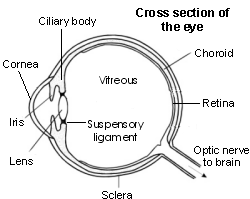
La refracción se refiere a la desviación de la luz, en este caso por el ojo, para enfocarla. Un error refractivo significa que el ojo no puede enfocar la luz correctamente en la retina. Esto generalmente ocurre ya sea debido a anomalías en la forma del globo ocular, o porque la edad ha afectado el funcionamiento de las partes del ojo encargadas del enfoque.
Hay cuatro tipos de errores refractivos:
Vista cansada relacionada con la edad (presbicia).
Astigmatismo (un error refractivo debido a una córnea curvada de manera desigual).
Para comprender completamente los errores refractivos, es útil saber cómo vemos.
When we look at an object, light rays from the object pass through the eye to reach the retina. This causes nerve messages to be sent from the cells of the retina down the optic nerve to the vision centres in the brain. The brain processes the information it receives, so that in turn, we can see.
Enfocando el ojo
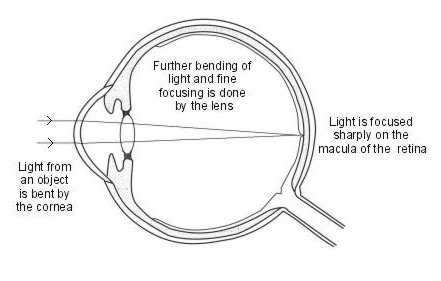
Light rays come off an object in all directions, as they result from the light around us from sun, moon and artificial light bouncing back off the object. The part of this bounced light that come into the eye from an object needs to be focused on a small area of the retina. If this doesn't happen, what we look at will be blurred.
The cornea and lens have the job of focusing light. The cornea does most of the work, as it (refracts) the light rays which then go through the lens, which finely adjusts the focusing. The lens does this by changing its thickness. This is called accommodation. The lens is elastic and can become flatter or more rounded. The more rounded (convex) the lens, the more the light rays can be bent inwards.
The shape of the lens is varied by the small muscles in the ciliary body. Tiny string-like structures called the suspensory ligaments are attached at one end to the lens and at the other to the ciliary body. This is a bit like a trampoline with the central bouncy bit being the lens, the suspensory ligaments being the springs and the ciliary muscles being the rim around the edge.
Cuando los músculos ciliares en el cuerpo ciliar se tensan, los ligamentos suspensorios se aflojan, haciendo que el cristalino se vuelva más grueso. Esto ocurre para objetos cercanos. Para mirar objetos lejanos, el músculo ciliar se relaja, haciendo que los ligamentos suspensorios se tensen y el cristalino se adelgace.
Se necesita más curvatura (refracción) de los rayos de luz para enfocar objetos cercanos, como al leer. Se necesita menos curvatura de la luz para enfocar objetos lejanos.
Presbyopia treatment
Gafas
Presbyopia can be corrected by wearing reading glasses; often the lenses are similar to bifocal lenses. If you already have glasses, bifocal or varifocal lenses may be prescribed to treat your age-related long sight. With these lenses, different parts of the lens have different prescriptions.
Bifocal ('bi' means two) lenses have a lens at the bottom for long sight (to allow close-up vision) and the rest of the lens above (allowing distant vision). Multifocal lenses have at least three focus 'zones' - for distant, middle and near vision, with gradual changes between them. Middle vision is best imagined as that needed for computer screen work.
Lentes de contacto
For people who already have contact lenses, reading glasses may be prescribed in addition to these to treat presbicia.
Other options include bifocal or multifocal contact lenses, or wearing a different contact lens in each eye - one to allow near vision, the other for distance vision (monovision contact lenses).
The disadvantage of correcting one eye (effectively to make it slightly short-sighted) is some loss of distance vision in that eye - but the other eye retains good distance vision. Usually the two eyes adapt to the differences between them, so that the patient can see near and far equally well.
Distance vision can be slightly compromised - and some patients notice 'ghosting' (faint double vision) on distant objects which does not always resolve with time.
Cirugía
Various surgical options are now offered to correct presbyopia. Some of these work on the principle of correcting one eye for near vision, whilst correcting the other eye to give good distant vision:
Kamra® corneal inlay
The Kamra® corneal inlay was approved by the US FDA in 2015. The inlay is designed to eliminate the need for reading glasses among people between the ages of 45 and 60 years who have good distance vision without glasses but have problems seeing up close due to age-related long sight.
The inlay is a small, thin opaque device with a tiny opening in the centre. It is surgically implanted in the central cornea, directly in front of the pupil of the eye. The central opening in the inlay creates a 'pinhole camera' effect. This effect, also seen if you look through a pinhole in a piece of paper, sharpens near vision while maintaining clear distance vision.
The inlay typically is implanted in the non-dominant eye. This allows both eyes to be used for distance vision, while the inlay sharpens near vision in the non-dominant eye.
Cirugía ocular con láser
Monovision LASIK® (LAsistidoEnsisted In situ Keratomileusis) and PRK® (Photo-Vefractive Keratectomy) can be used to remove corneal tissue and reshape the cornea to reduce the need for reading glasses. In monovision laser surgery for presbyopia, this is done for one eye only.
The surgeon fully corrects the distance vision of one eye (usually the dominant eye), and intentionally makes the non-dominant eye mildly short-sighted.
The newly short-sighted eye sees near objects clearly without glasses, although its distant vision may be less good. So, after monovision laser surgery, the dominant eye takes the lead to provide clear distance vision and the non-dominant eye is responsible for sharpening near vision.
Ver el folleto en Cirugía Ocular con Láser para más información.
Monovision conductive keratoplasty (CK)
CK uses low-level, radiofrequency energy to shrink fibres in the edge of the cornea to increase the curve and therefore increase its focusing power. Like monovision laser eye surgery, one eye is corrected for close vision and the other left for distance vision.
Monovision of any kind involves some compromise and not everyone adapts well to it. It's a good idea to try monovision with contact lenses before committing to a permanent surgical procedure, in case you don't adapt to it.
Intercambio de lente refractiva (RLE)
RLE is the removal and replacement of the eye's natural lens with an artificial lens to improve vision. The procedure is very similar to cataract surgery. The artificial lens is usually a multifocal lens, but various types are available.
RLE can reduce the need for reading glasses while providing clear distance vision without glasses. It is particularly helpful for patients with age-related long sight who are developing cataratas.
Several other surgical procedures to correct presbyopia are either available or in development, depending on which country you live in. In the UK, these procedures are not routinely done in the NHS.
It is important that you know your facts, including what the procedure involves, the failure rate, side-effects, the risk of complications, y el level of aftercare provided.
Se le debe dar la oportunidad de discutir estos hechos con anticipación con el cirujano que realizará el procedimiento.
How often should you have an eye test?
El NHS recomienda que la mayoría de las personas se hagan un examen de la vista cada dos años. A los niños se les ofrecerán revisiones oculares de manera rutinaria en varias etapas desde el nacimiento hasta la edad escolar.
People at high risk of sight problems need more frequent eyesight checks.
This includes people with:
A family history of these conditions.
Las personas mayores de 70 años y los niños que usan gafas también pueden necesitar exámenes de la vista más frecuentes.
You should get your eyes checked if you notice any changes in your vision.
La Dra. Mary Lowth es una autora o la autora original de este folleto.
Selecciones del paciente para Condiciones oculares

Salud ocular
Episcleritis y escleritis
La episcleritis y la escleritis son afecciones inflamatorias que afectan el ojo. Ambas causan enrojecimiento, pero la escleritis es mucho más grave (y más rara) que la episcleritis.
por el Dr. Doug McKechnie, MRCGP

Salud ocular
Problemas visuales
La mayoría de las personas se preocupan cuando desarrollan problemas que afectan sus ojos, especialmente si esto afecta su capacidad para ver claramente. Este folleto describe la mayoría de las condiciones oculares que pueden afectar la visión, ya sea temporal o permanentemente. Explica qué síntomas podrían esperarse y qué se puede hacer al respecto.
por la Dra. Philippa Vincent, MRCGP
Preguntas frecuentes
What is the difference between presbyopia and other types of long sight?
Presbyopia is specifically age-related long sight, caused by the natural stiffening and loss of elasticity of the eye's lens over time. Other types of long sight (hypermetropia) are refractive errors where the eye cannot focus light correctly, often due to abnormalities in the shape of the eyeball, but are not necessarily tied to the ageing process of the lens itself.
Are bifocal contact lenses available for presbyopia?
Yes, bifocal or multifocal contact lenses are an option for treating presbyopia. Another approach is to use 'monovision' contact lenses, where a different prescription is used in each eye – one for near vision and the other for distance vision.
What does 'monovision' mean in the context of presbyopia treatment?
Monovision is a treatment approach that corrects one eye for near vision and the other eye for distance vision. This can be achieved with contact lenses or surgical procedures like LASIK, PRK, or conductive keratoplasty. The aim is for the brain to adapt and use the appropriate eye for the task, allowing for both near and distant vision without glasses.
What is the purpose of a Kamra corneal inlay?
The Kamra corneal inlay is a small, thin device with a central opening that is surgically implanted into one eye. It creates a 'pinhole camera' effect, which sharpens near vision while maintaining clear distance vision. It is typically implanted in the non-dominant eye for individuals between 45 and 60 who have good distance vision but struggle with close-up tasks due to presbyopia.
When should someone consider refractive lens exchange (RLE)?
Refractive lens exchange (RLE) involves replacing the eye's natural lens with an artificial multifocal lens. This procedure is similar to cataract surgery and can reduce the need for reading glasses while providing clear distance vision. It is particularly helpful for patients who have age-related long sight and are also beginning to develop cataracts.
Lecturas adicionales y referencias
- Laser correction of refractive error following non-refractive ophthalmic surgery; Guía de procedimientos intervencionistas de NICE, marzo de 2011
- Corneal inlay implantation for correction of Presbyopia; NICE Interventional Procedure Guidance, April 2013
- Torricelli AA, Junior JB, Santhiago MR, et al; Surgical management of presbyopia. Clin Ophthalmol. 2012;6:1459-66. doi: 10.2147/OPTH.S35533. Epub 2012 Sep 6.
- Normas Profesionales para la Cirugía Refractiva; Real Colegio de Oftalmólogos (Dic 2021)
- Katz JA, Karpecki PM, Dorca A, et al; Presbyopia - A Review of Current Treatment Options and Emerging Therapies. Clin Ophthalmol. 2021 May 24;15:2167-2178. doi: 10.2147/OPTH.S259011. eCollection 2021.
- Wolffsohn JS, Davies LN, Sheppard AL; New insights in presbyopia: impact of correction strategies. BMJ Open Ophthalmol. 2023 Jan;8(1):e001122. doi: 10.1136/bmjophth-2022-001122.
Sobre el autorVer biografía completa
Actualizado por

Dr Colin Tidy, MRCGP
Médico General, Autor Médico
MBBS, MRCGP, MRCP (Paediatrics), DCH
El Dr. Colin Tidy es un médico del NHS, con sede en Oxfordshire.
Acerca del revisorVer biografía completa

Dra. Philippa Vincent, MRCGP
Médico General, Autor Médico
MB BS, Bsc, MRCGP (2000), DCH, DFSRH, DRCOG
Dra Philippa Vincent es un médico de cabecera del NHS que trabaja en el norte de Londres.
Únete a la conversación
Comparte tus pensamientos o experiencias con otros en nuestro comunidades de pacientes.

Pregunta, comparte, conecta.
Navega por discusiones, haz preguntas y comparte experiencias en cientos de temas de salud.

¿Te sientes mal?
Evalúa tus síntomas en línea de forma gratuita
Suscríbete al boletín de Patient
Tu dosis semanal de consejos de salud claros y confiables, escritos para ayudarte a sentirte informado, seguro y en control.
Al suscribirte aceptas nuestros Política de Privacidad. Puedes darte de baja en cualquier momento. Nunca vendemos tus datos.