Problemas de discos espinales
Revisado por pares por Dr Colin Tidy, MRCGPÚltima actualización por Dr Hayley Willacy, FRCGP Última actualización 17 Nov 2024
Cumple con las directrices editoriales
- DescargarDescargar
- Compartir
- Language
- Discusión
- Versión en audio
- Agregar a fuentes preferidas en Google
Los discos espinales también se llaman discos intervertebrales. Hay un disco espinal entre cada hueso (vértebra) en tu columna vertebral. Esto mantiene las vértebras separadas y actúa como un amortiguador. A medida que envejecemos, los discos espinales se dañan gradualmente y esto puede causar problemas como dolor de espalda. Otros problemas que afectan a los discos espinales incluyen un disco desplazado o, mucho más raramente, una infección (discitis).
De un vistazo
Spinal discs are shock absorbers between the bones in your spine.
Common problems include slipped discs, degenerative disc disease, and disc infection (discitis).
Symptoms often include back pain, which may spread to your legs.
"Red flag" symptoms like severe leg weakness or bladder/bowel problems need immediate medical attention.
Diagnosis may involve MRI scans after an assessment of your symptoms.
Treatment typically starts with painkillers, exercise, and keeping active.
What are spinal discs?
Lumbar spine and spinal cord
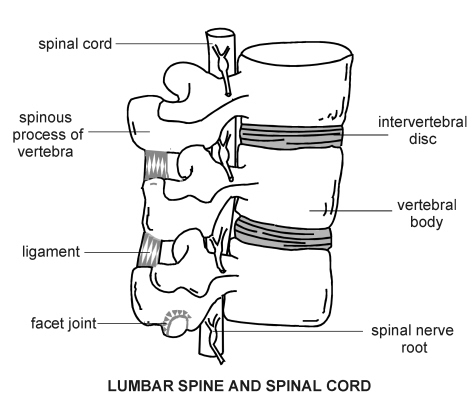
The spinal discs lie between the vertebrae in your spine. Spinal discs are also called intervertebral discs. A spinal disc acts as shock absorber between each of the vertebrae in the spinal column. Each disc keeps the vertebrae separated. The spinal discs also protect the nerves that run down the middle of the spine and the nerves that pass out of each level of the spinal column.
The spinal cord is shorter than the spinal canal. The cord ends between the first and second lumbar vertebrae in adults and between the second and third lumbar vertebrae in children. Below the end of the spinal cord, the nerve roots form what is called the cauda equina (because it looks like a horse's tail). Any problem with the spine below the first lumbar vertebra can cause weakness in the legs and also bladder or bowel upset. This is called síndrome de cauda equina.
What are the causes of spinal disc problems?
The main causes of spinal disc problems include:
Slipped disc (prolapsed disc).
Enfermedad degenerativa del disco. As we get older the spinal discs become damaged and weaker (degenerate).
Infection of the spinal disc (discitis). The infection is usually caused by a germ (bacterium) but is sometimes caused by a viral infection. See the end of this leaflet for more information about discitis.
A prolapsed disc
A 'slipped' (prolapsed) disc often causes severe lower back pain. The disc often presses on a nerve root which can cause pain and other symptoms in a leg. For more information see the separate leaflet called Slipped disc (Prolapsed disc).
Enfermedad degenerativa del disco
As we get older our spinal discs begin to shrink. The disc dries out and doesn't absorb shocks as well. Over a period of time this degeneration can be aggravated by sports and our daily activities. Injuries to our back can also cause the discs to degenerate more quickly. There is very little blood supply to the disc. So, once a disc is injured it cannot repair itself and the disc can start to deteriorate.
Nearly everyone has some signs of wear and tear of the spinal discs as they get older. Almost everyone older than 60 years has some degeneration of the discs, but not all people with disc degeneration will have back pain. In some cases, the discs may collapse completely and cause the facet joints in the vertebrae to rub against one another. This causes arthritis of the facet joints.
What are the symptoms of spinal disc problems?
Spinal disc problems can lead to symptoms of back pain, most often low back pain. The pain may also go into one or both of your legs (sciatica). Back pain with or without sciatica is very common. Most causes are not serious but it is very important for any serious cause to be found early so that it can be treated.
Nerve pain occurs if the affected disc is pressing on a nerve. The most common nerve pain caused by disc problems is sciatica - where the affected disc presses on your sciatic nerve, causing pain radiating into your leg. This nerve travels from your spine to your hip and buttock and down your leg.
The pain can be sudden and sharp, and move down the nerve to your leg and sometimes down to your foot. The pressure of the disc on the nerve may also cause numbness and tingling.
Sciatica is caused by a problem with a disc in your lower back (lumbar spine). A similar problem with a disc in your neck (cervical spine) may cause pain, numbness and tingling in your arm.
What are red flags?
'Red flags' are symptoms which may suggest that there is a serious underlying condition that is causing your symptoms.
Red flags that suggest cauda equina syndrome
Severe or worsening weakness of both legs.
Being unable to empty your bladder.
Loss of the feeling when you empty your bladder.
Losing control of your bladder (urinary incontinence).
Losing control of your bowels (faecal incontinence). This is caused by a loss of feeling of your rectum being full and weakness (laxity) of your back passage (anus).
Red flags that suggest spinal fracture
Sudden severe pain in your spine which is relieved by lying down.
History of major or minor injury - or even just strenuous lifting if you have 'thinning' of the bones (osteoporosis).
Localised tenderness over one of your vertebrae.
Red flags that suggest cancer or infection
(Infection includes conditions such as discitis, vertebral osteomyelitis, or spinal epidural abscess.)
Onset of symptoms in people aged older than 50 years, or younger than 20 years.
Pain that remains when you are lying down, night pain that disturbs your sleep, or pain in your spine in your upper or middle back (thoracic spine).
Past history of cancer.
High temperature (fever) or unexplained weight loss.
Recent infection (for example, urinary tract infection).
Drug abuse when the drug is injected into a vein.
Weak body defence against infection (immune deficiency).
Red flags that suggest arthritis affecting the spine
Early morning stiffness lasting longer than 45 minutes.
Pain during the night.
Pain that improves when you are moving and is worse after resting.
Red flags that suggest a high risk of permanent nerve damage
Muscle weakness or wasting.
Do you need any tests for spinal disc problems?
Sometimes no tests are needed but this will depend on your symptoms.
Initial tests may include blood tests. X-rays of your spine aren't usually recommended but you may need a escaneo de resonancia magnética (IRM) which will help to confirm the diagnosis and decide on the best treatment
What are the treatment options?
If there are red flag symptoms and signs that may suggest a serious underlying cause, you will need to be admitted urgently to hospital, or referred urgently to a neurosurgery or back specialist (an orthopaedic spinal specialist).
Otherwise, the initial treatment is usually analgésicos, simple back exercises and advice for you to keep as normally active and mobile as you can,
If the pain or any restrictions caused by the problem with your back last for more than 1-2 weeks the treatment options include:
Fisioterapia.
Referral to a specialist for an epidural corticosteroid injection.
Further treatment may be needed from an orthopaedic spinal specialist or a pain specialist.
¿Cuáles son las posibles complicaciones?
Permanent nerve damage may be caused by prolonged and severe disc problems.
The pain and restrictions may lead to psychological and social problems - for example, depression and being unable to continue with socialising and hobbies.
The pain and restrictions may also prevent you from working.
¿Cuál es la perspectiva?
The outlook (prognosis) is good for most people. However, some people will continue to have pain for longer than one year and sometimes much longer. The outlook tends to be worse for people who initially have more severe pain and have a greater restriction of daily activities.
Can spinal disc problems be prevented?
We should all take good care of our back. The ways we can do this include:
Ejercicio regular.
Weight loss if you are overweight.
Safe lifting techniques (such as bending your knees when lifting objects).
Posición y postura correctas al sentarse.
Discitis
Inflammation of a spinal disc (discitis) is rare. It is often caused by infection with a germ (a bacterial infection). Sometimes, however, the infection may be caused by a virus. Occasionally discitis is not caused by infection but results from a chemical reaction when you have a spinal injection.
Infection of the disc may occur after back surgery or a needle placed in the back for a punción lumbar o spinal injection. Infection can also spread from other sites in your body via the bloodstream - for example, a urinary tract infection or throat infection.
Discitis is more common in people with diabetes, in any condition reducing the body's defence against infection (immune deficiency) and in people with enfermedad arterial periférica. Drug misuse and alcohol misuse are also risk factors.
Severe, almost unbearable back pain is usually the main symptom of discitis. The pain is usually just in the area of the affected spinal disc and doesn't travel down your leg or to any other parts of your body. Other symptoms can include changes in your posture, stiffness in your back, difficulty performing your daily tasks, tummy (abdominal) pain or discomfort, and high temperature (fever).
Infection of the disc can be very difficult to treat. It usually takes a long course of antibiotics, usually given by injection into a vein (intravenously). Usually a period of six to eight weeks of antibiotic treatment is needed. Analgésicos fuertes are often needed and other treatments may include surgery.
Selecciones del paciente para Trastornos del cuello y la columna vertebral
Huesos, articulaciones y músculos
Dolor de espalda y columna
El dolor de espalda es extremadamente común; la mayoría de nosotros experimentaremos dolor de espalda en algún momento. Los niños pueden tener dolor de espalda, pero es más común en los adultos. Este folleto ofrece información general sobre la espalda y el dolor de espalda. También le dirigirá a páginas con información más detallada sobre las diferentes condiciones que pueden causar dolor de espalda.
por la Dra. Toni Hazell, FRCGP

Huesos, articulaciones y músculos
Espondilosis cervical
This leaflet is aimed at people who have been told they have cervical spondylosis as a cause of their neck symptoms. Cervical spondylosis is a 'wear and tear' of the vertebrae and discs in the neck. It is a normal part of ageing and does not cause symptoms in many people. However, it is sometimes a cause of neck pain. Symptoms tend to come and go. Treatments include keeping the neck moving, neck exercises and painkillers. In severe cases, the degeneration may cause irritation or pressure on the spinal nerve roots or spinal cord. This can cause arm or leg symptoms (detailed below). In these severe cases, surgery may be an option.
por el Dr. Doug McKechnie, MRCGP
Preguntas frecuentes
Are there specific activities or jobs that increase the risk of developing spinal disc problems?
While degeneration of spinal discs is a natural part of aging, certain activities can aggravate this process. Sports, daily activities, and injuries to the back can all contribute to discs degenerating more quickly. Therefore, jobs or hobbies that involve strenuous physical activity or a higher risk of back injury might increase the likelihood of developing problems.
Can I prevent disc degeneration from occurring as I get older?
Disc degeneration is a natural process that occurs as we age, with nearly everyone over 60 showing some signs of wear and tear. However, you can take steps to care for your back, which may help manage the process. These include maintaining a healthy weight, exercising regularly, using safe lifting techniques (bending your knees), and practicing correct sitting posture.
What is the difference between a 'slipped disc' and 'degenerative disc disease'?
'Slipped disc' (or prolapsed disc) refers to when a disc moves out of its normal position, often pressing on a nerve root and causing pain. 'Degenerative disc disease', on the other hand, describes the natural process where discs shrink, dry out, and become less effective shock absorbers as we get older. While they can both cause symptoms, one is an acute event, and the other is a gradual process of wear and tear.
If I have spinal disc degeneration, does that mean I will definitely experience back pain?
No, not necessarily. While almost everyone older than 60 years has some degeneration of their discs, not all people with disc degeneration will experience back pain. The presence of degeneration does not automatically mean you will have symptoms.
How soon should I expect to feel better after starting treatment for a spinal disc problem?
For most people, the outlook is good. However, some individuals may continue to experience pain for longer than a year, and sometimes even longer. The recovery time can vary, particularly for those who initially have more severe pain and greater restrictions in their daily activities.
Lecturas adicionales y referencias
- Dolor lumbar y ciática en mayores de 16 años: evaluación y manejo; Directrices NICE (noviembre 2016 - última actualización diciembre 2020)
- Molinos M, Almeida CR, Caldeira J, et al; Inflamación en la degeneración y regeneración del disco intervertebral. J R Soc Interface. 6 de marzo de 2015;12(104):20141191. doi: 10.1098/rsif.2014.1191.
- Dolor de espalda - bajo (sin radiculopatía); NICE CKS, septiembre 2023 (acceso solo en el Reino Unido)
- Ciática (radiculopatía lumbar); NICE CKS, septiembre 2023 (acceso solo en el Reino Unido)
Sobre el autorVer biografía completa

Dr Hayley Willacy, FRCGP
Médico General, Autor Médico
MBChB (1992), DRCOG, DFFP, MRCOG (Part 1) MRCGP (2007), DFSRH (2013), MSc - medical education (2020)
La Dra. Hayley Willacy fue una médica general del NHS que trabajaba en el noroeste de Inglaterra, quien se retiró de la práctica clínica en 2022 después de 30 años.
Acerca del revisorVer biografía completa

Dr Colin Tidy, MRCGP
Médico General, Autor Médico
MBBS, MRCGP, MRCP (Paediatrics), DCH
El Dr. Colin Tidy es un médico del NHS, con sede en Oxfordshire.
Historial del artículo
La información en esta página está escrita y revisada por pares por clínicos calificados.
Artículo también disponible en Inglés, Alemán, Español, Francés, Italiano, Portugués, Hindi, Hebreo, Árabe, y Sueco.
Próxima revisión: 16 Nov 2027
17 Nov 2024 | Última versión

Pregunta, comparte, conecta.
Navega por discusiones, haz preguntas y comparte experiencias en cientos de temas de salud.

¿Te sientes mal?
Evalúa tus síntomas en línea de forma gratuita
Suscríbete al boletín de Patient
Tu dosis semanal de consejos de salud claros y confiables, escritos para ayudarte a sentirte informado, seguro y en control.
Al suscribirte aceptas nuestros Política de Privacidad. Puedes darte de baja en cualquier momento. Nunca vendemos tus datos.
Más sobre huesos, articulaciones y músculos
- Medicamentos biológicos para la artritis reumatoide
- Dedo del pie roto
- Brazo superior roto
- Síndrome de cauda equina
- Condrocalcinosis
- Condromalacia rotuliana
- Lesiones y fracturas del antebrazo
- Gota
- Lesión de isquiotibiales
- Trastornos del espectro de la hipermovilidad
- Dolor de rodilla y rótula
- Dedo en martillo
- Esclerosis múltiple
- Enfermedad ósea de Paget
- cáncer de hueso primario
- Rabdomiosarcoma
- Periostitis tibial
- Lesiones deportivas
- Esguinces y distensiones
- Deficiencia de vitamina D