Aspiración con aguja fina
Revisado por pares por Dr Hannah Gronow, MBACPÚltima actualización por Dr Roger Henderson, MBBSÚltima actualización 22 Nov 2018
Cumple con las directrices editoriales
- DescargarDescargar
- Compartir
- Language
- Discusión
- Versión en audio
- Agregar a fuentes preferidas en Google
Esta página ha sido archivada.
No se ha revisado recientemente y no está actualizado. Los enlaces externos y las referencias pueden ya no funcionar.
In fine-needle aspiration a thin, hollow needle is used to take a sample of cells from an organ or lump under the skin. The cells are then analysed under a microscope.
Nota: the information below is a general guide only. The arrangements and the way tests are performed, may vary between different hospitals. Always follow the instructions given by your doctor or local hospital.
De un vistazo
Fine-needle aspiration uses a thin needle to take cell samples from a lump or organ.
This test can help to identify the type of cells in a lump, including detecting cancer.
It is commonly used for breast lumps or the thyroid gland in your neck.
A doctor inserts a thin needle into the lump, sometimes guided by a scan.
You may feel a little sore or get a bruise, but serious complications are uncommon.
En este artículo:
Selecciones de videos para Otras pruebas e investigaciones
Continúa leyendo abajo
What is fine-needle aspiration?
Fine-needle aspiration involves using a thin, hollow needle to remove samples of cells from tissue or fluid in an organ or a lump. It is not quite the same as a biopsy, which takes a very small chunk of tissue away. Once the samples of cells have been removed, they are sent to the laboratory for further testing.
Fine-needle aspiration is usually done to identify the type of cells inside a lump or to see how well treatment of an existing lump is working.
It is commonly used to investigate lumps found in the breast o a gland found in your neck (the thyroid). However, it can also be used in other parts of the body. It is a very useful way of detecting cancer.
How does fine-needle aspiration work?
Volver al contenidoA very thin, hollow needle is gently inserted through the skin into the lump or organ below. Often there is a syringe attached to the needle. The doctor can use the syringe to help 'suck' some of the cells into the needle by gently pulling on the plunger.
Usually, the test can be done without the need to make a cut in the skin. This helps to minimise any discomfort for the person having the test, as well as the risk of infection or other complications.
If the lump being tested is very small it might be necessary to use a scanning machine to help guide the needle to the right place. This may be done by an ultrasonido, a tomografía computarizada (TC) or an X-ray of the breast (a mammogram).
Continúa leyendo abajo
What happens?
Volver al contenidoThe doctor will clean the skin where the needle is to be inserted. In some cases you will also be given a local anaesthetic to numb the area. This may not be necessary if the lump is very close to the surface of your skin.
The doctor will hold the lump steady with one hand and insert a thin needle (which may be attached to a syringe) into the lump.
Aspiración con aguja fina
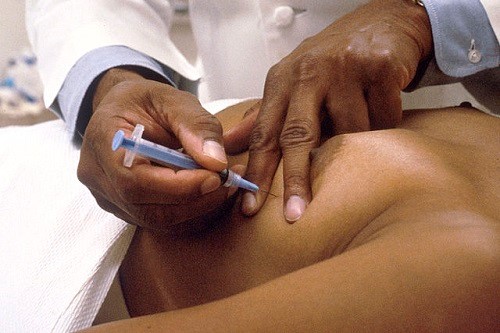
© By Linda Bartlett (photographer), National Institutes of Health, via Wikimedia Commons
They may move the needle in and out of the area to make sure of getting enough tissue or fluid. If there is a syringe attached they will gently pull back on the plunger to help remove the tissue or fluid. The process takes a few seconds to a few minutes. The needle will then gently be removed and your doctor may apply some pressure to help stop any bleeding.
If the doctor cannot easily feel the lump, you may have an imaging test, such as a CT scan, ultrasound scan, or mammogram to see where to put the needle. In this case, a doctor known as a radiologist may do the aspiration. The radiologist may do the investigation but they will not know the result immediately.
If the lump is a fluid-filled sac (a cyst), the fluid is removed and the lump usually goes away.
After the test is over, the cells taken from the needle are sent to the laboratory. It may take a few days to get the results of the test back, depending on what part of your body has been tested.
What should I do to prepare for a fine-needle aspiration?
Volver al contenidoThis depends on what part of your body is being tested. Your local hospital should give you information on what is required. Usually very little preparation is necessary.
Nota: if you take a blood-thinning medicine (an anticoagulant) such as warfarin, you may be asked to stop taking this for a few days before the procedure.
Continúa leyendo abajo
What can happen after a fine-needle aspiration?
Volver al contenidoMost fine-needle aspirations are carried out without any problems.
Commonly, you may feel a little sore for a couple of days after the test. You may develop a bruise at the site where the needle was inserted. Complications are uncommon but can include:
Bleeding or bruising. This should stop and heal quickly.
Infection at the point where the needle went in.
Other complications specific to the site of needle insertion.
Selecciones del paciente para Otras pruebas e investigaciones
Pruebas e investigaciones
Prueba de alergia por punción cutánea
La prueba de alergia por punción cutánea se utiliza para encontrar la causa de ciertas alergias.
por la Dra. Rosalyn Adleman, MRCGP

Pruebas e investigaciones
Pruebas de ITS
Si tienes un síntoma que piensas que se debe a una enfermedad de transmisión sexual - ETS - o si no tienes síntomas pero estás preocupado por tener una ETS, debes contactar a un profesional de la salud.
por la Dra. Hayley Willacy, FRCGP
Preguntas frecuentes
What is the difference between a fine-needle aspiration and a biopsy?
A fine-needle aspiration uses a thin, hollow needle to collect samples of cells, while a biopsy takes a small piece of tissue. Both are sent for laboratory testing, but the aspiration collects individual cells rather than a solid piece of tissue.
Will I feel pain during a fine-needle aspiration?
The doctor may clean the area and, in some cases, give you a local anaesthetic to numb it, especially if the lump is not very close to the skin's surface. This helps minimise discomfort. After the procedure, you might feel a little sore for a couple of days.
How long does a fine-needle aspiration procedure take?
The actual process of inserting the needle and collecting cells typically takes only a few seconds to a few minutes.
How long will it take to get the results back after a fine-needle aspiration?
It may take a few days to receive the results of the test, and the exact time can depend on which part of your body has been tested.
Lecturas adicionales y referencias
- Karadeniz Cakmak G, Emre AU, Tascilar O, et al; Diagnostic adequacy of surgeon-performed ultrasound-guided fine needle aspiration biopsy of thyroid nodules. J Surg Oncol. 2012 Jul 5. doi: 10.1002/jso.23212.
- Yu YH, Wei W, Liu JL; Diagnostic value of fine-needle aspiration biopsy for breast mass: a systematic review and meta-analysis. BMC Cancer. 2012 Jan 25;12:41.
- VanderLaan PA; Fine-needle aspiration and core needle biopsy: An update on 2 common minimally invasive tissue sampling modalities. Cancer Cytopathol. 2016 Dec;124(12):862-870. doi: 10.1002/cncy.21742. Epub 2016 May 16.
Continúa leyendo abajo
Sobre el autorVer biografía completa

Dr Roger Henderson, MBBS
Médico General, Autor Médico
MBBS, LMSSA
Dr Roger Henderson qualified as a GP in 1985 and has authored for EMIS since early 2013.
Acerca del revisorVer biografía completa

Dr Hannah Gronow, MBACP
Médico General
MB, ChB, MBACP
Hannah qualified as a GP in 1997. She joined EMIS (Patient) as a peer reviewer in August 2006.
Historial del artículo
La información en esta página está escrita y revisada por pares por clínicos calificados.
22 Nov 2018 | Última versión

Pregunta, comparte, conecta.
Navega por discusiones, haz preguntas y comparte experiencias en cientos de temas de salud.

¿Te sientes mal?
Evalúa tus síntomas en línea de forma gratuita
Suscríbete al boletín de Patient
Tu dosis semanal de consejos de salud claros y confiables, escritos para ayudarte a sentirte informado, seguro y en control.
Al suscribirte aceptas nuestros Política de Privacidad. Puedes darte de baja en cualquier momento. Nunca vendemos tus datos.