Forúnculo en el canal auditivo
Revisado por pares por Dr Colin Tidy, MRCGPÚltima actualización por Dr Doug McKechnie, MRCGPLast updated 19 Dic 2024
Cumple con las directrices editoriales
- DescargarDescargar
- Compartir
- Language
- Discusión
- Versión en audio
- Add to preferred sources on Google
En esta serie:Dolor de oídoDisfunción de la trompa de EustaquioInfección del oído medio (otitis media)Infección del oído externo (otitis externa)Infección fúngica del oídoBarotrauma en el oído
A small boil (furuncle) that occurs in the ear canal can be very painful. It usually clears without treatment. However, painkillers and antibiotic medicines are sometimes needed. Tips on how to help prevent further episodes are given below.
En este artículo:
Video picks for Infecciones de oído
Continúa leyendo abajo
Symptoms of a boil in the ear canal
Forúnculo en el canal auditivo
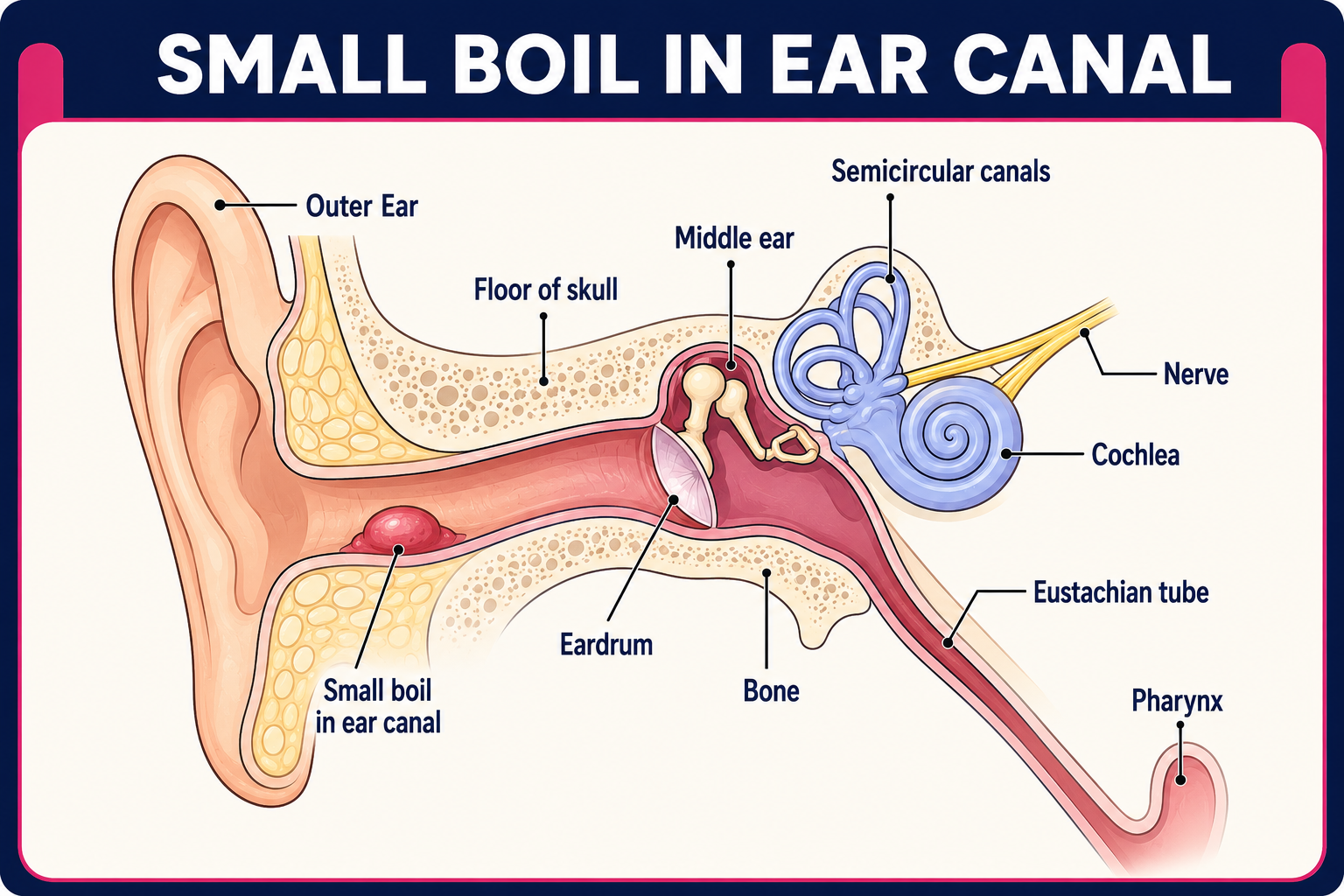
A boil in the ear canal can cause:
Pain that may become quite severe even though the boil is usually small.
Itch and skin irritation.
Temporary hearing loss.
Sudden discharge from the hear if the boil has bursts.
What causes a boil in the ear canal?
Volver al contenidoWhat happens when you get boils in the ear canal?
Mostly they occur 'out of the blue' for no apparent reason, like most spots or small boils that can occur on any area of the skin. In some cases the infection develops on damaged skin. The skin in the ear canal can become damaged by being poked with such objects as a cotton wool bud. Slightly damaged skin can quickly become inflamed and infected.
Continúa leyendo abajo
What is the treatment for a boil in the ear canal?
Volver al contenidoLike most small spots or tiny boils, a furuncle is likely to go without any treatment. The body's immune system can usually clear germs (bacteria) that cause boils. However, the pain may be significant until it goes.
The following may be used as treatment:
Panalgésicos such as paracetamol or ibuprofen can be bought over the counter.
A cloth (flannel) soaked in hot water and then held against the ear may relieve the pain.
Antibiotics, such as flucloxacillin, are sometimes needed if the infection does not clear on its own or if the infection is severe.
Occasionally the boil becomes very large and painful. An ear specialist referral may be needed if this happens.
How to prevent infections in the ear canal
Volver al contenidoSome people find that substances such as water, soap or shampoo which gets into their ears can cause irritation or itch. The itch may cause them to poke or scratch the ear canal with a finger or a cotton wool bud. This may damage the skin in the ear canal and cause inflammation. Inflamed skin can quickly become infected.
Some people try to clean out their ears with cotton buds. This is not only unnecessary but may damage the skin in the ear canal.
Prevention of boils or infections in the ear canal can be helped by:
Trying not to scratch or poke the ear canal with fingers, cotton buds, towels, etc.
Not cleaning the ear canal with cotton buds. They may scratch or irritate and may push dirt and wax further into the ear. The ear will clean itself, and bits of wax will fall out now and then.
For particularly sensitive ears which get frequent infections: Keeping the ear canal dry and avoid soap or shampoo getting in. This can be done whilst showering by placing a piece of cotton wool coated in soft white paraffin (for example, Vaseline®) in the outer ear. It is best not to use corners of towels or cotton buds to dry any water that does get into the ear canal as this will only push things further in. It is best to let the ear dry naturally. When swimming it is best to try to keep the ears dry. This can be done by wearing a tightly fitting cap that covers the ears. Some swimmers use silicone rubber earplugs. Some earplugs can cause more irritation to the skin in the ear canal.
Patient picks for Infecciones de oído
Oído, nariz y garganta
Infección fúngica del oído
Fungal ear infection is an infection of the ear with a fungus. It normally involves the ear canal that runs from the ear hole to the eardrum (the external auditory canal). The medical term for it is otomycosis.
por la Dra. Surangi Mendis, MRCGP
/og.png)
Oído, nariz y garganta
Infección del oído externo (otitis externa)
Otitis externa, more commonly known as an outer ear infection, is an inflammation of the ear canal. The inflammation is usually caused by infection, although it can sometimes be due to allergy or irritation. Treatment with ear drops is usually effective. Further episodes of the condition can often be prevented using the tips given below. Otitis externa usually clears within a week or so. When it is short-lasting, this is described as 'acute otitis externa'. However, occasionally it may persist for three months or more - this is described as 'chronic otitis externa'.
por el Dr. Colin Tidy, MRCGP
Lecturas adicionales y referencias
- Otitis externa; NICE CKS, mayo 2024 (acceso solo en el Reino Unido)
- Boils, carbuncles, and staphylococcal carriage; NICE CKS, mayo 2024 (acceso solo en el Reino Unido)
Continúa leyendo abajo
Historial del artículo
La información en esta página está escrita y revisada por pares por clínicos calificados.
Próxima revisión: 18 de diciembre de 2027
19 Dic 2024 | Última versión

Pregunta, comparte, conecta.
Navega por discusiones, haz preguntas y comparte experiencias en cientos de temas de salud.

¿Te sientes mal?
Evalúa tus síntomas en línea de forma gratuita
Suscríbete al boletín de Patient
Tu dosis semanal de consejos de salud claros y confiables, escritos para ayudarte a sentirte informado, seguro y en control.
By subscribing you accept our Política de Privacidad. Puedes darte de baja en cualquier momento. Nunca vendemos tus datos.