Pitiriasis rosada
Revisado por pares por Dr Doug McKechnie, MRCGPÚltima actualización por Dr Toni Hazell, MRCGPÚltima actualización 26 Ene 2025
Cumple con las directrices editoriales
- DescargarDescargar
- Compartir
- Language
- Discusión
- Versión en audio
Profesionales Médicos
Los artículos de Referencia Profesional están diseñados para ser utilizados por profesionales de la salud. Están escritos por médicos del Reino Unido y se basan en evidencia de investigación, así como en guías del Reino Unido y Europa. Puede encontrar el Pitiriasis rosadaartículo más útil, o uno de nuestros otros artículos de salud.
En este artículo:
Continúa leyendo abajo
¿Qué es la pitiriasis rosada?
Pityriasis rosea is an acute, self-limiting skin condition. A primary plaque ('herald patch') is followed by a distinctive, generalised itchy rash 1-2 weeks later.
The rash typically lasts for approximately 5-8 weeks. Lesions are typically oval, dull pink or tawny and appear in a 'Christmas tree' distribution, usually on the trunk and the upper arms and legs.
Causes of pityriasis rosea (aetiology)1 2
Volver al contenidoThe cause is unknown but it is believed to be infective in origin due to factors such as seasonal and geographical clustering.
No bacterium, virus, or fungus has been isolated as a cause but human herpesviruses 6 and 7 may play a role.
Pityriasis rosea-like drug eruptions have been associated with numerous medications, including:
Angiotensin-converting enzyme inhibitors.
Antibiotics (such as metronidazole) and antifungals (such as terbinafine).
Medicamentos antiinflamatorios no esteroideos (AINEs).
Antidepressants and anxiolytics, such as nortriptyline, bupropion and barbiturates.
Vaccines.
Lithium.
Lamotrigina.
Atenolol.
Omeprazole.
Biologics such as imatinib, adalimumab and etanercept.
Continúa leyendo abajo
How common is pityriasis rosea? (Epidemiology)1 3
Volver al contenidoPityriasis rosea is most common in children and young adults, aged 10-35 years. It is more common in women (with a female-to-male ratio of 1.4:1).
Pityriasis rosea is rare in infants and young children and in the elderly.
Prevalence in the community has been estimated to be around 1.3%.
It occurs most often during the spring and autumn.
Symptoms of pityriasis rosea (presentation)
Volver al contenidoPitiriasis rosada en el abdomen
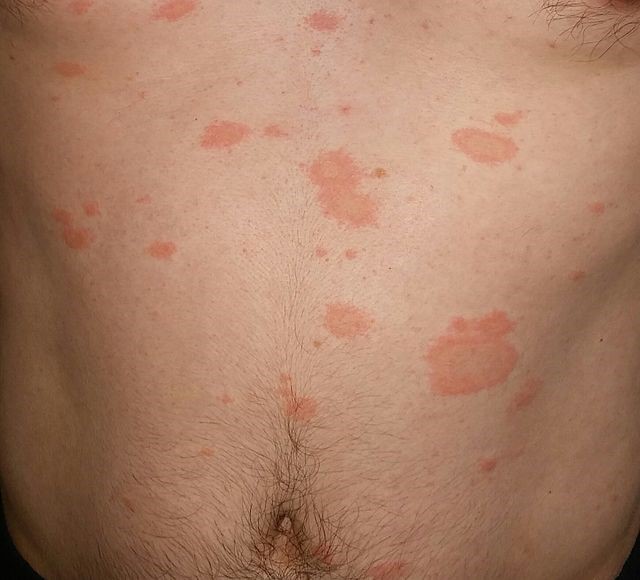
© Marekzerzan, CC BY-SA 4.0, vía Wikimedia Commons
Several images of the rash of pityriasis rosea are available on the DermNet NZ site.2
Características clínicas1
There may be prodromal symptoms (eg, malaise, nausea, anorexia, fever, joint pain, lymph node swelling and headache) that precede the appearance of the herald patch.
Pruritus (may be intense) is thought to occur in about half of cases.
The rash begins with a herald patch in 40-76% of cases. The herald patch measures 2-5 cm in diameter and is oval or round with a central, wrinkled, salmon-coloured area, separated from a dark-red peripheral zone by fine scales. The herald patch is usually located on the trunk but may be seen on the neck or extremities.
The secondary rash is symmetrical and localised, predominantly to the trunk, neck and proximal extremities.
The lesions of the secondary rash are small versions of the herald patch, with the two red zones separated by a scaling ring. They are distributed in a 'Christmas tree' pattern.
In some cases, the herald patch is either absent or confluent with the other lesions. In others, there are multiple herald patches.
Variant presentations include peripheral distribution of the rash; facial involvement may be seen in children. Skin lesions may also be large, urticarial, vesicular, pustular, and purpuric, and resemble erythema multiforme.
Hypopigmentation and hyperpigmentation of affected skin may follow the inflammatory stage.
Oral lesions are rare but may occur - eg, erythematous plaques and ulcers.
Continúa leyendo abajo
Diagnóstico diferencial3
Volver al contenidoPolymorphic eruption of pregnancy.
Secundaria sífilis.
HIV seroconversion (usually associated with a febrile, flu-like illness).
Diagnosing pityriasis rosea (investigations)
Volver al contenidoDiagnosis is clinical and usually no investigations are required.
Skin biopsy is not usually advised but may be occasionally required to confirm or alter the diagnosis.
Other investigations - eg, syphilis serology - may be required to rule out other possible diagnoses.
It is not uncommon for the herald patch to be diagnosed as tinea, with the actual diagnosis of pityriasis rosea only becoming apparent after the more generalised rash appears.
Management of pityriasis rosea1 3
Volver al contenidoPityriasis rosea is a self-limiting disease. Treatment is symptomatic and only if required. Reassure the person that the rash will disappear on its own but that it may take a few weeks to do so. Explain that new areas may be affected by the rash for up to six weeks. Also reassure that it is not contagious.
There is no convincing evidence of efficacy for any treatments used. For pruritus the following may be tried:
Emollients.
Topical corticosteroids, with the potency depending on the severity of the itch.
Topical menthol.
A sedative antihistamine at night such as hydroxyzine or chlorphenamine.
Derivación
Refer to a dermatologist if:
The rash persists for more than three months.
Itch is severe.
Diagnosis is not clear.
Although the evidence of efficacy is not yet clear, phototherapy is often used in secondary care.
Oral aciclovir has been shown to be effective in terms of rash improvement. Erythromycin may be effective in improving the itch.4
Embarazo 356
There is believed to be a risk of viral reactivation in pregnancy, due to the change in immune response. Consequently, there appears to be an increased risk of miscarriage for women who develop pityriasis rosea in early pregnancy. The absolute risk is low and most of the data comes from small studies; women can be reassured that the vast majority who get pityriasis rosea during pregnancy will have no significant complications. Despite this reassurance, the NICE CKS page suggest that we discuss pityriasis rosea urgently with secondary care, and the NHS website tells women to call their maternity team if they notice a new rash. It would therefore be prudent to discuss a suspected case with obstetrics.
Pronóstico3
Volver al contenidoThe eruptions are self-limiting and usually disappear gradually in 2-12 weeks, without any treatment.
However, they can take up to five months to disappear in some cases.
New skin lesions may continue to appear in the first 2-6 weeks.
After lesions have disappeared, there may be some darkening or lightening of the affected skin for several months.
It typically heals without scarring.
Most people who have pityriasis rosea will not have another attack during their lifetime; the risk of recurrence is 2-3%.
Lecturas adicionales y referencias
- Eisman S, Sinclair R; Pityriasis rosea. BMJ. 2015 Oct 29;351:h5233. doi: 10.1136/bmj.h5233.
- Pitiriasis rosada; DermNet NZ
- Pitiriasis rosada; NICE CKS, abril 2020 (acceso solo en el Reino Unido)
- Contreras-Ruiz J, Peternel S, Jimenez Gutierrez C, et al; Intervenciones para la pitiriasis rosada. Cochrane Database Syst Rev. 30 de octubre de 2019;2019(10). doi: 10.1002/14651858.CD005068.pub3.
- Stashower J, Bruch K, Mosby A, et al; Pregnancy complications associated with pityriasis rosea: A multicenter retrospective study. J Am Acad Dermatol. 2021 Dec;85(6):1648-1649. doi: 10.1016/j.jaad.2020.12.063. Epub 2021 Jan 8.
- Wenger-Oehn L, Graier T, Ambros-Rudolph C, et al; Pityriasis rosea in pregnancy: A case series and literature review. J Dtsch Dermatol Ges. 2022 Jul;20(7):953-959. doi: 10.1111/ddg.14763. Epub 2022 May 26.
Continúa leyendo abajo
Historial del artículo
La información en esta página está escrita y revisada por pares por clínicos calificados.
Próxima revisión: 25 Ene 2028
26 Ene 2025 | Última versión

Pregunta, comparte, conecta.
Navega por discusiones, haz preguntas y comparte experiencias en cientos de temas de salud.

¿Te sientes mal?
Evalúa tus síntomas en línea de forma gratuita