Grupos y tipos sanguíneos
Revisado por pares por Dr Colin Tidy, MRCGPÚltima actualización por Dr Rosalyn Adleman, MRCGPÚltima actualización 20 Jun 2023
Cumple con las directrices editoriales
- DescargarDescargar
- Compartir
- Language
- Discusión
- Versión en audio
En esta serie:Análisis de sangreAnálisis de sangre para detectar inflamaciónPrueba de CoombsHemograma completo y frotis de sangre
ABO y rhesus son ambos tipos de antígenos que se encuentran en la superficie de los glóbulos rojos. Hay muchos otros tipos, pero estos son los más importantes.
En este artículo:
Videos seleccionados para Análisis de sangre
The main reasons to know your blood group are if you need to have a blood transfusion or if you are pregnant.
Continúa leyendo abajo
What is a blood group?
Red blood cells (erythrocytes) have certain proteins on their surface, called antigens. Also, your plasma contains antibodies which will attack certain antigens if they are present.
ABO y rhesus son ambos tipos de antígenos que se encuentran en la superficie de los glóbulos rojos. Hay muchos otros tipos, pero estos son los más importantes.
ABO blood types
These were the first type discovered.
If you have type A antigens on the surface of your red blood cells, you also have anti-B antibodies in your plasma.
If you have type B antigens on the surface of your red blood cells, you also have anti-A antibodies in your plasma.
If you have type A and type B antigens on the surface of your red blood cells, you do not have antibodies to A or B antigens in your plasma.
If you have neither type A nor type B antigens on the surface of your red blood cells, you have anti-A and anti-B antibodies in your plasma.
It is not known what the functions of the A and B antigens are. People who don't have either (blood group O) are still just as healthy. There is some evidence that people of different blood groups may be more or less susceptible to certain diseases - for example, blood clots in the blood vessels (thromboembolism) and malaria. There is no evidence that people with different blood groups should follow different diets.
Rhesus types
Most people are 'rhesus positive'. This means they have rhesus antigens on their red blood cells. But, about 3 in 20 people do not have rhesus antibodies and are said to be 'rhesus negative'.
Blood group names
Your blood group depends on which antigens occur on the surface of your red blood cells. Your genetic make-up, which you inherit from your parents, determines which antigens are present on your red blood cells. Your blood group is said to be:
A+ (A positive) if you have A antigens and rhesus antigens.
A− (A negative) if you have A antigens but don't have rhesus antigens.
B+ (B positive) if you have B antigens and rhesus antigens.
B− (B negative) if you have B antigens but don't have rhesus antigens.
AB+ (AB positive) if you have A antigens, B antigens and rhesus antigens.
AB− (AB negative) if you have A antigens and B antigens but don't have rhesus antigens. This is the rarest blood group in the UK.
O+ (O positive) if you have neither A nor B antigens but you do have rhesus antigens. This is the commonest blood group in the UK.
O− (O negative) if you don't have A, B or rhesus antigens.
Other blood types
There are many other types of antigens which may occur on the surface of red blood cells. However, most are classed as 'minor' and are not as important as ABO and rhesus.
How is blood group testing done?
Volver al contenidoBasically, a sample of your blood is mixed with different samples of plasma known to contain different antibodies. For example, if plasma which contains anti-A antibodies makes the red cells in your blood (erythrocytes) clump together, you have A antigens on your blood cells. Or, if plasma which contains rhesus antibodies makes the red cells in your blood clump together, you have rhesus antigens on your blood cells.
By doing a series of such tests it is possible to determine what antigens are on your red blood cells and therefore determine your blood group. Routine blood grouping checks for your ABO and rhesus status. Other red cell antigens are tested for in certain other situations.
Continúa leyendo abajo
Blood transfusions and cross-matching
Volver al contenidoIf you have a blood transfusion, it is vital that the blood you receive is well matched (compatible) with your own. For example, if you receive blood from a person who is A positive and you are B positive then the anti-A antibodies in your plasma will attack the red blood cells (erythrocytes) of the donated blood.
This causes the red cells of the donated blood to clump together. This can cause a serious or even fatal reaction in your body. Therefore, before a blood transfusion is done, your blood group is tested. Then a donor bag of blood is selected with the same ABO and rhesus blood group as yourself.
Then, to make sure there is no incompatibility, a small sample of your blood is mixed with a small sample of the donor blood. After a short time the mixed blood is looked at under a microscope to see if there has been any clumping of blood. If there is no clumping, then it is safe to transfuse the blood.
Blood groups and pregnancy
Volver al contenidoA blood group test is always done on pregnant women. If the mother is rhesus negative and the unborn baby is rhesus positive (inherited from a rhesus positive father) then the mother's immune system may produce anti-rhesus antibodies.
These may attack and destroy the baby's blood cells. This is rarely a problem in a first pregnancy. However, without treatment, this can become a serious problem in subsequent pregnancies, as the mother's immune system will be 'sensitised' after the first pregnancy. This is called rhesus disease, but it is rare nowadays as it can be prevented with injections of a medicine called anti-D immunoglobulin.
Continúa leyendo abajo
Donating blood
Volver al contenidoGiving blood is simple and saves lives. The blood transfusion service needs people of all blood groups to donate blood, but especially if you have one of the rarer blood groups. By donating blood, you will find out what blood group you are.
Selecciones del paciente para Análisis de sangre

Pruebas e investigaciones
prueba de PSA
La prueba de PSA (antígeno prostático específico) es un análisis de sangre que evalúa la probabilidad de cáncer de próstata. También se utiliza para monitorear el tratamiento del cáncer de próstata. El nivel de PSA en sangre también puede aumentar en otras condiciones. Por lo tanto, tener un resultado elevado en la prueba de PSA no significa que el diagnóstico sea cáncer de próstata. Actualmente no existe un programa nacional de detección de cáncer de próstata en el Reino Unido, pero hay estudios en curso que analizan si la detección sería adecuada para el cáncer de próstata. Se está planificando el ensayo controlado aleatorizado TRANSFORM para comenzar durante 2024. Esto incluirá una prueba de PSA, entre otras, para evaluar si un programa de detección de cáncer de próstata es posible o adecuado.
por la Dra. Philippa Vincent, MRCGP
Pruebas e investigaciones
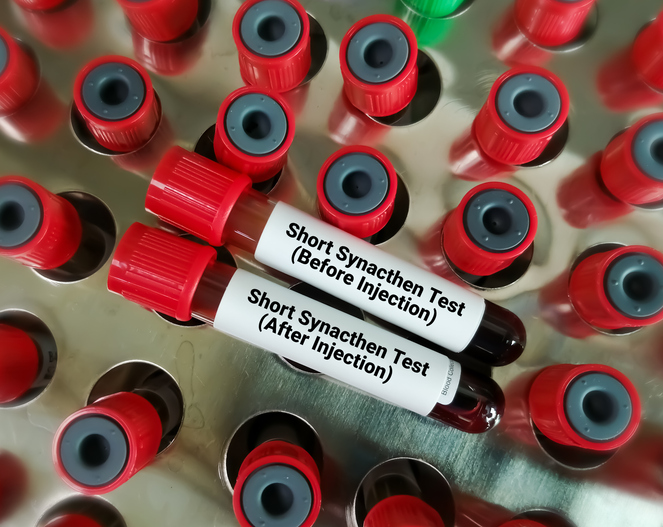
Prueba de Synacthen
Una prueba de synacthen verifica la función de las glándulas suprarrenales. Puede ayudar a ver si las glándulas suprarrenales están produciendo suficiente hormona esteroide (cortisol). Nota: la información a continuación es solo una guía general. Los arreglos y la forma en que se realizan las pruebas a menudo varían entre diferentes hospitales. Siempre siga las instrucciones dadas por su médico o hospital local.
por la Dra. Philippa Vincent, MRCGP
Lecturas adicionales y referencias
- Pruebas de Laboratorio en Línea® - Reino Unido
- Dean L; ABO Blood Group. Medical Genetics Summaries. Bethesda (MD): National Center for Biotechnology Information (US); 2012-[updated 2015 Jul 27].
Continúa leyendo abajo
Historial del artículo
La información en esta página está escrita y revisada por pares por clínicos calificados.
Next review due: 4 May 2028
20 Jun 2023 | Última versión

Pregunta, comparte, conecta.
Navega por discusiones, haz preguntas y comparte experiencias en cientos de temas de salud.

¿Te sientes mal?
Evalúa tus síntomas en línea de forma gratuita
Suscríbete al boletín de Patient
Tu dosis semanal de consejos de salud claros y confiables, escritos para ayudarte a sentirte informado, seguro y en control.
Al suscribirte aceptas nuestros Política de Privacidad. Puedes darte de baja en cualquier momento. Nunca vendemos tus datos.