Seborrhoeic dermatitis in babies
Cradle cap
Peer reviewed by Dr Colin Tidy, MRCGPLast updated by Dr Hayley Willacy, FRCGP Last updated 14 Apr 2025
Meets Patient’s editorial guidelines
- DownloadDownload
- Share
- Language
- Discussion
- Audio Version
- Add to preferred sources on Google
In this series:Seborrhoeic dermatitis
Seborrhoeic dermatitis in babies causes bad dandruff (cradle cap). It sometimes causes a rash on other areas of the skin. Treatment is not usually needed, as it does not normally cause any discomfort and usually clears on its own.
At a glance
Seborrhoeic dermatitis in babies is a skin inflammation often called cradle cap.
It typically starts between 2 and 6 weeks of age, affecting the scalp and face.
Symptoms include greasy, yellow, scaly patches on the scalp.
It is usually not itchy or painful and often clears up by itself.
Treatment is not usually needed, but daily washing may help remove scales.
See a doctor if scales become thick or inflamed.
What is seborrhoeic dermatitis (cradle cap)?
Seborrhoeic dermatitis in babies is a type of skin inflammation which mainly affects the scalp and face. Cradle cap affects many newborns, typically starting between the ages of 2 and 6 weeks. It is most common in babies under 1 year of age, though it can sometimes persist beyond the first year.
The exact cause of seborrhoeic dermatitis is not known. It is thought that babies who develop seborrhoeic dermatitis may produce more oil (sebum) from the sebaceous glands in their skin. Yeast germs from the Malassezia species may also be involved. However, seborrhoeic dermatitis is not just a simple skin infection and you cannot catch this condition from others (it is not contagious). The fungal germ lives in the sebum of human skin and some babies may react to the germ in some way which causes the skin inflammation.
Many babies have a mild form of seborrhoeic dermatitis within the first six months of life but it usually goes away on its own after a few months. In most children, cradle cap has cleared by the age of 6 months. It does not usually occur in older children. Some teenagers and adults have a related condition which causes bad dandruff and a rash. See the separate leaflet called Seborrhoeic dermatitis (Dandruff) for more details.
What are the symptoms of seborrhoeic dermatitis in babies?
Symptoms include:
Cradle cap. This is areas of greasy, yellow, scaly patches on the scalp. In some cases a thick scaly layer covers the whole scalp. Over time the scales may become flaky and rub off easily. Cradle cap is not usually itchy and, in most cases, the baby is not aware of any problem or discomfort.
Cradle cap
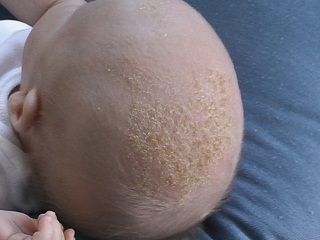
Rash. In addition to cradle cap, some affected babies develop a mild red rash. This can appear on the eyebrows, on the skin next to their nose, or in the creases of the skin such as around the neck, behind the ears or in the armpits. Sometimes it can cause a kind of nappy rash in the groin creases.
Is cradle cap painful?
Cradle cap is generally not painful or itchy, though some babies may experience mild irritation. It does not cause discomfort, but in some cases, the scales can become thicker or inflamed, requiring treatment.
What is the treatment for seborrhoeic dermatitis in babies?
Treatment for seborrhoeic dermatitis is not usually needed, as the condition is usually mild, is not serious and does not usually cause any discomfort to the baby. Seborrhoeic dermatitis will usually clear up by itself eventually.
However, the appearance of the scalp can be improved by daily washing with a baby shampoo followed by gentle brushing with a soft brush to loosen scales.
Alternatively, soften the scales with baby oil first, followed by gentle brushing and then washing off with baby shampoo.
If this does not work, it may be helpful to soften the scales by rubbing in olive oil, vegetable oil or white petroleum jelly. Leave this in overnight to allow it time to work. Wash it off with baby shampoo in the morning.
Another option is to try a greasy moisturising lotion (emollient) such as emulsifying ointment.
If other areas are affected by seborrhoeic dermatitis, regular washing helps. Use an emollient cream instead of soap on the affected skin.
If needed, a medicated antifungal cream may be prescribed by your doctor. Creams which may be used are clotrimazole, econazole or miconazole. This will usually clear the rash. Rarely, if inflammation is more severe, a mild steroid cream may be prescribed by your doctor.
How to prevent cradle cap
There is no guaranteed way to prevent cradle cap, but you can help reduce the risk by:
Gently washing your baby's scalp with mild soap or shampoo.
Avoiding harsh chemicals or products that could irritate the skin.
Using soft brushes to keep the scalp clean and free from excessive buildup.
Patient picks for Baby and toddler
Children's health
Bronchiolitis
Bronchiolitis is a viral chest infection. It affects the small airways of the lung (the bronchioles). It is a common condition in babies. Most affected babies are not seriously ill and make a full recovery. Sometimes it becomes more serious and hospital care may be needed.
by Dr Doug McKechnie, MRCGP

Children's health
Baby-led weaning
Weaning is the process of adding food other than breast milk or infant formula to your baby's diet. Advice on when exactly to do this varies.
by Dr Mary Elisabeth Lowth, FRCGP
Frequently asked questions
What is the difference between cradle cap and nappy rash caused by seborrhoeic dermatitis?
Cradle cap specifically refers to greasy, yellow, scaly patches on the scalp. However, seborrhoeic dermatitis can also manifest as a type of nappy rash in the groin creases, which is a rash in a different location but related to the same underlying condition.
If my baby has seborrhoeic dermatitis on other parts of their body, how should I care for their skin?
For areas affected by seborrhoeic dermatitis other than the scalp, regular washing is helpful. You should use an emollient cream instead of soap on the affected skin to keep it moisturised and reduce irritation.
When might a doctor prescribe a medicated cream for cradle cap or other seborrhoeic dermatitis symptoms?
A doctor may prescribe a medicated antifungal cream if the usual methods of loosening scales and washing don't clear the rash. Examples of such creams include clotrimazole, econazole, or miconazole. In rare cases, if inflammation is severe, a mild steroid cream might also be prescribed.
Further reading and references
- Nobles T, Harberger S, Krishnamurthy K; Cradle Cap.
- Seborrhoeic dermatitis; NICE CKS, November 2024 (UK access only)
- Seborrhoeic dermatitis - infants (Simple advice); NICE CKS, November 2024 (UK access only)
- Cradle cap (infantile seborrhoeic dermatitis); DermNet NZ
About the authorView full bio
Updated by

Dr Hayley Willacy, FRCGP
General Practitioner, Medical Author
MBChB (1992), DRCOG, DFFP, MRCOG (Part 1) MRCGP (2007), DFSRH (2013), MSc - medical education (2020)
Dr Hayley Willacy was an NHS GP working in northwest England, who retired from clinical practice in 2022 after 30 years.
About the reviewerView full bio

Dr Colin Tidy, MRCGP
General Practitioner, Medical Author
MBBS, MRCGP, MRCP (Paediatrics), DCH
Dr Colin Tidy is an NHS Doctor, based in Oxfordshire.
Join the conversation
Share your thoughts or experiences with others in our patient communities.

Ask, share, connect.
Browse discussions, ask questions, and share experiences across hundreds of health topics.

Feeling unwell?
Assess your symptoms online for free
Sign up to the Patient newsletter
Your weekly dose of clear, trustworthy health advice - written to help you feel informed, confident and in control.
By subscribing you accept our Privacy Policy. You can unsubscribe at any time. We never sell your data.