Psoriasis en gotas
Revisado por pares por Dr Hayley Willacy, FRCGP Última actualización por Dr Colin Tidy, MRCGPÚltima actualización 13 Oct 2022
Cumple con las directrices editoriales
- DescargarDescargar
- Compartir
- Language
- Discusión
- Versión en audio
En esta serie:La psoriasisArtritis psoriásicaPsoriasis ungueal
Guttate psoriasis is a skin condition which gives you light red, scaly patches scattered over almost your whole body. It often happens a few weeks after a throat infection with a particular germ (bacterium) called a group A beta-haemolytic streptococcus.
En este artículo:
Videos seleccionados para Otros problemas de la piel
Continúa leyendo abajo
What is guttate psoriasis?
Although it has the name 'psoriasis', guttate psoriasis is almost a completely different condition to the usual psoriasis. It is a skin condition that comes on quickly, usually a few weeks after a throat infection. Some medications can also cause it.
Guttate psoriasis causes
Volver al contenidoFor some reason a group A beta-haemolytic streptococcus infection, which can cause a really sore throat, sometimes causes a skin reaction.
It's thought to be caused by your immune system going into 'overdrive' and accidentally reacting to your own skin.
The throat infection is found in about 80% of cases.
No one can quite figure out why this happens but some people seem to be more prone to it than others. It might be to do with your genetic make-up.
In this way it's similar to the way a throat infection can lead to reumática aguda.
Can anything else cause guttate psoriasis?
Rarely some medications can cause guttate psoriasis, particularly lithium (used for mental health problems) and beta-blockers (used in heart conditions).
Continúa leyendo abajo
What does guttate psoriasis look like?
Volver al contenidoThe word 'gutta' means 'drop' in Latin so that's where the name guttate psoriasis comes from: it can look like tiny pink drops have been scattered on the person's body. They are usually slightly raised, with a thin white scale. They don't hurt, but they can be a bit itchy.
Guttate psoriasis hands
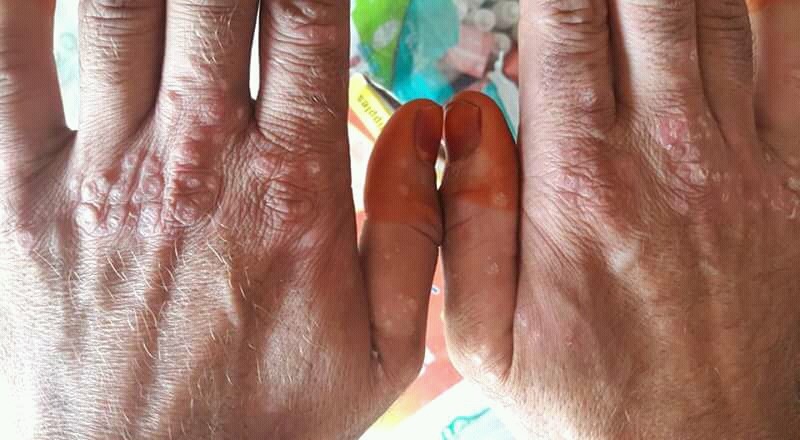
© Mohammad2018, CC BY-SA 4.0, a través de Wikimedia Commons
The above image shows guttate psoriasis on the back of someone's hands:
The spots come on pretty quickly, over just a day or two.
They usually cover the chest, tummy, upper arms and thighs.
Usually the palms of the hands and soles of the feet are not affected.
It only occasionally affects your head and face.
They are slightly raised, light pink skin marks that might have a white scale to their surface.
Does guttate psoriasis make you feel ill?
Usually the appearance of the spots is the worst thing about it.
It doesn't usually make you feel ill or feverish.
The spots are not usually painful, but they can be a tiny bit itchy (only a little bit though).
You can imagine that coming up in spots all over your body in just a few days can be pretty distressing: a lot of people are quite upset when they see their doctor.
Guttate psoriasis treatment
Volver al contenidoThe good news is, guttate psoriasis typically fades by itself within a few weeks to a few months.
It doesn't necessarily need treating unless it's really bothering the person. No particular treatment option has been shown to work better than others.
A GP may prescribe a mild steroid cream if the lesions are itchy - although in practice it is quite hard to spread cream over such a large area of the body. It is worth nourishing the skin with simple moisturisers.
Although it is related to a bacterial throat infection, giving antibiotics doesn't actually speed up the spots going away.
A dermatologist may use 'light therapy' which is where they beam UV light at you in a special box (a bit like tanning!). This is a specialised treatment that isn't available in all hospitals. It can help to clear up the guttate psoriasis a bit quicker than otherwise.
Continúa leyendo abajo
Guttate psoriasis diagnosis
Volver al contenidoThere aren't any particular tests for guttate psoriasis.
It's diagnosed by the way it looks and also by finding out if there has been a throat infection a few weeks before. Occasionally a blood test can be used to detect the streptococcus germ (bacterium): this is called an anti-streptolysin antibody assay.
A skin biopsy is not usually needed. If it isn't quite clear what the skin condition is, a specialist skin doctor (dermatologist) might use a small microscope (a dermatoscope) to look at it more closely.
Can guttate psoriasis be confused with anything else?
There are other conditions that give similar skin problems.
Pitiriasis rosada can look a bit like guttate psoriasis, but doesn't follow a throat infection.
Pityriasis lichenoides can resemble guttate psoriasis, but again doesn't follow a throat infection. And the lesions look a bit different to guttate psoriasis.
See also the separate leaflet on Skin Rashes.
Who is affected by guttate psoriasis?
Usually young people get guttate psoriasis, in their teens or twenties. Men and women are affected equally.
It seems to occur all over the world.
No one really quite knows how common it is. In general, a GP in the UK would have heard of it and probably know how to diagnose it, but they may not have seen a case themselves for many years.
What's the outlook like after having guttate psoriasis?
Volver al contenidoIn nearly two thirds of people with guttate psoriasis, the spots clear up and never come back.
Occasionally the spots turn into a more long-term type of psoriasis called plaque psoriasis. This can be treated with similar creams and light treatment.
Once it's cleared, sometimes (but not very often) a second outbreak of guttate psoriasis happens. This could happen if the streptococcus bug is lurking in your tonsils.
Thankfully the guttate psoriasis never properly scars, although sometimes it can leave tiny pale marks where it used to be: these should fade with time though.
What happens after the first outbreak?
Volver al contenidoUsually it comes and goes and then that's all there is to it. In about 80% of people the spots will fade in three weeks to three months and never come back. But in some people it carries on to be long-term plaque psoriasis. Sometimes you can get a second outbreak, particularly if the streptococcus germ (bacterium) is still in your throat or tonsils.
Selecciones del paciente para Otros problemas de la piel

Salud de la piel, uñas y cabello
Hidradenitis supurativa
La hidradenitis supurativa es una afección cutánea crónica que provoca bultos dolorosos y recurrentes de pus (forúnculos o abscesos). La causa exacta se desconoce. La supuración significa formación o descarga de pus. Estas áreas (comúnmente las axilas y la ingle) filtran pus y son difíciles de curar. Finalmente, se produce cicatrización. Los tratamientos incluyen lociones o medicamentos con antibióticos, o una operación para eliminar la zona afectada de la piel. Un tratamiento más reciente funciona bloqueando una sustancia química del sistema inmunológico que causa inflamación en el cuerpo.
por el Dr. Colin Tidy, MRCGP

Salud de la piel, uñas y cabello
Queloide
Un queloide (también llamado cicatriz queloide) es un crecimiento excesivo de una cicatriz, después de que la piel ha sido dañada. Es un tipo anormal de cicatrización de heridas. Es particularmente común en personas con piel oscura o que tienen familiares que han desarrollado cicatrices queloides.
por la Dra. Caroline Wiggins, MRCGP
Lecturas adicionales y referencias
- Maruani A, Samimi M, Stembridge N, et al; Non-antistreptococcal interventions for acute guttate psoriasis or an acute guttate flare of chronic psoriasis. Cochrane Database Syst Rev. 2019 Apr 8;4:CD011541. doi: 10.1002/14651858.CD011541.pub2.
- Psoriasis en gotas; DermNet
- Guttate Psoriasis; Sociedad de Dermatología de Atención Primaria.
- La psoriasis; NICE CKS, septiembre 2022 (acceso solo en el Reino Unido)
Continúa leyendo abajo
Historial del artículo
La información en esta página está escrita y revisada por pares por clínicos calificados.
Next review due: 12 Oct 2027
13 Oct 2022 | Última versión
8 Jul 2017 | Publicado originalmente
Escrito por:
Dr Oliver Starr, MRCGP

Pregunta, comparte, conecta.
Navega por discusiones, haz preguntas y comparte experiencias en cientos de temas de salud.

¿Te sientes mal?
Evalúa tus síntomas en línea de forma gratuita
Suscríbete al boletín de Patient
Tu dosis semanal de consejos de salud claros y confiables, escritos para ayudarte a sentirte informado, seguro y en control.
Al suscribirte aceptas nuestros Política de Privacidad. Puedes darte de baja en cualquier momento. Nunca vendemos tus datos.