Queloide
Revisado por Dr Rosalyn Adleman, MRCGPÚltima actualización por Dr Caroline Wiggins, MRCGP Última actualización 1 Jul 2025
Cumple con las directrices editoriales
- DescargarDescargar
- Compartir
- Language
- Discusión
- Versión en audio
- Agregar a fuentes preferidas en Google
Un queloide (también llamado cicatriz queloide) es un crecimiento excesivo de una cicatriz, después de que la piel ha sido dañada. Es un tipo anormal de cicatrización de heridas. Es particularmente común en personas con piel oscura o que tienen familiares que han desarrollado cicatrices queloides.
De un vistazo
Un queloide es un crecimiento excesivo de tejido cicatricial que se extiende más allá de la herida original.
Por lo general, son lisos, elevados, firmes y pueden causar picazón o dolor.
Las cicatrices queloides son más comunes en personas con piel negra o marrón, entre 10 y 30 años de edad.
A menudo aparecen en la parte superior del cuerpo, especialmente después de perforaciones en las orejas, varicela o acné.
La extirpación quirúrgica de queloides rara vez tiene éxito y puede llevar a una cicatriz más grande.
Las opciones de tratamiento incluyen inyecciones de esteroides, crioterapia, láser y radiación.
Para prevenir los queloides, evita lesiones innecesarias en la piel como perforaciones o tatuajes si eres propenso a ellos.
¿Qué es una cicatriz queloide?
A keloid scar is an overgrowth of the scar tissue that develops after a wound has healed. It expands beyond the original scar. Rather than stay in a straight line, for example, after a surgical incision, it can spread outwards and also upwards, giving a raised scar.
Who gets keloid scars?
Keloid scars are more common in people with black or brown skin, or white skin that tans after sunburn. Most people who develop a keloid are between 10-30 years old. Half of people with keloids will have members of their family who have also developed keloids.
What causes keloid scars?
We don't yet have a definite answer to explain why some people go on to develop keloid scars after an injury. But we have a pretty good idea of how it happens.
Keloid scars are an overgrowth of scar tissue after a skin injury. The keloid becomes larger than the original wound. When a keloid scar is formed, we know that the process of normal scar tissue being created and gradually fading away, to reveal new, healed skin, is changed. There are many ideas being researched about why this may happen, but at the moment we don't know exactly why.
How does a keloid scar form?
Keloid scars typically starts to develop about three months after the original skin injury though it can occur years later. The first thing you will probably notice is that rubbery scar tissue starts growing beyond the borders of the original injury. The growth is usually slow and once they stop growing they usually stay the same size or they can get a bit smaller.
Typical areas keloid scars develop
Keloid scars occur most often on areas of the body where the skin is stretched, rather than where skin feels looser. They are more common on the upper body, for example:
On the ears, after ear piercing.
On the chest or back after chickenpox, acne, or an injury.
On the upper arms or shoulder.
If a keloid scar is over a joint, such as your elbow, it can restrict your ability to move that joint.
What do keloid scars feel like?
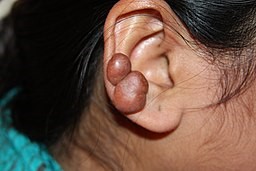
They are usually smooth, slightly shiny, raised, firm skin growths which extend beyond the original skin injury.
They can feel itchy, prickly or sore.
Many people do not notice any itching or pain.
What do keloid scars look like?
The image below shows a woman's ear affected by keloid scarring:
Keloid scarring on ear
How does a doctor diagnose a keloid scar?
There is no particular test for a keloid scar. It is diagnosed by a healthcare professional who will listen to what has happened, ask questions and examine the scar. They may want to look at scars you have elsewhere on your body to compare if this one is different to other ones you have.
Occasionally a keloid scar can mimic other skin tumours.
In that case, a biopsy will need to be taken by a specialist. A biopsia is a procedure where a sample of tissue is taken for further analysis.
The biopsy will be looked at under a microscope and a specialist (histopathologist) will be able to see the typical microscopic features of a keloid scar.
Nota: a biopsy is hardly ever necessary because the history - that is, the patient's story - and the appearance of the skin growth allow the healthcare professional to diagnose a keloid without this test.
How to treat keloid scars
Many patients ask for their keloid scar to be 'cut out' (surgically excised). This is hardly ever successful and in fact can result in an even bigger keloid scar coming back. If surgical excision is tried it must be done by a specialist doctor such as a dermatologist or plastic surgeon and will usually be done in combination with another treatment.
Keloid scars can be difficult to treat and treatments can have side effects. It is important to be clear what you would like to achieve with treatment. Some people they want the itch or pain to improve, others want it to look more like the skin around the keloid. The medical team can then consider what treatment options are most likely to achieve what is important to you.
How to reduce keloid scars without surgery
One of the most common methods is injecting steroid (triamcinolone acetonide) and local anaesthetic into the keloid scar itself. The injections are done with a tiny needle, but can be a bit sore. This is called 'intralesional corticosteroid injection treatment':
The steroids and anaesthetic can help to stop the proliferation of the skin cells in the keloid scar.
The injections are usually given once a month for 4-6 months.
Side-effects of the steroids include the skin becoming thin, easily damaged, changing colour to become darker (hyperpigmentation) or lighter (hypopigmentation) than the surrounding skin, or being able to see many tiny blood vessels in the thinned skin.
New research suggests that combining the steroid injections with another form of treatment may reduce the possible side effects from the steroids and still improve the keloid. Many of these options are very new and the research is in small numbers of people and can give conflicting results. Further research is recommended before they are offered as standard treatments.
Other injection options may now include 5-FU, bleomycin, verapamil, hyaluronic acid and hyaluronidase, botulinum toxin, and collagenase.
Other treatment options include cryotherapy (using freezing temperatures), láser, radiofrequency ablation, radiation, and shock-wave therapy.
Sometimes steroids can be applied to the skin as an ointment under a dressing, or in a tape impregnated with steroids. can dampen down a keloid scar. Silicone dressings and compression dressings are also areas of research which have suggested they may help.
How to prevent keloid scars
If you have a keloid scar then it is more likely future skin injuries will develop into a keloid scar. The best way to stop more keloids developing is to prevent unnecessary skin injuries.
People who are prone to keloid scars are advised to avoid body piercings, tattoos and ideally any surgery unless essential. Steer clear too of unnecessary procedures such as cosmetic surgery, especially in those areas of the body that are prone to keloids.
If you get acne, seek effective treatment at an early stage so the spots do not scar. If you are identified as being at risk of keloid and need an operation, your surgeon may offer you dressings, steroid injections or other treatments to reduce the risk of keloid developing.
Selecciones del paciente para Otras condiciones de la piel
Salud de la piel, uñas y cabello
La psoriasis
La psoriasis es una condición crónica de la piel que también puede afectar las uñas y las articulaciones. Tiende a empeorar ocasionalmente. El tratamiento con varias cremas o ungüentos puede a menudo eliminar o reducir las manchas (placas) de psoriasis. La terapia con luz especial y/o medicamentos potentes son opciones de tratamiento para casos severos en los que las cremas y ungüentos no han funcionado muy bien. Las personas con psoriasis tienen más probabilidades de desarrollar enfermedades cardiovasculares (enfermedad cardíaca y accidentes cerebrovasculares).
por el Dr. Doug McKechnie, MRCGP

Salud de la piel, uñas y cabello
Úlceras por presión
Una úlcera por presión también se conoce como 'llaga de cama' o 'úlcera por presión'. Es una llaga o área ulcerada de la piel causada por irritación y presión continua en una parte de tu cuerpo. Las úlceras por presión son más comunes en lugares donde los huesos están cerca de la piel (prominencias óseas) como los talones, la parte baja de la espalda y las nalgas. Hay varios factores que pueden aumentar el riesgo de desarrollar una úlcera por presión. En particular, el riesgo aumenta si tu movilidad está reducida por alguna razón y pasas largos períodos acostado en la cama o sentado en una silla. Existen varias medidas que puedes tomar para prevenir el desarrollo de la mayoría de las úlceras por presión. Estas incluyen cambiar de posición tanto como sea posible y también usar dispositivos que alivien la presión.
por la Dra. Hayley Willacy, FRCGP
Preguntas frecuentes
¿Pueden las cicatrices queloides dejar de crecer naturalmente?
Sí, las cicatrices queloides generalmente comienzan a crecer aproximadamente tres meses después de la lesión original en la piel. Sin embargo, su crecimiento suele ser lento, y una vez que dejan de crecer, a menudo permanecen del mismo tamaño o incluso pueden disminuir ligeramente.
¿Es posible que las cicatrices queloides aparezcan años después de una lesión?
Mientras que las cicatrices queloides típicamente comienzan a desarrollarse alrededor de tres meses después de una lesión en la piel, es posible que aparezcan mucho más tarde, incluso años después de que la herida inicial haya sanado.
¿Cuál es la probabilidad de que una cicatriz queloide reaparezca después de un tratamiento no quirúrgico?
El artículo menciona que la extirpación quirúrgica rara vez tiene éxito y puede resultar en una cicatriz queloide aún más grande. Para tratamientos no quirúrgicos como las inyecciones de esteroides, aunque pueden ayudar a detener la proliferación de células de la piel, el artículo no detalla específicamente la tasa de recurrencia después de estas diversas intervenciones no quirúrgicas.
¿Pueden ciertas actividades empeorar o irritar una cicatriz queloide existente?
Las cicatrices queloides pueden sentirse con picazón, punzantes o dolorosas. Aunque el artículo no enumera explícitamente actividades que las empeoren, cualquier acción que pueda causar fricción o presión sobre la cicatriz podría aumentar potencialmente estas sensaciones. También se señala que si un queloide está sobre una articulación, puede restringir el movimiento.
¿Existen nuevos tratamientos prometedores para las cicatrices queloides que se estén investigando actualmente?
Sí, nuevas investigaciones sugieren que combinar inyecciones de esteroides con otras formas de tratamiento podría reducir los efectos secundarios de los esteroides y mejorar los queloides. Sin embargo, muchas de estas opciones son muy nuevas y se recomienda realizar más investigaciones antes de que se conviertan en tratamientos estándar. Otras opciones emergentes de inyección incluyen 5-FU, bleomicina, verapamilo, ácido hialurónico, hialuronidasa, toxina botulínica y colagenasa.
Lecturas adicionales y referencias
- Davidson S, Aziz N, Rashid RM, et al; Una perspectiva de atención primaria sobre los queloides. Medscape J Med. 2009;11(1):18. Epub 2009 Jan 20.
- Limmer EE, Glass DA 2nd; A Review of Current Keloid Management: Mainstay Monotherapies and Emerging Approaches. Dermatol Ther (Heidelb). 2020 Oct;10(5):931-948. doi: 10.1007/s13555-020-00427-2. Epub 2020 Jul 23.
- Thornton NJ, Garcia BA, Hoyer P, et al; Keloid Scars: An Updated Review of Combination Therapies. Cureus. 2021 Jan 30;13(1):e12999. doi: 10.7759/cureus.12999.
- Keloid and hypertrophic scar; DermNet.
- Ekstein SF, Wyles SP, Moran SL, et al; Keloids: a review of therapeutic management. Int J Dermatol. 2021 Jun;60(6):661-671. doi: 10.1111/ijd.15159. Epub 2020 Sep 9.
Sobre el autorVer biografía completa
Actualizado por

Dr Caroline Wiggins, MRCGP
Médico General, Autor Médico
MBBS Honores (con Distinción), MRCGP (2016), MSc.SEM (con Distinción), BSc (Hons)
La Dra. Caroline Wiggins es una médica de cabecera suplente actualmente en el suroeste de Inglaterra.
Escrito por

Dr Laurence Knott
Médico General, Autor Médico
Licenciatura (Hons) en Bioquímica, MBBS
El Dr. Laurence Knott se graduó en 1973 y tiene una amplia experiencia como Médico General.
Acerca del revisorVer biografía completa

Dr Rosalyn Adleman, MRCGP
MRCGP
La Dra. Rosalyn Adleman es una médica de cabecera del NHS que trabaja en el norte de Londres.
Historial del artículo
Artículo también disponible en Inglés, Alemán, Español, Francés, Italiano, Portugués, Hindi, Hebreo, Árabe, y Sueco.
Próxima revisión: 30 de junio de 2028
1 Jul 2025 | Última versión
25 May 2011 | Publicado originalmente
Escrito por:
Dr Laurence Knott
Únete a la conversación
Comparte tus pensamientos o experiencias con otros en nuestro comunidades de pacientes.

Pregunta, comparte, conecta.
Navega por discusiones, haz preguntas y comparte experiencias en cientos de temas de salud.

¿Te sientes mal?
Evalúa tus síntomas en línea de forma gratuita
Suscríbete al boletín de Patient
Tu dosis semanal de consejos de salud claros y confiables, escritos para ayudarte a sentirte informado, seguro y en control.
Al suscribirte aceptas nuestros Política de Privacidad. Puedes darte de baja en cualquier momento. Nunca vendemos tus datos.