Tiña versicolor
Tinea versicolor
Revisado por pares por Dr Philippa Vincent, MRCGPÚltima actualización por Dr Toni Hazell, FRCGPÚltima actualización 10 Dic 2024
Cumple con las directrices editoriales
- DescargarDescargar
- Compartir
- Language
- Discusión
- Versión en audio
- Agregar a fuentes preferidas en Google
El pitiriasis versicolor es una infección fúngica de la piel causada por un germen similar a un hongo que provoca la aparición de una erupción. No es dañina ni se transmite por contacto (contagiosa). El tratamiento puede eliminar la erupción. Algunas personas propensas a esta condición necesitan tratamiento regular para evitar que la erupción vuelva a aparecer (recurrencia).
De un vistazo
Pityriasis versicolor is a common fungal skin condition, also known as tinea versicolor.
It causes pale or darker patches on the skin, often on the back, chest, or neck.
These patches may become scaly and are more noticeable on tanned skin.
The condition is not serious or contagious.
Treatments include special shampoos or antifungal creams.
It may take weeks or months for skin colour to return to normal after treatment.
The rash can recur, and preventative treatments are available.
What is pityriasis versicolor?
Small numbers of the malassezia germs that causes pityriasis versicolor commonly live on the skin and do no harm. However, some people are prone to this germ multiplying and spreading on their skin more than usual, which then leads to a rash developing. Often the germ multiplies and causes the rash for no apparent reason. In some cases, hot, sunny or humid weather seems to trigger the germ to multiply on the skin. In people who sweat more it may be more likely to occur.
Pityriasis versicolor is a common fungal condition. It is more common in young adults - people in their teens and 20s. It is sometimes called tinea versicolor.
Pityriasis versicolor symptoms
The rash
Pityriasis versicolor close-up
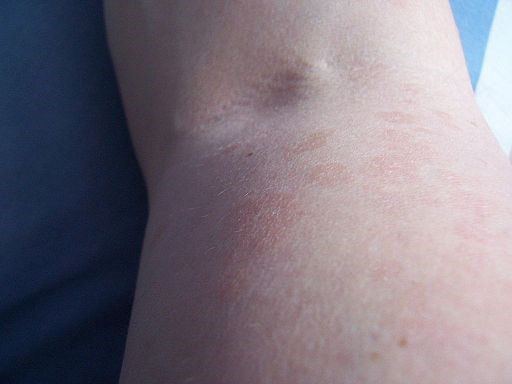
© Richardkiwi at nl.wikipedia (Own work), Public domain, via Wikimedia Commons
This usually starts as small pale patches. Sometimes the rash is darker than the skin in fair-skinned people, and in this case it looks like brown marks. In those with darker skin, it will be lighter than the usual colour of the skin. At first these usually appear on your back, chest, neck or upper arms.
The rash sometimes spreads to your tummy (abdomen) and thighs. Occasionally it may affect your face. More patches may appear and patches next to each other may join together. The affected skin may become slightly scaly.
Pityriasis versicolor on the forehead
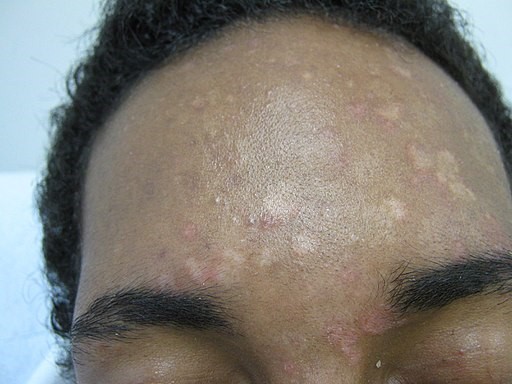
© Grook Da Oger (Own work) CC BY-SA 3.0, via Wikimedia Commons
The rash is usually pale and is barely noticeable if you are fair-skinned. You may not notice it until after you sunbathe. Affected areas do not tan and therefore the rash becomes more obvious on tanned skin. The pale patches are more obvious if you have dark skin.
There are usually no other symptoms. Sometimes it is slightly itchy.
Is pityriasis versicolor serious?
No. If you wanted an even suntan then this rash is a nuisance, as pale patches on tanned skin may look unsightly. It does not lead to any other skin conditions, or cause damage to the surrounding skin.
Is pityriasis versicolor contagious?
No - it is not possible to catch this condition from another person. The type of yeast that causes the rash is commonly found on the skin and usually does no harm. For reasons that are not clear, it seems that the germ grows out of control more easily with certain people, and causes a rash.
Pityriasis versicolor treatment
The type of treatment varies between cases and may depend on the location of the rash and also if you have had this condition before. It may take weeks or months for the rash to fully go after you treat it. The following are treatment options:
Ketoconazole shampoo (Nizoral®)
Ketoconazole shampoo (Nizoral®): is commonly advised. You can buy this at pharmacies and it is also available on prescription. Ketoconazole kills the germ that causes this rash. Apply the shampoo directly to affected areas and then wash off after three to five minutes. Repeat every day for five days.
Selenium sulfide shampoo
This is an alternative treatment. It is not strictly licensed for the treatment of this rash; however, it works. You can buy it from pharmacies or it is also available on prescription. Apply the shampoo to the affected areas and leave to dry for ten minutes and then rinse off. This should be repeated daily for a week. Diluting it (half water and half shampoo) may prevent it irritating your skin. This should not be used if you are pregnant. Selenium sulfide shampoo has been unavailable in the UK for some years.
Cremas antifúngicas
These may be used if only a very small area of skin is affected. Clotrimazole (Canesten®) cream is one example. It should be applied twice a day for two or three weeks.
Tabletas antifúngicas
Tabletas antifúngicas may very occasionally be prescribed if the rash is over a large area of your skin, or is not cleared by the above treatments. The ones used are usually itraconazol o fluconazol.
Antifungal treatment may need to be repeated if this rash comes back (recurs) and becomes scaly again.
If you are prone to develop recurrent episodes in the sun then it may be advisable to use ketoconazole shampoo once a day for three days prior to going on holiday to the sun. This will help to prevent recurrence when you are away.
Nota: after treatment, skin colour usually takes 2-3 months to return to normal. It sometimes takes even longer. As long as the rash is not scaly, this does not mean the treatment has not worked.
How to prevent pityriasis versicolor
Some people seem prone to this yeast-like germ multiplying on their skin and the rash may come back (recur) after treatment. One option is to apply one of the above shampoos to your skin every 2-4 weeks. This may keep the germ away, or prevent the numbers building up, which will prevent the rash from recurring. Alternatively, if you have frequent recurrences then you may be advised to take antifungal tablets for one day each month as a preventative measure.
Selecciones del paciente para Infecciones de la piel

Infecciones
Virus de la viruela del mono
La mpox, anteriormente conocida como viruela del mono, es una infección viral causada por el virus de la mpox (viruela del mono). Es muy similar al virus de la viruela, pero causa menos muertes. Se pensaba anteriormente que no era muy contagiosa, pero parece estar propagándose más fácilmente en los últimos años. Existe una vacuna efectiva que funciona contra la viruela y que también es efectiva contra la mpox.
por la Dra. Philippa Vincent, MRCGP

Infecciones
Enfermedad por arañazo de gato
La enfermedad de la scratch de gato es una infección bacteriana causada por arañazos o mordeduras de gato. Provoca ganglios linfáticos inflamados y otros síntomas como fiebre. Por lo general, desaparece sin tratamiento, pero a menudo se usan antibióticos para acelerar la recuperación de la infección.
por el Dr. Doug McKechnie, MRCGP
Preguntas frecuentes
Can pityriasis versicolor go away on its own?
The article suggests that treatment is typically needed to clear the rash. While it doesn't explicitly state whether it can disappear spontaneously, the focus on various treatment options and recurrence prevention implies it generally requires intervention. The return of skin colour to normal after treatment can take 2-3 months, sometimes longer.
Does pityriasis versicolor cause any damage to the skin?
No, pityriasis versicolor does not lead to any other skin conditions or cause damage to the surrounding skin. It is considered a nuisance, particularly due to the appearance of pale patches on tanned skin, but it is not serious.
How long does it take for skin colour to return to normal after pityriasis versicolor treatment?
After successful treatment, it usually takes 2-3 months for the skin colour to return to normal. In some cases, it can take even longer. If the rash is no longer scaly, it indicates that the treatment has worked, even if the colour hasn't fully normalised yet.
Is it possible for pityriasis versicolor to come back after treatment?
Yes, pityriasis versicolor can reoccur after treatment. Some individuals are prone to the germ multiplying again on their skin. The article suggests preventative measures like applying shampoo every 2-4 weeks or, for frequent recurrences, taking antifungal tablets once a month.
What can I do to prevent pityriasis versicolor from coming back?
To prevent pityriasis versicolor from recurring, you can apply one of the prescribed shampoos to your skin every 2-4 weeks. This helps to keep the germ from multiplying. If you experience frequent recurrences, your doctor might recommend taking antifungal tablets once a month as a preventative measure. For those who get it when holidaying in the sun, it's advised to use ketoconazole shampoo once a day for three days before going away.
Lecturas adicionales y referencias
- Pityriasis Versicolor; DermIS (Sistema de Información de Dermatología)
- Tiña versicolor; DermNet NZ
- Tiña versicolor; NICE CKS, octubre 2023 (solo acceso en el Reino Unido)
- Gupta AK, Foley KA; Antifungal Treatment for Pityriasis Versicolor. J Fungi (Basel). 2015 Mar 12;1(1):13-29. doi: 10.3390/jof1010013.
Sobre el autorVer biografía completa

Dr Toni Hazell, FRCGP
MBBS, BSc, FRCGP, DFSRH, Dip GU med, DRCOG, DCH (London, UK, 2000)
La Dra. Toni Hazell se graduó de la Escuela de Medicina del Hospital St. Mary y realizó su VTS en el Hospital Northwick Park.
Acerca del revisorVer biografía completa

Dra. Philippa Vincent, MRCGP
Médico General, Autor Médico
MB BS, Bsc, MRCGP (2000), DCH, DFSRH, DRCOG
Dra Philippa Vincent es un médico de cabecera del NHS que trabaja en el norte de Londres.
Historial del artículo
La información en esta página está escrita y revisada por pares por clínicos calificados.
Artículo también disponible en Inglés, Alemán, Español, Francés, Italiano, Portugués, Hindi, Hebreo, Árabe, y Sueco.
Next review due: 9 Dec 2024
10 Dic 2024 | Última versión

Pregunta, comparte, conecta.
Navega por discusiones, haz preguntas y comparte experiencias en cientos de temas de salud.

¿Te sientes mal?
Evalúa tus síntomas en línea de forma gratuita
Suscríbete al boletín de Patient
Tu dosis semanal de consejos de salud claros y confiables, escritos para ayudarte a sentirte informado, seguro y en control.
Al suscribirte aceptas nuestros Política de Privacidad. Puedes darte de baja en cualquier momento. Nunca vendemos tus datos.
Más en infecciones
- Absceso
- Antibióticos
- Neumonía por aspiración
- Resfriado común
- Infecciones por hongos
- Gérmenes
- Hepatitis C
- VIH y SIDA
- Inmunización contra la gripe
- Enfermedad del legionario
- COVID prolongado
- Vacuna meningocócica para la meningitis
- MRSA
- Mycoplasma genitalium
- Osteomielitis
- Neuralgia posherpética
- Tiña
- Síndrome de la mejilla abofeteada
- Candidiasis en hombres