What is creatine? Benefits, uses and risks
Revisado por pares por Dr Colin Tidy, MRCGPEscrito por Josh AldermanPublicado originalmente 12 Mar 2026
Cumple con las directrices editoriales
- DescargarDescargar
- Compartir
- Language
- Discusión
- Versión en audio
Creatine is one of the most popular sports supplements in the UK. Often associated with gym training and muscle building, creatine is widely used to support strength and performance. But it isn’t just for athletes - it’s a naturally occurring substance found in your body and in certain foods.
So, what does creatine do, what are the potential creatine benefits, and are there any downsides to consider?
En este artículo:
Videos seleccionados para Vitaminas y suplementos
Continúa leyendo abajo
What is creatine?
Creatine is a natural compound made in your liver, kidneys and pancreas from amino acids. Around 95% of it is stored in your muscles, with small amounts found in your brain.1
You also get creatine from foods such as red meat and fish. However, the amount from diet alone is much lower than the amount typically provided by supplements.
Creatine supplements are usually sold as powders, capsules, or tablets. The most widely studied and commonly used form is creatine monohydrate.2
How does creatine work?
Volver al contenidoCreatine plays an important role in energy production. It helps your body make adenosine triphosphate (ATP), which is the main energy source your cells use, especially during short bursts of intense activity.
Taking creatine increases the amount stored in your muscles.
This may help your muscles:
Produce energy more quickly.
Sustain high-intensity activity for slightly longer.
Recover more effectively between sets.
So when it comes to short, high-powered efforts such as weightlifting, sprinting, or HIIT, creatine can make a real impact-but it doesn’t offer the same benefit for longer, steady-state endurance exercise.
Continúa leyendo abajo
What are the benefits of creatine?
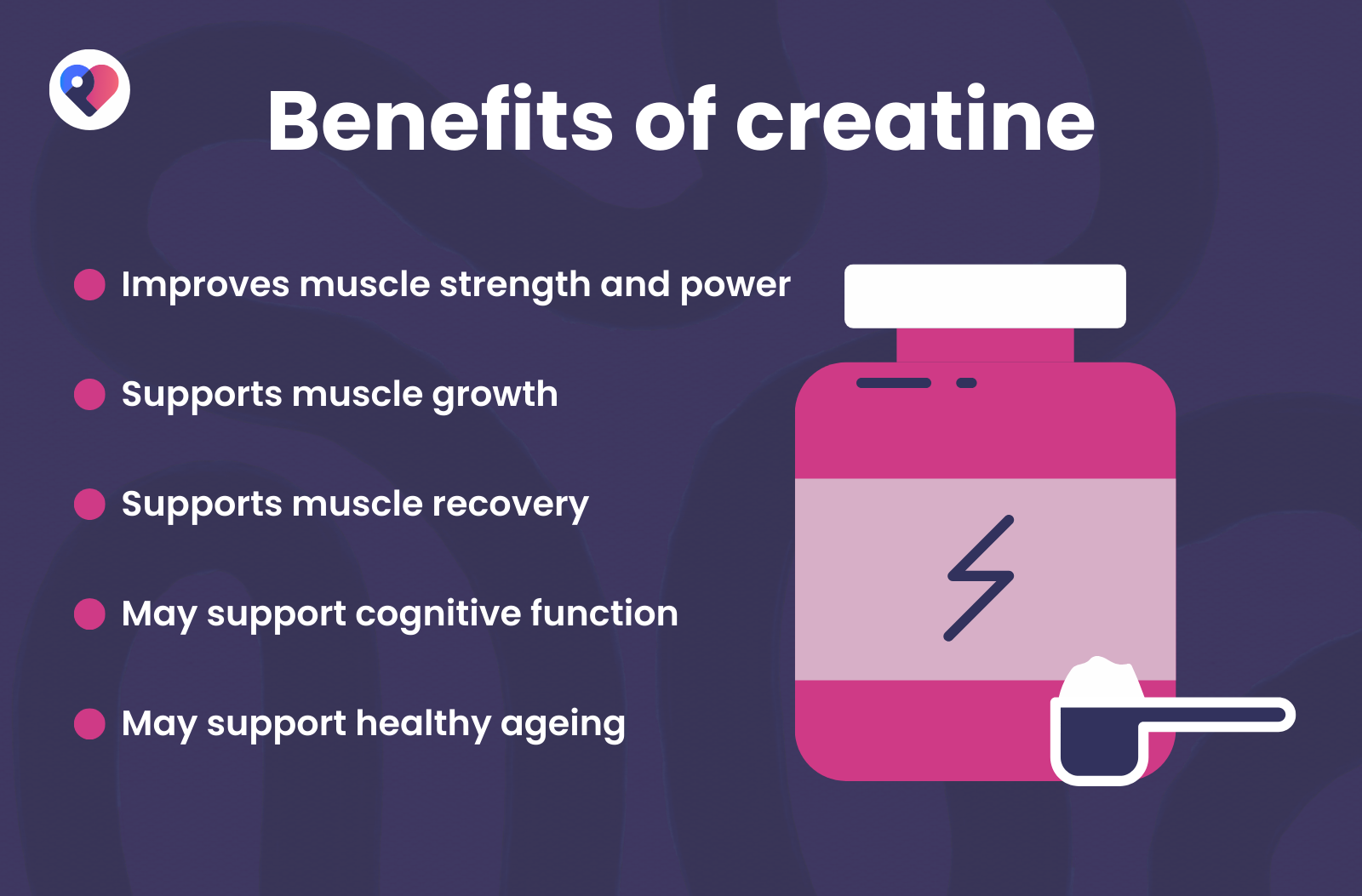
Volver al contenidoIf you're thinking about adding creatine to your routine, here are five reasons it might be worth it.
© Paciente / Heather Ainsworth
1. Improves muscle strength and power
Creatine may increase muscle strength and power output.3Many people find they can lift slightly heavier weights or perform more repetitions.
2. Supports muscle growth
Creatine can contribute to increased muscle size.4 This is partly due to greater training capacity and partly because creatine draws water into muscle cells.
A small increase in body weight is common in the first few weeks. This is usually water stored in muscle, not fat.
3. Supports muscle recovery
Some evidence suggests creatine may help support muscle recovery after intense exercise,5 allowing more consistent training.
4. May support cognitive function
Because creatine is also present in the brain, researchers are studying whether it may support memory or mental performance in certain situations as well as possibly aid in combating conditions such as demencia.5 More research is needed before firm conclusions can be made.
5. May support some medical conditions
Creatine has also been studied in a range of medical conditions that affect muscle strength and energy production. These include inherited muscle disorders such as distrofia muscular and other myopathies,6 as well as mitochondrial disorders,8 where the body’s ability to produce energy is impaired.
Researchers have also explored its potential role in neurological conditions such as Parkinson’s disease7y esclerosis múltiple,8 y en age-related muscle loss (sarcopenia). 9
While some small studies suggest creatine may improve muscle strength or reduce fatigue in certain groups, results have been mixed and benefits are not consistent.
Is creatine safe?
Volver al contenidoFor healthy adults taking recommended doses, creatine is generally considered safe. It is one of the most researched supplements available.
Side effects of creatine
Possible side effects include:
Temporary weight gain.
Bloating.
Mild stomach discomfort.
These effects are more likely with higher doses. Drinking enough fluids may help reduce digestive symptoms.
There is no strong evidence that creatine causes kidney damage in healthy people using standard doses.
Should you speak to a doctor before taking creatine?
Creatine may not be suitable for everyone.
Seek medical advice if you:
Have kidney or liver disease.
Are pregnant or breastfeeding.
Are under 18.
Have a long-term medical condition.
Take regular medicine.
As with all supplements, product quality can vary. Choosing reputable brands is advisable.
Continúa leyendo abajo
Resumen
Volver al contenidoCreatine is a naturally occurring compound that helps your muscles produce energy during short bursts of high-intensity activity. When taken as a supplement, it may improve strength, power, and muscle mass - particularly when combined with structured training.
The main creatine benefits relate to improved exercise performance and increased muscle size. For most healthy adults taking recommended doses, creatine is considered safe, with mild side effects such as temporary weight gain or bloating.
However, creatine isn’t suitable for everyone. If you have kidney disease, are pregnant, or manage a long-term health condition, it’s important to seek medical advice before starting supplementation.
Creatine can be a useful addition to a well-balanced training plan - but it’s not a replacement for regular exercise and a healthy diet.
Frequently asked questions
Volver al contenidoIs creatine safe to take every day?
Yes, for most healthy adults, taking 3-5 grams of creatine daily is considered safe. Consistency is more important than cycling on and off.
Does creatine cause hair loss?
There is limited evidence linking creatine to hair loss. A small study suggested it may increase levels of a hormone linked to male pattern baldness, but this has not been confirmed in larger research. There is no clear evidence that creatine directly causes hair loss.10
Does creatine damage your kidneys?
In healthy people using recommended doses, creatine has not been shown to damage kidney function. However, people with existing kidney disease should avoid it unless advised by a doctor.
Do you need a loading phase?
A loading phase (around 20 grams daily for 5-7 days) can increase muscle creatine stores more quickly. However, it is not essential. Taking 3-5 grams daily will achieve similar levels over several weeks.
Can you take creatine without exercising?
Creatine may still increase muscle stores without exercise, but most creatine benefits are seen when combined with resistance training.
Selecciones del paciente para Vitaminas y suplementos

Dieta y nutrición
¿Cuáles son los beneficios de la vitamina E?
La vitamina E es un ingrediente muy apreciado en cualquier rutina de cuidado de la piel. Pero también es vital para tu salud y el funcionamiento de tu cuerpo. Descubre por qué y cómo obtener suficiente vitamina E aquí.
por Victoria Raw

Salud de los mayores
Los mejores suplementos antienvejecimiento para tu salud
El término antienvejecimiento está escrito en muchos envases de cremas de belleza y otros productos para el cuidado de la piel. Pero, ¿qué significa antienvejecimiento dentro del cuerpo? Aquí, va más allá de la apariencia de las líneas de nuestro rostro, hacia un envejecimiento interno saludable. Esto significa cuán bien nuestras células y órganos se mantienen saludables y son capaces de combatir el deterioro y las enfermedades a medida que envejecemos, para que podamos vivir felices el mayor tiempo posible. Exploramos los suplementos antienvejecimiento que ayudan a nuestros cuerpos a lograr esto, según los expertos.
por Lawrence Higgins
Lecturas adicionales y referencias
- Felipe Ribeiro et al. "Creatine supplementation and muscle-brain axis: a new possible mechanism?." Frontiers in Nutrition, 12 (2025).
- R. Kreider et al. "Bioavailability, Efficacy, Safety, and Regulatory Status of Creatine and Related Compounds: A Critical Review."
- Camic CL, Hendrix CR, Housh TJ, et al; The effects of polyethylene glycosylated creatine supplementation on muscular strength and power. J Strength Cond Res. 2010 Dec;24(12):3343-51. doi: 10.1519/JSC.0b013e3181fc5c5c.
- Drzewiecki, Artur, et al. “The Effect of Creatine on Muscle Mass Gain: A Literature Review”. Quality in Sport,
- Xu, Chen, et al. “The Effects of Creatine Supplementation on Cognitive Function in Adults: A Systematic Review and Meta-Analysis.”
- Kley, Rudolf A, et al. “Creatine for Treating Muscle Disorders.” Cochrane Database of Systematic Reviews
- Yea-Hyun Leem, et al. “Creatine Supplementation with Exercise Reduces α-Synuclein Oligomerization and Necroptosis in Parkinson’s Disease Mouse Model.” The Journal of Nutritional Biochemistry, vol. 126
- Ostojic, Sergej M. “Creatine and Multiple Sclerosis.” Nutritional Neuroscience
- Dolan, Eimear, et al. “Muscular Atrophy and Sarcopenia in the Elderly: Is There a Role for Creatine Supplementation?”
- Lak, Mohammadyasin, et al. “Does Creatine Cause Hair Loss? A 12-Week Randomized Controlled Trial.” Journal of the International Society of Sports Nutrition, vol. 22
Continúa leyendo abajo
Historial del artículo
La información en esta página es revisada por pares por clínicos calificados.
Next review due: 12 Mar 2029
12 Mar 2026 | Publicado originalmente
Escrito por:
Josh AldermanRevisado por pares por
Dr Colin Tidy, MRCGP

Pregunta, comparte, conecta.
Navega por discusiones, haz preguntas y comparte experiencias en cientos de temas de salud.

¿Te sientes mal?
Evalúa tus síntomas en línea de forma gratuita
Suscríbete al boletín de Patient
Tu dosis semanal de consejos de salud claros y confiables, escritos para ayudarte a sentirte informado, seguro y en control.
Al suscribirte aceptas nuestros Política de Privacidad. Puedes darte de baja en cualquier momento. Nunca vendemos tus datos.