Sickle cell trait
Peer reviewed by Dr Adrian Bonsall, MBBSLast updated by Dr Sarah JarvisLast updated 2 May 2018
Meets Patient’s editorial guidelines
- DownloadDownload
- Share
- Language
- Discussion
- Audio Version
- Add to preferred sources on Google
In this series:Sickle cell disease
This page has been archived.
It has not been reviewed recently and is not up to date. External links and references may no longer work.
If you inherit a gene from one of your parents, called a sickle cell gene, you have a condition called sickle cell trait. If you inherit a sickle cell gene from both parents, you get a double dose of the sickle cell gene. This causes a condition called sickle cell disease (SCD).
At a glance
Sickle cell trait means you have one gene for sickle cell disease (SCD).
It usually causes no problems and is not considered a disease.
It is most common in people of Black African, Black Caribbean, or Black British family origin.
Having sickle cell trait means your children could inherit the sickle cell gene.
A blood test can diagnose sickle cell trait.
Complications are rare and mainly occur under severe physical stress or dehydration.
Seek medical advice if you experience pain, breathing difficulty, or blood in your urine.
What is sickle cell trait?
Sickle cell trait means having one gene for a condition called sickle cell disease (SCD). This in itself does not normally cause problems and sickle cell trait is not considered as a disease. It is extremely rare for it to cause problems or complications, which mainly occur under conditions of severe physical stress (explained below).
Sickle cell trait is important because your children can inherit the sickle cell gene. If both parents have sickle cell trait or sickle cell disease, their children could get a double dose of the sickle cell gene, which would give them the serious condition called SCD. This is relevant if you are pregnant or wanting to start a family.
Who gets sickle cell trait?
Anyone can have sickle cell trait but it is most common in people whose family origin is Black African, Black Caribbean or Black British. It also occurs in people who originate from the Middle East, India and Eastern Mediterranean areas. In other populations, sickle cell trait is unusual but can occur.
In England, about 240,000 people carry a sickle cell gene.
What causes sickle cell trait?
You inherit haemoglobin genes from both parents. One sickle cell gene gives you sickle cell trait; two sickle cell genes give you SCD.
Sickle cell inheritance
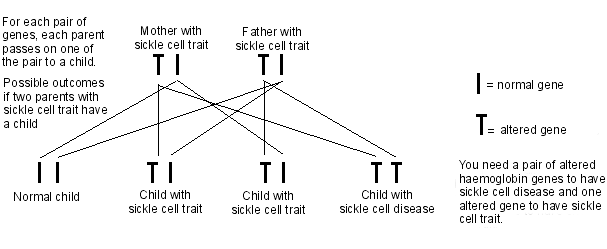
This means that: if both parents have sickle cell trait, their children have: a 1 in 2 chance of having sickle cell trait, a 1 in 4 chance of having SCD, and a 1 in 4 chance of having no sickle genes (as shown in the diagram above).
If one parent has SCD and the other has sickle cell trait, their children have: a 1 in 2 chance of having sickle cell trait, and a 1 in 2 chance of having SCD.
If one parent has sickle cell trait and the other has no sickle genes, their children have: a 1 in 2 chance of having sickle cell trait, and a 1 in 2 chance of having normal haemoglobin genes.
Actually, the inheritance of SCD is slightly more complicated than that. This is because there are other haemoglobin genes which can interact with sickle cell trait. If you have one of these genes plus a sickle gene, you also get SCD (the combination behaves like two sickle cell genes). Examples of these interacting genes are HbC, beta thalassaemia, Hb Lepore and HbO Arab.
The result of these genes is that an important body chemical called haemoglobin is altered. This is what affects the red blood cells and makes them change into a sickle shape. With sickle cell trait, you have only small amounts of altered haemoglobin, so the blood cells are not much affected (unless conditions are very extreme). With sickle cell disease, there is more altered haemoglobin and the red blood cells easily change into sickle shape, which causes various problems. These are described in more detail in our separate leaflet called Sickle Cell Disease.
Sickle cell blood test
Sickle cell trait is diagnosed in the same way as SCD. It involves a blood test. The test may be offered to pregnant women and if necessary their partners. Babies may also need the test.
Sickle cell trait symptoms
It is extremely uncommon for people with sickle cell trait to have any symptoms. Complications of sickle cell trait are also uncommon. Most of the complications which do occur are due to extreme physical conditions, and so are usually preventable. The possible complications are:
Complications of severe low oxygen conditions or severe dehydration
These can occur in conditions where oxygen is extremely low - such as flight in an unpressurised aircraft, very high altitude or problems during a general anaesthetic. Also, if you become severely lacking in fluid in the body (dehydrated).
In these situations, sickle cells can form and can block small blood vessels. This may cause episodes of pain in bones, muscles or the spleen. If in the spleen, it is called splenic infarction and may cause pain in the tummy (abdomen) or chest. These problems may be severe enough to make you very unwell and to need treatment in hospital. They will usually clear up with treatment and when oxygen and hydration levels are back to normal.
To avoid possible complications, you should
Avoid flying in unpressurised aircraft.
Avoid visiting very high altitudes.
Keep your fluid intake up, especially if you have a fever or are exercising.
Complications of severe physical exercise
Sometimes people can become seriously ill as a result of extreme physical training. This can particularly occur if it is a forced pace, under very hot conditions, if they are unused to the training, or if they do not drink enough fluid. Anyone can become ill under these conditions, but people with sickle cell trait are probably at higher risk.
In these conditions, people with sickle cell trait may get pain episodes or pain in the spleen (as explained above).
How can complications of severe exercise be prevented?
The following are a few recommendations which may be useful to prevent complications occurring:
Tell your trainer, sports association, doctor and nurse that you have sickle cell trait, and make sure they are aware of the guidelines.
Avoid extremes such as heat, very high altitude, exertion to the point of collapse, or sudden increase in exercise without proper training. You can still take part in sports if you take precautions. There are professional athletes who have sickle cell trait.
When exercising, drink enough fluid. Have breaks for drinks, rest and cooling.
Sports where you can pace yourself are safer than a forced pace.
If you have symptoms such as pain or difficulty breathing, stop, report your symptoms, rest and rehydrate. Get medical advice if symptoms don't improve quickly.
Build up your training gradually.
If you also have asthma, make sure it is treated and well controlled.
Extreme activities may not be suitable - you will need medical advice.
As with any condition affecting the blood, it is healthier not to smoke.
Other complications
There are some other conditions which seem slightly more common in people with sickle cell trait. However, there is still uncertainty as to how far these conditions are linked to sickle cell trait. Possibly, you may be more prone (compared with people without the trait) to:
Blood in the urine (haematuria) - this may be noticeable, or in a tiny quantity found only on urine tests. It may affect about 1 in 50 people with sickle cell trait. If you have blood in the urine, it should be investigated (tests done) to see if there is any particular cause. Treatment is needed in some cases.
A form of kidney cancer. If you develop weight loss, loin pain, fever, and/or tummy pain, along with blood in the urine, always see a doctor straightaway. You should be referred urgently for investigation.
Bladder or kidney infections (urinary tract infections).
A blood clot in the leg or lung (deep vein thrombosis (DVT) or pulmonary embolus).
To help prevent these problems, advice is to avoid dehydration by drinking enough fluid. To prevent a DVT or a pulmonary embolus, keep mobile and move your legs when on a long journey or flight. See separate leaflets called Deep Vein Thrombosis, Preventing DVT When You Travel and Pulmonary Embolism for more details.
If you have sickle cell trait, you are more at risk of severe complications if you catch malaria. If you visit any area where there is a risk of malaria, it is absolutely essential that you take antimalarial tablets. You must also take precautions to avoid being bitten by mosquitoes.
Symptoms of sickle cell trait in children
Younger children are extremely unlikely to have any symptoms. They will usually be no more prone to becoming ill than children who do not have sickle cell trait. Older children and young people who do heavy physical exercise may have the same complications as adults (see above).
Patient picks for Genetic conditions

Children's health
Ehlers-Danlos syndrome
The Ehlers-Danlos syndromes (EDS) are a group of conditions that affect the stretchiness and strength of supporting tissues in the body, including skin, joints, blood vessels and internal organs. They vary in their impact from very mild through to very severe.
by Dr Rachel Hudson, MRCGP

Children's health
Cystic fibrosis
Cystic fibrosis is an inherited disease which mainly affects the lungs and pancreas but can involve other organs. Symptoms usually begin in early childhood and include persistent cough, wheeze, repeated chest infections, difficulty digesting food and general ill health. Treatments include antibiotics, physiotherapy, medicines for thinning mucus, pancreatic enzyme replacements and other therapies.
by Dr Toni Hazell, FRCGP
Frequently asked questions
If I have sickle cell trait, should I get screened regularly for kidney problems or blood clots?
While certain kidney issues and blood clots might be slightly more common in people with sickle cell trait, the article doesn't recommend routine screening in these areas. Instead, it advises seeking medical attention if you experience symptoms like unexplained weight loss, loin pain, fever, tummy pain along with blood in urine, or general symptoms that concern you. To help prevent blood clots, stay mobile and move your legs during long journeys, and avoid dehydration by drinking enough fluids.
Can children with sickle cell trait participate in sports safely?
Yes, children with sickle cell trait can participate in sports, including professional athletics, but certain precautions are important, especially for older children and those doing heavy physical exercise. It's crucial to avoid extremes like heat and very high altitude, and not to exert themselves to the point of collapse. They should also build up training gradually, drink enough fluids, take breaks for rest and cooling, and stop exercising if they experience pain or difficulty breathing. Informing trainers and doctors about the trait is also advised.
Is it safe to travel to areas with malaria if I have sickle cell trait?
If you have sickle cell trait, you are at a higher risk of severe complications if you contract malaria. Therefore, if you travel to an area where there is a risk of malaria, it is essential to take antimalarial tablets and take precautions to avoid mosquito bites.
Can having sickle cell trait affect general anaesthesia?
Yes, problems during general anaesthesia can be one of the rare conditions of severe low oxygen that might cause complications for someone with sickle cell trait. In such situations, sickle cells can form and block small blood vessels, leading to pain episodes. These problems usually clear up once oxygen levels return to normal.
What should I do if a family member has sickle cell trait and I am planning to start a family?
If you are planning to start a family and a family member has sickle cell trait, this information is particularly relevant for you. You may want to consider genetic counselling or testing to understand your own carrier status and the potential risks for your children, as the children could inherit the sickle cell gene if both parents have the trait or sickle cell disease.
Further reading and references
- Sickle cell and thalassaemia screening: programme overview; Public Health England, 2017
- PHE; Sickle cell and thalassaemia screening: programme overview, 2013.
- Management of sickle cell trait - part of guidance on sickle cell disease; NICE CKS, November 2016 (UK access only)
About the authorView full bio

Dr Sarah Jarvis
Clinical Consultant
MA (Cantab), BM, BCh (Oxon), DRCOG, FRCGP, MBE
After training in medicine at Cambridge and Oxford, Dr Sarah Jarvis MBE became a GP.
About the reviewerView full bio

Dr Adrian Bonsall, MBBS
Medical Author
MA (Chemistry), MBBS (Hons), DCH
Since 2000 Adrian has been employed in emergency and critical care paediatrics based in Sydney, with particular interests in toxicology, trauma and resuscitation.
Article history
Article also available in English, German, Spanish, French, Italian, Portuguese, Hindi, Hebrew, Arabic, and Swedish.
2 May 2018 | Latest version
Join the conversation
Share your thoughts or experiences with others in our patient communities.

Ask, share, connect.
Browse discussions, ask questions, and share experiences across hundreds of health topics.

Feeling unwell?
Assess your symptoms online for free
Sign up to the Patient newsletter
Your weekly dose of clear, trustworthy health advice - written to help you feel informed, confident and in control.
By subscribing you accept our Privacy Policy. You can unsubscribe at any time. We never sell your data.
More in children's health
- Albinism
- Anxiety in children
- Childhood gastro-oesophageal reflux
- Children's cancers
- Cleft lip and palate
- Diabetes in children
- Ehlers-Danlos syndrome
- Glycogen storage disorders
- Hirschsprung's disease
- Kawasaki disease
- Muscular dystrophy
- Rotavirus
- Safeguarding children
- Seborrhoeic dermatitis in babies
- Spina bifida
- Surviving adolescence
- Tetanus and the tetanus vaccine
- Whooping cough
- Wilson's disease