Queratosis pilaris
Revisado por Dr Toni Hazell, FRCGPEscrito por Dr Philippa Vincent, MRCGPPublicado originalmente 3 Aug 2026
Cumple con las directrices editoriales
- DescargarDescargar
- Compartir
- Language
- Discusión
- Ask Patient
- Versión en audio
- Agregar a fuentes preferidas en Google
Keratosis pilaris is a very common skin condition which affects children and teenagers more than adults. It causes rough skin, particularly over the upper arms, outer legs and buttocks.
Explore moisturisers for dry skin
Reciba asesoramiento sanitario experto desde la comodidad de su hogar. Complete una consulta rápida en línea, disponible las 24 horas del día, los 7 días de la semana, y un profesional sanitario colegiado en el Reino Unido revisará su solicitud. Hay entrega al día siguiente disponible para los tratamientos que cumplan los requisitos.

Puntos clave
Keratosis pilaris is a harmless, very common skin condition caused by a build-up of keratin.
It causes rough, small bumps, usually on the upper arms, thighs, face, or buttocks.
Moisturisers and gentle exfoliation can improve its appearance, but there's no cure.
Keratosis pilaris usually improves over time. It often gets worse during colder weather, better in warmer weather.
What is keratosis pilaris?
Keratosis pilaris is a very common skin condition which causes rough skin with raised red bumps. It is caused by "keratin" - the protein that makes your hair, nails, and the outer layer of your skin - building up in the pores of your skin, instead of shedding as normal.
Who gets keratosis pilaris?
Keratosis pilaris is very common. Between five and eight in ten of all teenagers have keratosis pilaris but it is also common in babies and younger children. It tends to settle down after your teenage years; about four in ten adults have keratosis pilaris.
People with all skin types get keratosis pilaris but it seems to be more common in girls and women than in boys and men.
If you have another skin condition, such as eczema or dry skin, you are more likely to get keratosis pilaris. You are also more likely to have keratosis pilaris if other people in your family have it as well.
Can I catch keratosis pilaris?
Keratosis pilaris cannot be caught from someone else. No one knows why it develops or what makes some people get keratosis pilaris and others not.
What does keratosis pilaris look like?
Keratosis pilaris is often described as being like "chicken skin" or "goosebumps". There are lots of tiny bumps over the surface of the skin which feels rough if you run your hand over it. In white or pale skin, these usually look red but in darker skin they can look dark brown or black.
It is most common on the upper arms but it can also occur on:
Face and neck.
Legs, especially thighs.
Back.
Pecho.
Glúteos.
Forearms.
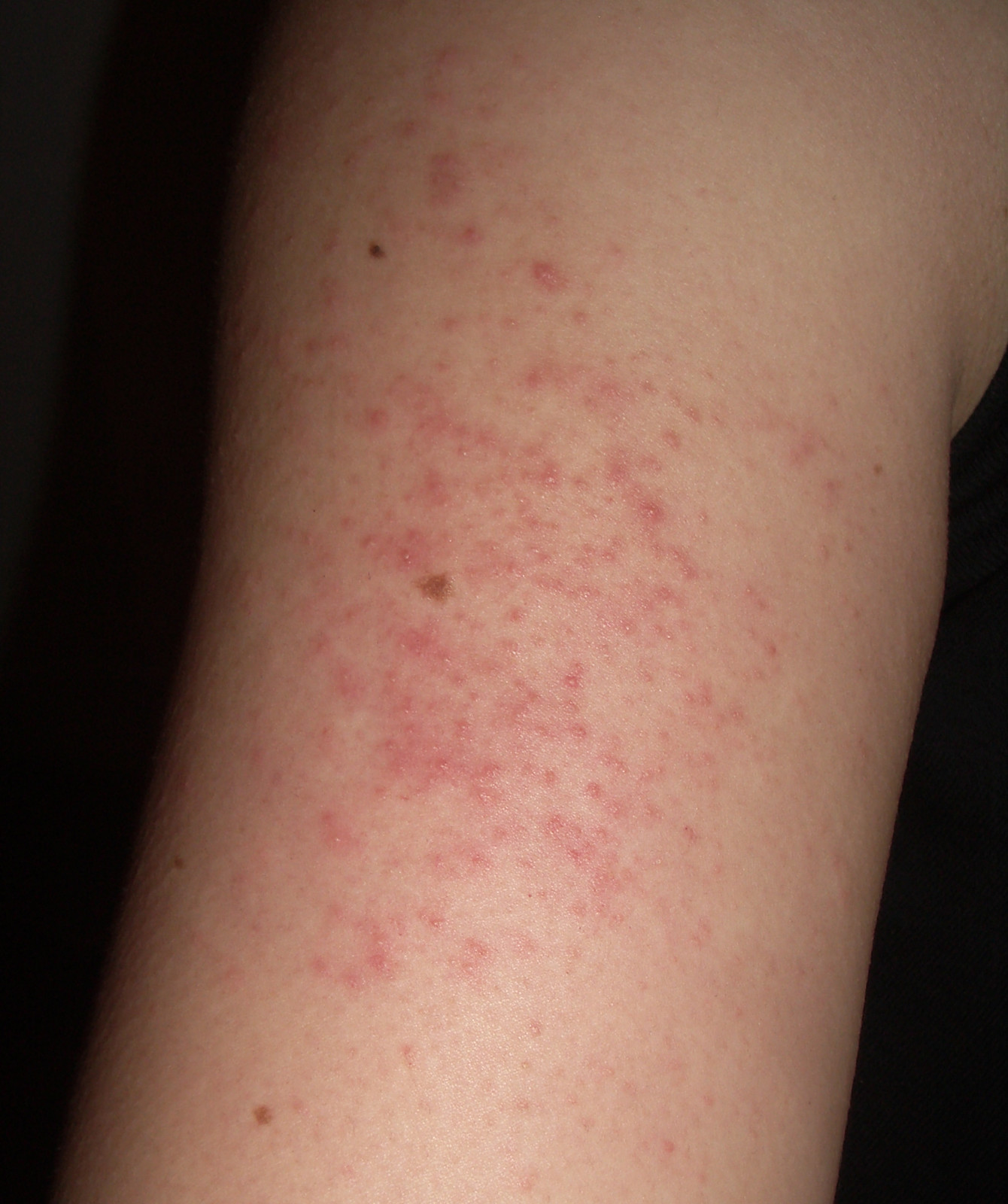
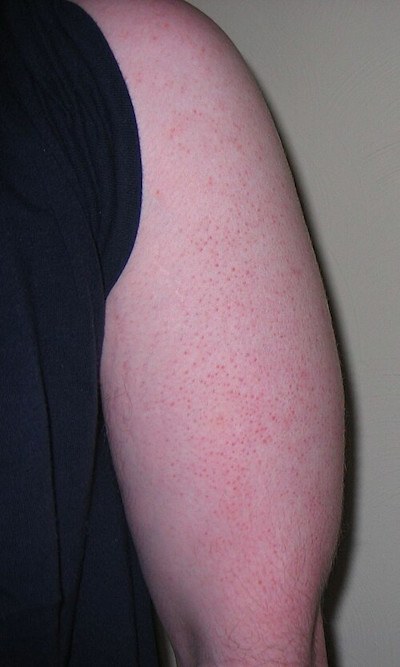
How is keratosis pilaris diagnosed?
There are no tests for keratosis pilaris. You don't need to see a doctor but, if you do, then they will diagnose keratosis pilaris by looking at it.
Treatment of keratosis pilaris
Keratosis pilaris is not harmful. It does not need to be treated. It often gets better in warmer weather and worse in colder weather.
However, some people find that keratosis pilaris makes them feel self-conscious and they want to try and reduce the appearance of it. Although keratosis pilaris can't be cured, there are some treatments which can help.
Some things that can help the appearance of keratosis pilaris include:
Usando emollients or moisturisers regularly to try and soften the skin (but avoid scented products).
Using creams that contain urea, salicylic acid, or lactic acid to try and flatten the bumps.
Using exfoliating pads or mittens.
Having lukewarm showers and avoiding hot baths.
Using a humidifier in winter to stop your skin drying out.
Laser treatment has been shown to be beneficial but is not available on the NHS.
Treatments that have reportado been shown to help include:
Expensive cosmetics which are sold specifically to help with keratosis pilaris.
Vitamin creams.
Scratching or picking at your skin can make keratosis pilaris worse.
How long does it take for keratosis pilaris to get better?
When the treatments above work, it usually takes around six to eight weeks for the skin to start improving. However, even without treatments, it usually gets better with time and is usually much better after the age of 30.
Explore moisturisers for dry skin
Reciba asesoramiento sanitario experto desde la comodidad de su hogar. Complete una consulta rápida en línea, disponible las 24 horas del día, los 7 días de la semana, y un profesional sanitario colegiado en el Reino Unido revisará su solicitud. Hay entrega al día siguiente disponible para los tratamientos que cumplan los requisitos.
Selecciones del paciente para Otras condiciones de la piel

Salud de la piel, uñas y cabello
Hidradenitis supurativa
La hidradenitis supurativa es una afección cutánea crónica que provoca bultos dolorosos y recurrentes de pus (forúnculos o abscesos). La causa exacta se desconoce. La supuración significa formación o descarga de pus. Estas áreas (comúnmente las axilas y la ingle) filtran pus y son difíciles de curar. Finalmente, se produce cicatrización. Los tratamientos incluyen lociones o medicamentos con antibióticos, o una operación para eliminar la zona afectada de la piel. Un tratamiento más reciente funciona bloqueando una sustancia química del sistema inmunológico que causa inflamación en el cuerpo.
por el Dr. Colin Tidy, MRCGP

Salud de la piel, uñas y cabello
Congelación
La congelación es una lesión causada por la exposición de partes del cuerpo al frío. Hay diferentes grados de congelación. En la congelación superficial, la piel puede recuperarse completamente con un tratamiento rápido. Sin embargo, si la congelación es profunda, el daño tisular puede ser permanente y puede ocurrir pérdida de tejido. La forma más importante de prevenir la congelación es salir del frío. Si estás expuesto al frío, asegúrate de tener ropa protectora adecuada.
por la Dra. Toni Hazell, FRCGP
Lecturas adicionales y referencias
- Queratosis pilaris; Asociación Británica de Dermatólogos
- Keratosis Pilaris; DermNet
Sobre el autorVer biografía completa
Escrito por

Dra. Philippa Vincent, MRCGP
Médico General, Autor Médico
MB BS, Bsc, MRCGP (2000), DCH, DFSRH, DRCOG
Dra Philippa Vincent es un médico de cabecera del NHS que trabaja en el norte de Londres.
Acerca del revisorVer biografía completa

Dr Toni Hazell, FRCGP
MBBS, BSc, FRCGP, DFSRH, Dip GU med, DRCOG, DCH (London, UK, 2000)
La Dra. Toni Hazell se graduó de la Escuela de Medicina del Hospital St. Mary y realizó su VTS en el Hospital Northwick Park.
Historial del artículo
Artículo también disponible en Inglés, Alemán, Español, Francés, Italiano, Portugués, Hindi, Hebreo, Árabe, y Sueco.
Next review due: 2 Feb 2031
3 Aug 2026 | Publicado originalmente
Escrito por:
Dra. Philippa Vincent, MRCGPRevisado por
Dr Toni Hazell, FRCGP
Comparte tus pensamientos o experiencias con otros en nuestro comunidades de pacientes.
Acceso sencillo a tratamientos y servicios de salud confiables en línea.
Common conditions
Get help with common conditions through the NHS, without a GP appointment.
 Sinusitis aguda
 Amigdalitis bacteriana
 Impetigo
 Picaduras de insectos
 Herpes zósterInfección del tracto urinario (ITU)
Suscríbete al boletín de Patient
Tu dosis semanal de consejos de salud claros y confiables, escritos para ayudarte a sentirte informado, seguro y en control.
Al suscribirte aceptas nuestros Política de Privacidad. Puedes darte de baja en cualquier momento. Nunca vendemos tus datos.