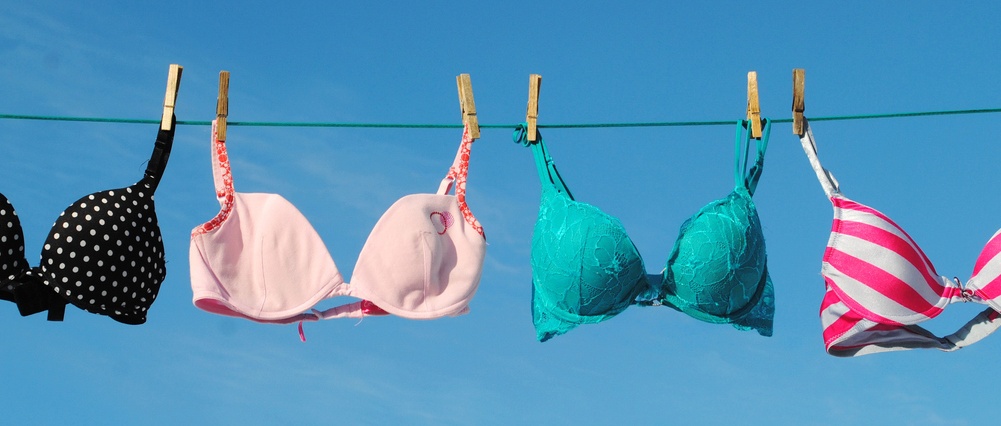
Is your bra harming your health?
Peer reviewed by Dr Krishna Vakharia, MRCGPLast updated by Victoria RawLast updated 16 Jan 2025
Meets Patient’s editorial guidelines
- DownloadDownload
- Share
- Language
- Discussion
- Audio Version
- Add to preferred sources on Google
What you're wearing underneath your clothes could have more of an impact on your physical - and mental - wellbeing than you think. We explore the possible consequences of wearing a bra that doesn't fit you properly.
You may have a years-old bra, now slightly stretched or discoloured, that you love for how comfortable it is. You might also have a bra you've been unable to wear more than once because it doesn't feel right - maybe the wires poke into your skin, or there's too much padding.
Research has shown that around 8 in 10 of us are wearing the wrong bra for our bodies - but why does it matter?
Can your bra cause breast cancer?
There are a whole host of myths out there when it comes to breast health, even suggesting that wearing bras causes breast cancer.
Amy Sanchez, Senior Research Associate in Biomechanics with the Research Group in Breast Health at the University of Portsmouth says that wearing a well-fitting bra has no known negative consequences.
She explains: "We often get asked about cancer and bras, and existing research shows no link between bra use and breast cancer."
However, she warns that while bras don't cause breast cancer, that doesn't mean that they can't impact your health.
"Wearing an ill-fitting bra can cause poor posture, back and neck pain, shoulder grooves leading to numbness in the fingers, and a lack of self-confidence," says Sanchez.
Tracey-Jane Hughes, founder of Bra Lady agrees that wearing an uncomfortable bra can have an affect on body confidence and self-esteem.
She says: "If something is pressing on your breast tissue it can cause discomfort. Sometimes that can cause mental health issues as well. I see a lot of women who don't like their breasts because they find them uncomfortable - all because they are not wearing a well-fitting bra."
With wear, bras stretch and don't provide the same support they had when you first bought them. Your body also changes over time so it's a good idea to buy new bras regularly.
"A bra will last for about six months," says Hughes.
Is braless better?
There's a growing trend to turn to non-wired soft-cup bras, fabric 'bralettes' or not wearing a bra. In particular there has been an increase in the number of bralettes on the market.
So is an underwire always necessary?
Sanchez says: "As far as I am aware there has been little research done specifically on bralettes. We have, however, tested several non-wired bras and these can be effective at supporting your breasts if constructed well.
There are many different materials and techniques used in the bra industry and it is no longer essential for a bra to have underwire to provide good support."
Bralettes aren't one size fits all. What works for you might not work for someone else, and sometimes that can lead to pain and problems with your breasts.
Sanchez explains that wearing no bra - or a low-support bra - can cause your skin to stretch beyond its elastic limit. This could lead to permanent deformation and premature sagging of the breast.
"There is also plenty of research to show that wearing low breast support leads to increased breast pain and reduced movement efficiency during exercise or physical activity," she adds.
Body shape can make all the difference when it comes to buying a bra.
Hughes says that if you have larger breasts you may not get the support you need from a bralette. You are likely to end up with neck ache or back ache because it's not supportive enough.
Fit is just as important in bralettes as in traditional bras.
"An ill-fitting bra is an ill-fitting bra - it doesn't matter whether it's got wires in or not," she warns. "Soft-cup bras are becoming more popular. But if you've got an ill-fitting soft-cup bra, that will still do as much damage to your breasts, back and neck as a underwired bra."
How to find your perfect bra
You will have you own criteria for your bra, including style, support and comfort. The Research Group in Breast Health advocates a 'best-fit' approach to finding the right bra, using five key criteria.
These are:
Underband - should fit firmly, pulling away about one inch, and be level all around the torso.
Underwire - should follow the breast crease and not sit on any breast tissue.
Cups - should fully encase the breast tissue without bulging or gaping.
Straps - should sit comfortably on the shoulders, pulling away about one inch.
Centre-front - should sit flat against the body.
Sanchez advises: "If a bra does not meet all these criteria try going up or down a size."
The underband is crucial to getting the perfect fit. Many wear the underband too loose and the cup too small.
Hughes explains: "You wear it around the smallest part of your back. You might be wearing them too high - so your breasts aren't being supported.
"Make sure your breasts are enclosed in the cup. We all have one breast bigger than the other so we always fit the larger breast which can be one or two cup sizes different."
If you're lucky enough to find your 'perfect bra' don't forget that it might not be suitable for all occasions. Breasts change during the month - and even during the day. Hormones can make your breast size fluctuate during your monthly cycle, up to one to two cup sizes. What you need from your bra also changes at different times.
Sanchez says: "Consider wearing different bras for different activities, as support level, strap configuration, adjustability, and style requirements are likely to change between activities. Invest in a well-fitting bra if you are having discomfort or embarrassment associated with your breasts - even if it's only worn at certain times of the month, or for specific activities."
It's a good idea to have a supportive sports bra for exercise. But generally you should avoid wearing restrictive sports bras all day every day as they can become uncomfortable with prolonged use.
It can be difficult to know if a bra works for you until you've tried it out for a few hours. However, you can check if it's fit for purpose by trying it out in the fitting room in the way that you would normally wear it. This helps you make sure that it isn't too tight, gives you support and lets you move in the way you need to.
Hughes suggests: "Try your top on. Does it look good? Does it feel good? Jump up and down, swing your arms around. Make sure your bra is fit for the purpose you need it for. If it is a sports bra, do some of the things that you would do if you were doing that sport.
If you're sitting down in a job all day, sit down on a chair to try it out because our bodies are in a very different position from standing to sitting. Try it out as you would wear it every day. If it's not comfortable, it's definitely not right. If you've got any doubt at all, don't get it."
Patient picks for Breast health
Women's health
Anatomy of the breast
The medical name for breast is mammary gland. Each breast consists of tissue overlying the chest wall muscles (the pectoral muscles). In women, the breasts are composed principally of specialised tissue (glandular tissue) that produces milk. The remaining part is made up of fatty tissue. In humans, breast tissue begins to enlarge at puberty. This is unlike other primates, where breast tissue only enlarges during milk production.
by Dr Laurence Knott

Women's health
Why we need to talk about breast implant illness
Have you heard of breast implant illness? Although not yet recognised as an official medical condition, understanding that this is a possible side-effect of breast implant surgery can help people make more informed decisions, identify the root of their health issues, and improve their chances of recovery.
by Amberley Davis
About the authorView full bio

Milly Evans
Editor
Milly writes on a range of health topics, with a particular interest in health inequality and sexual health.
About the reviewerView full bio

Dr Krishna Vakharia, MRCGP
Chief Medical Officer for Health, Optum UK
MBChB, MRCGP(2013), BMedSci (hons), DFSRH, DRCOG, PGDipDerm (Distn)
Dr Krishna Vakharia is an NHS GP. She is also a regular examiner for the postgraduate Diploma in Practical Dermatology at Cardiff University as well as being the Chief Medical Officer for health at Optum UK.
Article history
Article also available in English, German, Spanish, French, Italian, Portuguese, Hindi, Hebrew, Arabic, and Swedish.
Next review due: 17 Jan 2028
16 Jan 2025 | Latest version
16 Oct 2019 | Originally published
Authored by:
Milly Evans
Join the conversation
Share your thoughts or experiences with others in our patient communities.

Ask, share, connect.
Browse discussions, ask questions, and share experiences across hundreds of health topics.

Feeling unwell?
Assess your symptoms online for free
Sign up to the Patient newsletter
Your weekly dose of clear, trustworthy health advice - written to help you feel informed, confident and in control.
By subscribing you accept our Privacy Policy. You can unsubscribe at any time. We never sell your data.
More in women's health
- 7 tips to help relieve endometriosis pain
- Does the menopause cause hair loss?
- First period - supporting your child when they start menstruation
- UpdatedFlax seeds: a secret weapon for women's health?
- How to cope with metastatic breast cancer
- How to talk to your doctor about your vagina
- Is women's pain taken seriously?
- Menstrual cups as safe and effective as pads and tampons
- Period blood loss chart
- The female reproductive system
- The health benefits of sex toys
- The most likely causes of pain during sex
- What a missed period could mean if you're not pregnant
- What is abnormal uterine bleeding and when should I worry?
- What is inflammaging - and why should women care?
- What it's like to go through the menopause when you have HIV
- What to do about contraception after giving birth
- What to do about lumps on the vagina or vulva
- What's the link between PCOS and diabetes?
- Will we ever have a male contraceptive pill?