Cómo examinarse para detectar cáncer testicular
Revisado por pares por Dr Krishna Vakharia, MRCGPEscrito por Lydia SmithPublicado originalmente 20 Oct 2022
Cumple con las directrices editoriales
- DescargarDescargar
- Compartir
- Language
- Discusión
- Versión en audio
- Agregar a fuentes preferidas en Google
Revisar tus testículos puede ser una manera fácil de asegurarte de que no haya bultos o protuberancias inusuales, lo cual puede ser el primer signo de cáncer testicular. Sin embargo, puede ser difícil saber lo que estás haciendo, especialmente si no lo has hecho antes.
How common is testicular cancer?
Testicular cancer is a very common type of cancer. There are around 2,400 new cáncer testicular cases in the UK every year1, which is more than six every day. Carrying out a self-examination is an important part of staying healthy - especially if you have a family history of testicular cancer, and noticing any changes early could mean catching cancer cells earlier.
Why is it important to check your own testicles?
"Regularly checking your testicles is an important part of keeping on top of your health,” says Kieran Kelly, manager at the testicular cancer charity The OddBalls Foundation.
"It's quick, easy and could potentially save your life. It's important to check regularly because you need to know what feels normal for you. Therefore, if you do notice any changes, you can be proactive and seek the medical help required."
How to check your testicles
From puberty onwards, it is important to check your testicles regularly. Testicular cáncer is usually always cured but it is easier to treat when it is diagnosed early. Examining yourself once a month means you know what feels normal for you.
First, you need to hold your scrotum in the palm of your hand. Use your fingers and thumb to examine each testicle. You should feel for lumps or swellings, anything unusual or any differences between your testicles.
"The best time to check yourself is after having a warm bath or a warm shower because your testicles become more soft and easier to feel for any physical changes," says Kelly.
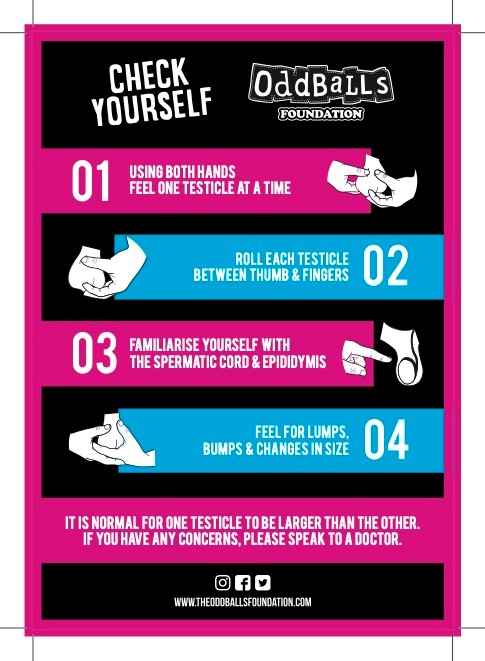
Kelly recommends a four-step process for checking yourself. "Step one involves using both hands to feel one testicle at a time. Step two involves rolling the testicle between your thumb and your fingers to inspect any changes," he says.
"Step three encourages people to familiarise themselves with the spermatic cord and the epididymis tube (- tube that carries sperm - that connects to the back side of each testicle," adds Kelly.
The epididymis feels like a coiled tube and it is common to get harmless cysts and benign lumps in that area, which can be treated. However, every lump needs to be assessed just in case.
"Lastly, step four involves feeling for lumps, bumps and any changes in size. It's important to note that it is normal for one testicle to be larger than the other. We encourage everyone to speak to a doctor if they have any concerns whatsoever, as it's always better to be safe than sorry."
Oddballs Foundation Testicle Checker
What are the signs of testicular cancer?
The most common symptom of testicular cáncer is a lump in a testicle, or a dull ache or feeling of heaviness in the scrotum. Another symptom is a painless lump or swelling in a testicle, which may suddenly get larger and become painful.
"Some people who have been diagnosed with testicular cancer have been unable to report any specific signs but they just felt like something didn't feel right or normal to them," says Kelly. Other conditions can also cause lumps or swellings.Most lumps are not cáncer. However, it is important you get your doctor to check anything unusual as soon as possible.
What should you do if you are worried about testicular cancer?
If you notice any changes in your testicles or are worried that something doesn't seem right, it's important not to feel embarrassed and to speak to your doctor as soon as you can. Not all lumps and bumps are a sign of testicular cancer, but if you do receive a diagnosis, quimioterapia, radioterapia and surgery are the three main treatments. Although cancer can be a scary diagnosis, the outlook and survival rates for testicular cancer is one of the best for all cancers2.
"It's important to get things checked out early because treatment for testicular cancer is much more effective when started early," says Kelly.
Lectura adicional
Selecciones del paciente para Condiciones testiculares

Salud masculina
¿El cáncer de testículo afecta tu fertilidad?
El cáncer de testículo tiene una de las tasas de supervivencia más altas de todos los tipos de cáncer, pero las implicaciones para la fertilidad masculina varían según el tipo de tratamiento recibido.
por Amberley Davis

Salud masculina
Conociendo tus testículos
If you are a young man or teenage boy, you should be aware of how your testicles (testes) normally feel. Report any changes or lumps to your doctor.
por el Dr. Laurence Knott
Sobre el autorVer biografía completa

Lydia Smith
Escritora de artículos
BA, MA, MSc
Lydia Smith es una periodista galardonada y escritora de reportajes que ha escrito extensamente sobre la salud de las mujeres y la salud mental. Actualmente está estudiando una maestría en psicología.
Acerca del revisorVer biografía completa

Dr Krishna Vakharia, MRCGP
Director Médico de Salud, Optum UK
MBChB, MRCGP(2013), BMedSci (hons), DFSRH, DRCOG, PGDipDerm (Distn)
La Dra. Krishna Vakharia es una médica general del NHS. También es examinadora habitual del Diploma de Posgrado en Dermatología Práctica en la Universidad de Cardiff, además de ser la Directora Médica de salud en Optum UK.
Historial del artículo
La información en esta página es revisada por pares por clínicos calificados.
Artículo también disponible en Inglés, Alemán, Español, Francés, Italiano, Portugués, Hindi, Hebreo, Árabe, y Sueco.
20 Oct 2022 | Publicado originalmente
Escrito por:
Lydia SmithRevisado por pares por
Dr Krishna Vakharia, MRCGP

Pregunta, comparte, conecta.
Navega por discusiones, haz preguntas y comparte experiencias en cientos de temas de salud.

¿Te sientes mal?
Evalúa tus síntomas en línea de forma gratuita
Suscríbete al boletín de Patient
Tu dosis semanal de consejos de salud claros y confiables, escritos para ayudarte a sentirte informado, seguro y en control.
Al suscribirte aceptas nuestros Política de Privacidad. Puedes darte de baja en cualquier momento. Nunca vendemos tus datos.
Más sobre la salud masculina
- ¿Son más comunes los problemas de erección en los hombres jóvenes?
- ¿Pueden los hombres experimentar depresión postnatal?
- ¿Pueden los hombres tener candidiasis?
- ¿Los esteroides anabólicos causan infertilidad?
- ¿Realmente los condones causan problemas de erección?
- ¿Los hombres necesitan hacer ejercicios de Kegel?
- ¿Qué tan precisas son las pruebas de cáncer de próstata?
- Cómo los problemas de erección pueden afectar tu relación
- Cómo prevenir la eyaculación precoz
- Cómo tu estilo de vida puede ser una causa de bajo conteo de esperma
- ¿Es cáncer de próstata o algo más?
- La decisión de la circuncisión en adultos: ¿por qué, dónde y cómo?
- El sistema reproductor masculino
- La rutina de cuidado de la piel más sencilla para hombres
- Prueba de orina para el cáncer de próstata podría revelar quién necesita tratamiento urgente
- ¿Cuáles son los signos de depresión en los hombres?
- ¿Cuáles son los signos del cáncer de próstata?
- ¿Qué es la masculinidad tóxica y cómo afecta a los hombres?
- ¿Cuál es la altura promedio para los hombres?
- ¿Por qué los hombres negros tienen más probabilidades de morir por cáncer de próstata?