
Getting to know your testicles
Peer reviewed by Dr John Cox, MRCGPLast updated by Dr Laurence KnottLast updated 11 Oct 2017
Meets Patient’s editorial guidelines
- DownloadDownload
- Share
- Language
- Discussion
- Audio Version
- Add to preferred sources on Google
If you are a young man or teenage boy, you should be aware of how your testicles (testes) normally feel. Report any changes or lumps to your doctor.
Why should I know how my testicles (testes) feel?
Although uncommon, cancer of the testicles (testicular cancer) is the most common cancer in young men in the UK. About 1 man in 500, aged between 15 and 50 years, develops testicular cancer. The exact cause is not known. However, if caught early it is one of the easiest cancers to treat and cure. So, If you are a teenage boy or young man, you should get to know how each testicle (testis) normally feels. Any changes would then be easier to detect. This is especially important for brothers of people with testicular cancer, as they have a higher-than-average chance of developing this type of cancer.
Normal testicles (testes)
Cross-section view
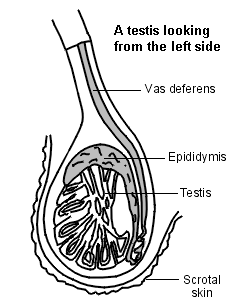
The best time to feel your testes is after a bath or shower when you are relaxed. Hold each testicle (testis) in turn in the palm of a hand and use your finger and thumb gently to feel the testes and nearby structures.
It is normal for one testis to be slightly bigger than the other and for one to hang slightly lower than the other. The testes themselves feel like smooth, soft balls inside the baggy scrotum. At the top and to the back of each testis is the epididymis (this stores the sperm). This feels like a soft swelling attached to the testis; it can be quite tender if you press it firmly. Leading from the epididymis is the vas deferens. You can feel each vas deferens at each side at the back and top of the scrotum. They feel like soft, narrow tubes which pass up and into the groin. (The vas deferens carries the sperm to the penis.) Some people confuse the normal epididymis or vas deferens with an abnormal lump.
What changes should I look out for?
If you notice any change in size or weight of a testicle (testis), or any abnormal lumps, swellings, or tender spots, see your doctor. Doctors are used to examining testicles (testes) and will be able to advise if the abnormality is serious or not.
Note: most abnormalities are not cancer. For example: collections of fluid, infections, and harmless cysts are common and treatable. Testicular cancer usually starts as a small, hard, painless lump on one testis, which you can feel away from the normal soft lump of the epididymis.
What if it is cancer?
Treatment of cancer of the testicle (testis) is often effective. In more than 9 in 10 cases, treatment can result in a complete cure. However, the earlier it is detected, the easier it is to treat. More than a third of people with this cancer consult their doctor after the cancer has spread, which makes treatment more difficult. Often this is because of unfounded fears, or just hoping it will go away.
Patient picks for Testicle conditions

Men's health
How to check yourself for testicular cancer
Checking your testicles can be an easy way to make sure there aren't any unusual lumps and bumps, which can be the first sign of testicular cancer. However, it can be difficult to know what you're doing, especially if you've not done it before.
by Lydia Smith

Men's health
Does testicular cancer affect your fertility?
Testicular cancer has one of the highest survival rates of all cancer types, but the implications for male fertility vary depending on the type of treatment given.
by Amberley Davis
About the authorView full bio

Dr Laurence Knott
General Practitioner, Medical Author
BSc (Hons) Biochemistry, MBBS
Dr Laurence Knott qualified in 1973 and has had extensive experience as a General Practitioner.
About the reviewerView full bio

Dr John Cox, MRCGP
MA, MB, B Chir, DCH, DRCOG, MRCP (UK), MRCGP
Dr John Cox worked as a Medical Registrar in the UK and New Zealand and as a locum Physician in New Zealand.
Article history
The information on this page is peer reviewed by qualified clinicians.
Article also available in English, German, Spanish, French, Italian, Portuguese, Hindi, Hebrew, Arabic, and Swedish.
11 Oct 2017 | Latest version
Join the conversation
Share your thoughts or experiences with others in our patient communities.

Ask, share, connect.
Browse discussions, ask questions, and share experiences across hundreds of health topics.

Feeling unwell?
Assess your symptoms online for free
Sign up to the Patient newsletter
Your weekly dose of clear, trustworthy health advice - written to help you feel informed, confident and in control.
By subscribing you accept our Privacy Policy. You can unsubscribe at any time. We never sell your data.
More in men's health
- Are testosterone supplements safe for men?
- Can men experience postnatal depression?
- Cystitis in men
- Do anabolic steroids cause infertility?
- Do condoms really cause erection problems?
- Do men need to do Kegel exercises?
- How accurate are prostate cancer tests?
- How erection problems can affect your relationship
- How your lifestyle may be a cause of low sperm count
- Is it prostate cancer or something else?
- Testicle pain: what could it be?
- The adult circumcision decision: why, where and how?
- The male reproductive system
- The simplest men's skincare routine
- Urine test for prostate cancer could reveal who needs urgent treatment
- What are the signs of depression in men?
- What you need to know before you take erectile dysfunction medication
- What's the average height for men?
- Why is there blood in my semen?
- Will we ever have a male contraceptive pill?