La verdad sobre la grasa en tu dieta
Revisado por pares por Dra. Sarah JarvisÚltima actualización por Amberley DavisÚltima actualización 22 Feb 2024
Cumple con las directrices editoriales
- DescargarDescargar
- Compartir
- Language
- Discusión
- Versión en audio
- Agregar a fuentes preferidas en Google
Dietary fat has received its share of bad press, but not all fat is bad for us. We delve into this important food group, separating the healthy from the unhealthy, and fact from fiction.
What is fat?
What we call fat is actually the family name for a whole host of individual fatty acids. These are split into two groups - saturated and unsaturated - depending on key aspects of their structure.
Saturated fats
Saturated fats are straight, dense chains of molecules and this characteristic makes them typically solid at room temperature. Saturated fats are less healthy for your heart as they push up LDL colesterol levels - the 'bad' cholesterol that can build up in your arteries and cause problems.
You can find saturated fats in animal products, such as:
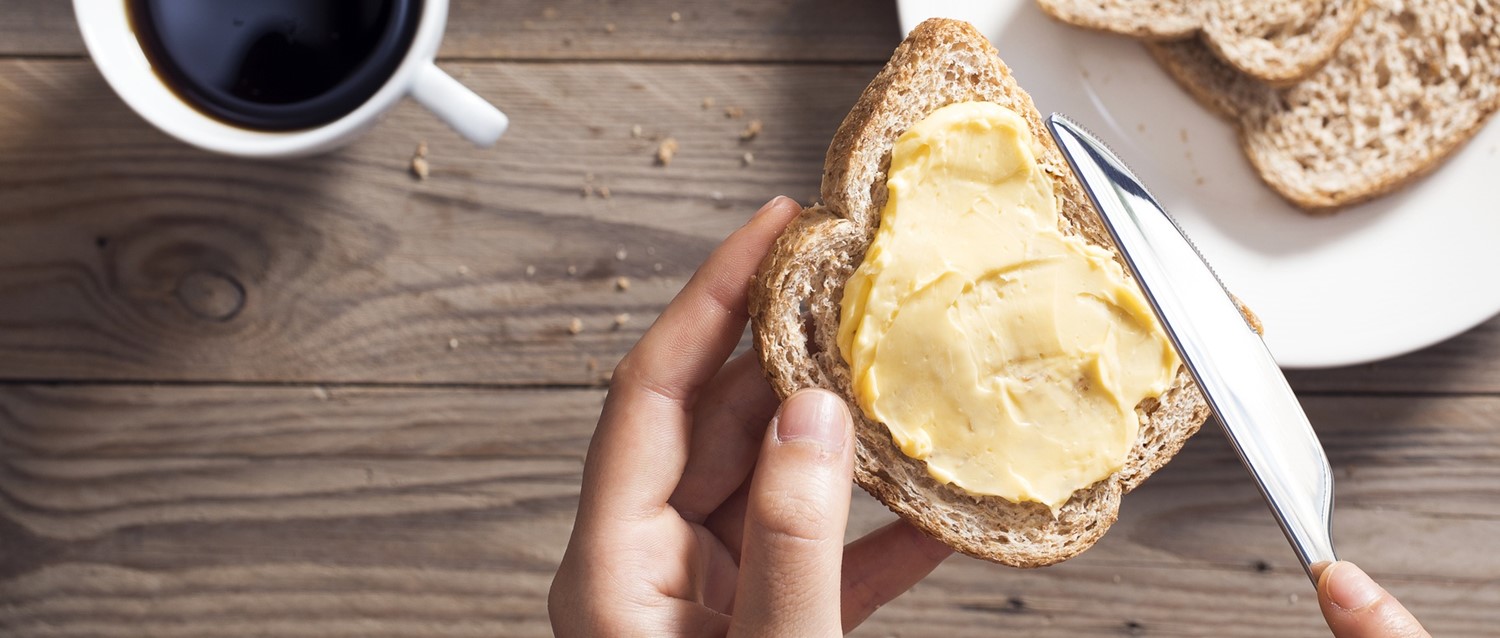
Mantequilla.
Crema.
Lard.
Cheese.
Fatty meats - including lamb, pork and beef.
Processed meats - including sausages, bacon and burgers.
Saturated fats are also in vegetable products, such as:
Coconut fat.
Palm oil.
Processed treats are contributing a large amount of saturated fat to a typical Western diet:
Pasteles.
Galletas.
Pies.
Pasteles.
Sweets.
Unsaturated fats
Unsaturated fats are less dense and are liquid at room temperature. Unsaturated fats are believed to be healthier options. Studies have shown that they can reduce your cholesterol levels and protect against cardiovascular disease1.
They are split into monounsaturated fats and polyunsaturated fats, and include:
Frutos secos.
Seeds.
Avocado.
Oily fish.
Olive, rapeseed, and other vegetable oils - but not palm and coconut oils.
Grasas trans
A third group, trans fats, only exist in tiny amounts in a few natural foods, such as:
Ruminant meat - such as meat from cows, sheep, and goats.
Productos lácteos.
However, in the 1970s, large amounts of trans fats were manufactured by changing the structure of unsaturated fats to force them to be solid at room temperature. These were then added to a range of processed foods, such as:
Margarine.
Pasteles.
Galletas.
In the last few decades, efforts have been made to minimise trans fats in products, due to concerns about their negative effect on blood cholesterol levels and heart disease risk.
Intakes of trans fats in the UK have now reduced to half the maximum limit2. In the UK, there is no legal requirement to list trans fats on labels but you can check product ingredient lists for 'hydrogenated fats/oils' which may contain trans fats. Takeaway foods are also a source, as the high temperature heating of vegetable oil boosts the trans fat content.
Is dietary fat healthy?
There is no need to fear dietary fat as it's essential for health. Fat provides energy, helps to keep us warm, cushions our vital organs, protects our body cells and acts as a carrier for fat-soluble vitamins, such as A, D, E and K. More than half of the brain is fat3 and our cognitive development and brain functions rely on essential fatty acids that cannot be made by our bodies.
However, fats are a rich source of calories, making them easy to overeat. As an example, one 50 g cube of cheddar cheese has the same calories as two medium bananas. Also, several high-fat foods, such as biscuits, cakes, confectionery, desserts, and ice cream, are high in sugar too.
Which types of fats are the healthiest?
We should try to focus on unsaturated fats, while limiting our consumption of saturated and trans fats.
Professor of nutritional immunology, Philip Calder from the University of Southampton, says: "Fats affect the way that cells and tissues in the body work. Some, like omega-3s - which are unsaturated - are better for us because they promote optimal cell and tissue function. Ultimately, this relates to improved wellbeing and less risk of disease."
According to Professor Calder, his top choice would be omega-3s from oily fish, although: "Plant omega-3s from nuts, especially walnuts, and monounsaturated fats like those in olive oil, are important too."
Should we avoid some fats?
Apart from artificial trans fats, there's no need to cut out any particular fats from the diet - but we should limit our saturated fat consumption.
The effect of saturated fats on cholesterol and heart disease has been under debate in recent years4. The confusion may have arisen because scientists now know that individual saturated fatty acids have different effects on the body and are not one entity as previously believed5.
However, in 2019 the UK's Scientific Advisory Committee on Nutrition found that6:
Too much saturated fat increases your chances of cardiovascular disease, coronary heart disease, and high blood pressure.
The average person's intake of saturated fat is too high - and should be reduced to no more than 10% of their total dietary energy.
Saturated fats should be replaced with unsaturated fats, carbohydrates, or proteins.
How to eat the right fats
The best way to do this is to rebalance our fats towards plant sources, choose lean meats, poultry and oily fish, and keep high-calorie fatty foods to a minimum.
Sian Porter, spokesperson for the British Dietetic Association, says: "In the UK we eat too much of the saturated fats found in cakes, biscuits, pies, pastries, confectionery, and fatty meats so we need to cut down these foods."
She adds: "As for cooking, it depends on what you’re making but, in the main, try to use small amounts of unsaturated fats such as olive oil and rapeseed oil.
"Poor storage and constant reuse can change the fatty acids into harmful forms so always store your oils away from sunlight in a cool, dark place and replace regularly.
Butter, ghee, and coconut fat are fine to use occasionally in small amounts if you like the taste but there's no evidence that adding them to your diet offers any benefits."
Lectura adicional
Selecciones del paciente para Dieta
Dieta y nutrición
¿Qué es la dieta Ornish y puede transformar tu salud?
La dieta Ornish es un plan basado en plantas, desarrollado originalmente por el Dr. Dean Ornish como una forma de prevenir y revertir enfermedades del corazón. Promueve una dieta baja en grasas y alta en fibra, junto con cambios significativos en el estilo de vida. Te anima a reducir tu consumo de azúcar y alimentos procesados, mientras incorporas ejercicio regular y manejas el estrés.
por Victoria Raw
Dieta y nutrición
Cómo la dieta afecta a tu corazón
The expression 'you are what you eat' is most true of all where your heart is concerned. What you put into your body has a huge impact on your liver, your bowel, your kidneys, and your brain - but also on your arteries, which supply all your organs with vital oxygen.
por Josh Alderman
Sobre el autorVer biografía completa

Dra. Carrie Ruxton, PhD, Nutrición Infantil
Dietista y Escritora de Salud
Doctorado, Nutrición Infantil
La Dra. Carrie Ruxton se graduó como Dietista en la Universidad Queen Margaret, Edimburgo, antes de obtener un doctorado en Nutrición Infantil.
Acerca del revisorVer biografía completa

Dra. Sarah Jarvis
Consultora Clínica
MA (Cantab), BM, BCh (Oxon), DRCOG, FRCGP, MBE
Después de formarse en medicina en Cambridge y Oxford, la Dra. Sarah Jarvis MBE se convirtió en médica general.
Historial del artículo
La información en esta página es revisada por pares por clínicos calificados.
Artículo también disponible en Inglés, Alemán, Español, Francés, Italiano, Portugués, Hindi, Hebreo, Árabe, y Sueco.
Próxima revisión: 22 Feb 2027
22 Feb 2024 | Última versión
16 Feb 2018 | Publicado originalmente
Escrito por:
Dra. Carrie Ruxton, PhD, Nutrición Infantil

Pregunta, comparte, conecta.
Navega por discusiones, haz preguntas y comparte experiencias en cientos de temas de salud.

¿Te sientes mal?
Evalúa tus síntomas en línea de forma gratuita
Suscríbete al boletín de Patient
Tu dosis semanal de consejos de salud claros y confiables, escritos para ayudarte a sentirte informado, seguro y en control.
Al suscribirte aceptas nuestros Política de Privacidad. Puedes darte de baja en cualquier momento. Nunca vendemos tus datos.
Más sobre dieta y nutrición
- 5 golosinas saludables para Halloween
- 5 comidas vegetarianas ricas en proteínas para mantener tu fuerza
- 5 comidas rápidas y saludables para estudiantes
- ¿Puede cambiar tu dieta aliviar los síntomas de la endometriosis?
- ¿Puede ayudar cambiar tu dieta a la psoriasis?
- ¿Pueden las vitaminas realmente prevenir la caída del cabello?
- ¿Realmente existen los 'superalimentos'?
- ¿Comer comida picante te ayuda a perder peso?
- Disparos de jengibre que mejoran la salud: ¿moda o realidad?
- Recetas de panqueques saludables para tu dieta
- ¿Qué tan saludable es el agua saborizada?
- ¿Cuánta carne roja deberías comer?
- Cómo aumentar tus niveles de energía y sentirte menos cansado en invierno
- Cómo tener una barbacoa más saludable
- Jugo: ¿Es bueno para nosotros exprimir frutas y verduras?
- Probióticos para el SII: ¿funcionan?
- ¿Cuál es la mejor dieta para la enfermedad de Crohn?
- ¿Qué alimentos ayudan a combatir las infecciones?
- Por qué los alimentos ultraprocesados son tan adictivos y cómo reducir su consumo
- Por qué no necesitas desintoxicarte