Lesión del nervio femoral
Revisado por Dr John Cox, MRCGPÚltima actualización por Dr Roger Henderson, MBBSÚltima actualización 20 Aug 2015
Cumple con las directrices editoriales
- DescargarDescargar
- Compartir
- Language
- Discusión
- Ask Patient
- Versión en audio
- Agregar a fuentes preferidas en Google
Aviso sobre el contenido
Esta página no se ha revisado recientemente, por lo que es posible que haya cambiado parte de la información o que algunos enlaces externos ya no funcionen.
Profesionales Médicos
Los artículos de Referencia Profesional están diseñados para ser utilizados por profesionales de la salud. Están escritos por médicos del Reino Unido y se basan en evidencia de investigación, así como en guías del Reino Unido y Europa. Puede encontrar uno de nuestros artículos de salud más útil.
Damage to the femoral nerve may result from trauma, iatrogenically, or as a consequence of disease processes. Disruption may be complete or partial.
Epidemiología
Femoral nerve lesions are uncommon. One study of 27,004 primary hip arthroplasties found only two patients with complete and one with partial femoral nerve palsy1. A review of cases treated surgically at a neurosurgical department found 119 patients over a period of 33 years. 52 cases were iatrogenic, 19 were due to hip or pelvic fractures, 10 to gunshot wounds and 8 to lacerations. The remainder were the result of various tumours or cysts2.
Etiología3
Iatrogénico:
Trauma - hip or pelvic fractures, thigh lacerations (these are often partial lesions, affecting nerve supply to the quadriceps).
Psoas haematoma - can occur as a complication of anticoagulant therapy or in haemophilia.
Psoas abscess6.
Diabetic amyotrophy (proximal neuropathy, seen in patients with diabetes, causes burning pain in the hip and thigh and wasting of thigh muscles)7.
Tumours - a variety of benign and malignant tumours - eg:
Arthropathy - femoral nerve palsy secondary to synovitis of the hip joint10.
Neonatal - femoral nerve palsy has been reported after breech lie in utero11.
Presentación
Síntomas12
There may be instability of the knee (often described as 'buckling') on climbing stairs. The weakness is typically acute or subacute, in contrast to that caused by myopathy, in which the onset is often gradual and usually bilateral. Numbness of the medial side of the leg and calf may occur. Involvement of the lateral cutaneous branch of the nerve may produce painful paraesthesiae of the thigh (meralgia paraesthetica). Mild pain near the inguinal ligament may be experienced. Acute severe pain in the groin, thigh and lower abdomen may occur if the cause is a retroperitoneal haematoma.
Signos12
Estas pueden incluir:
Quadriceps muscle weakness and wasting.
Loss of knee jerk.
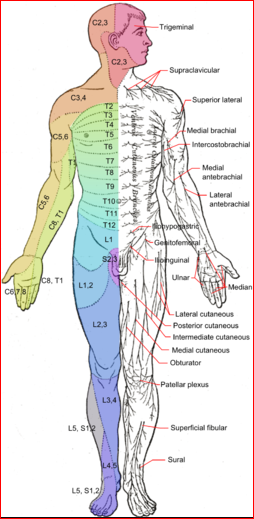
Numbness along the medial side of the thigh and anteromedial side of the calf (the L2-L4 dermatomes).
Pain on hip extension (in cases of retroperitoneal haematoma).
In one small study after gynaecological surgery, diagnosis was made based on the following criteria13:
History of falling during postoperative ambulation.
Quadriceps weakness.
Straight leg raise weakness.
Diminished knee jerk response.
No evidence of psoas haematoma or abscess.
Neurological Examination
Diagnóstico diferencial1415
Focal muscular atrophies
HIV-1-associated multiple mononeuropathies.
Inclusion body myositis (a group of hereditary disorders causing muscle weakness in which inclusion bodies are seen on microscopy of muscle cells).
Leptomeningeal carcinomatosis.
Metabolic myopathies.
Vasculitic neuropathy.
Lumbar plexopathies (peripheral neuropathy in the area of the lumbar plexus).
Lumbosacral disc syndromes.
Investigaciones12
Imágenes
A CT scan of the abdomen may help to exclude retroperitoneal haematoma if this is suspected. CT or MRI imaging of the pelvis may also help to elucidate the cause (eg, tumour or aneurysm).
Otras pruebas
Nerve conduction studies may reveal motor deficit.
Electromyography may show quadriceps weakness. Iliopsoas involvement may be demonstrated in pelvic lesions (ie the inguinal ligament).
Manejo16
Médico
Most patients can be treated conservatively with exercises, avoidance of excessive external rotation and abduction of the hip and with knee bracing.
Medical treatment depends on the underlying cause and this may include chemotherapy for an underlying tumour, immunotherapy for a diabetic or vasculitic cause and neuropathic pain medication (eg, pregabalin, gabapentin, amitriptyline).
The successful use of permanent percutaneous femoral nerve stimulation using a stimulating lead placed close to the femoral nerve with the aid of ultrasound guidance has been reported17.
Quirúrgico
Surgical procedures which may be required include:
Drainage of a psoas haematoma or abscess18.
Treatment of a tumour.
Surgical decompression of the nerve.
Surgical exploration for other reasons (eg, penetrating wounds)2.
Nerve grafting after tumour excision19.
Successful transfer of the obturator nerve to the femoral nerve has been reported20.
Pronóstico
Prognosis depends on the underlying cause. Most cases resolve spontaneously or with the aid of physical therapy. Symptoms caused by compression or stretching (eg, obstetric) can take three to four months to settle. Some patients are left with permanent residual neurological deficits21.
Actualizaciones exclusivas para profesionales de la salud
Mantente informado con las últimas actualizaciones clínicas, perspectivas profesionales y orientación basada en evidencia. El boletín de Patient Pro selecciona contenido esencial para profesionales de la salud, entregado directamente en tu bandeja de entrada.
Al suscribirte aceptas nuestros Política de Privacidad. Puedes darte de baja en cualquier momento. Nunca vendemos tus datos.
Lecturas adicionales y referencias
- Kurt S, Kaplan Y, Karaer H, et al; Femoral nerve involvement in diabetics. Eur J Neurol. 2009 Mar;16(3):375-9.
- Retroperitoneal Hematoma with Femoral Nerve Damage; Nucleus Medical Media
- Farrell CM, Springer BD, Haidukewych GJ, et al; Motor nerve palsy following primary total hip arthroplasty. J Bone Joint Surg Am. 2005 Dec;87(12):2619-25.
- Kim DH, Murovic JA, Tiel RL, et al; Intrapelvic and thigh-level femoral nerve lesions: management and outcomes in 119 surgically treated cases. J Neurosurg. 2004 Jun;100(6):989-96.
- Head KA; Peripheral neuropathy: pathogenic mechanisms and alternative therapies. Altern Med Rev. 2006 Dec;11(4):294-329.
- Pechter EA, Smith PB; Transient femoral neuropathy after abdominoplasty. Ann Plast Surg. 2008 Nov;61(5):492-3.
- Barcin C, Kursaklioglu H, Kose S, et al; Transient femoral nerve palsy after diagnostic coronary angiography. Anadolu Kardiyol Derg. 2009 Jun;9(3):248-9.
- Atkinson C, Morris SK, Ng V, et al; A child with fever, hip pain and limp. CMAJ. 2006 Mar 28;174(7):924.
- Idiculla J, Shirazi N, Opacka-Juffry J, et al; Diabetic amyotrophy: a brief review. Natl Med J India. 2004 Jul-Aug;17(4):200-2.
- Stuplich M, Hottinger AF, Stoupis C, et al; Combined femoral and obturator neuropathy caused by synovial cyst of the hip. Muscle Nerve. 2005 Oct;32(4):552-4.
- Tajima Y, Sudoh K, Matsumoto A, et al; Femoral neuropathy induced by a low-grade myofibroblastic sarcoma of the groin. J Neurol. 2005 Nov;252(11):1416-7. Epub 2005 Jun 27.
- Tatsumura M, Mishima H, Shiina I, et al; Femoral nerve palsy caused by a huge iliopectineal synovitis extending to the iliac fossa in a rheumatoid arthritis case. Mod Rheumatol. 2008;18(1):81-5. Epub 2008 Jan 5.
- Szalay EA; Femoral nerve palsy and hip instability in infants with breech birth presentation: a review of the literature and report of 2 cases. J Pediatr Orthop. 2010 Oct-Nov;30(7):739-41.
- Felice KJ; Focal neuropathies of the femoral, obturator, lateral femoral cutaneous and other nerves of the thigh and pelvis. In: Bromberg MB, Smith GA,eds. Handbook of Peripheral Neuropathy. Boca Raton,FI: Taylor and Francis; 2005: chapter 31.
- Fanning J, Carol T, Miller D, et al; Postoperative femoral motor neuropathy: diagnosis and treatment without neurologic consultation or testing. J Reprod Med. 2007 Apr;52(4):285-8.
- Goyal N et al; Neuropathies - Weakness: Guidelines for a Cost-Effective Workup, ConsultantLive, 2007
- Goyal N et al; Myopathies - Weakness: Guidelines for a Cost-Effective Workup, ConsultantLive, 2007
- Ducic I, Dellon L, Larson EE; Treatment concepts for idiopathic and iatrogenic femoral nerve mononeuropathy. Ann Plast Surg. 2005 Oct;55(4):397-401.
- Narouze SN, Zakari A, Vydyanathan A; Ultrasound-guided placement of a permanent percutaneous femoral nerve stimulator leads for the treatment of intractable femoral neuropathy. Pain Physician. 2009 Jul-Aug;12(4):E305-8.
- Parmer SS, Carpenter JP, Fairman RM, et al; Femoral neuropathy following retroperitoneal hemorrhage: case series and review of the literature. Ann Vasc Surg. 2006 Jul;20(4):536-40. Epub 2006 May 31.
- Tsuchihara T, Nemoto K, Arino H, et al; Sural nerve grafting for long defects of the femoral nerve after resection of a retroperitoneal tumour. J Bone Joint Surg Br. 2008 Aug;90(8):1097-100.
- Campbell AA, Eckhauser FE, Belzberg A, et al; Obturator nerve transfer as an option for femoral nerve repair: case report. Neurosurgery. 2010 Jun;66(6 Suppl Operative):375; discussion 375.
- Moore AE, Stringer MD; Iatrogenic femoral nerve injury: a systematic review. Surg Radiol Anat. 2011 Feb 17.
Sobre el autorVer biografía completa
Actualizado por

Dr Roger Henderson, MBBS
Médico General, Autor Médico
MBBS, LMSSA
Dr Roger Henderson qualified as a GP in 1985 and has authored for EMIS since early 2013.
Acerca del revisorVer biografía completa

Dr John Cox, MRCGP
MA, MB, B Chir, DCH, DRCOG, MRCP (UK), MRCGP
El Dr. John Cox trabajó como Registrador Médico en el Reino Unido y Nueva Zelanda y como Médico suplente en Nueva Zelanda.
Acceso sencillo a tratamientos y servicios de salud confiables en línea.
Common conditions
Get help with common conditions through the NHS, without a GP appointment.
 Sinusitis aguda
 Amigdalitis bacteriana
 Impetigo
 Picaduras de insectos
 Herpes zósterInfección del tracto urinario (ITU)
Más en historia y examen
- Otitis media supurativa crónica
- Síndrome de dolor regional complejo
- Fármacos antirreumáticos modificadores de la enfermedad
- Eritema anular centrifugum
- Parálisis del nervio facial
- Destellos, cuerpos flotantes y halos
- Flatulencia y gases
- Hemospermia
- Sofocos
- Hiperventilación
- Síndrome de dificultad respiratoria del lactante
- Chequeo posnatal de seis semanas de la madre
- Secreción nasal
- Examen neonatal
- Vejiga hiperactiva
- Síndrome del seno enfermo
- Testículos no descendidos
- Venas varicosas
- Vulvodinia
- Sibilancias en niños