Fractura de escafoides en la muñeca
Revisado por pares por Dr Colin Tidy, MRCGPÚltima actualización por Dra. Toni Hazell, MRCGPÚltima actualización 15 Sept 2023
Cumple con las directrices editoriales
- DescargarDescargar
- Compartir
- Language
- Discusión
- Versión en audio
- Agregar a fuentes preferidas en Google
El hueso escafoides es uno de los huesos carpianos en tu mano alrededor del área de tu muñeca. Es el hueso carpiano que se fractura con más frecuencia. Una fractura de escafoides generalmente es causada por una caída sobre una mano extendida. Los síntomas pueden incluir dolor e hinchazón alrededor de la muñeca. El diagnóstico de una fractura de escafoides a veces puede ser difícil, ya que no todas aparecen en las radiografías. El tratamiento suele ser con un yeso que se lleva en el brazo hasta el codo durante 6-12 semanas. A veces se recomienda cirugía. Un diagnóstico correcto y un tratamiento rápido de una fractura de escafoides pueden ayudar a reducir las complicaciones.
De un vistazo
A scaphoid fracture is a break in a small bone in the wrist called the scaphoid.
It often happens after a fall onto an outstretched hand, bending the wrist backwards.
Symptoms include pain, bruising, or swelling around the wrist after an injury.
Standard X-rays may not always show a scaphoid fracture initially.
If a scaphoid fracture is suspected, you will usually be treated with a cast.
Untreated scaphoid fractures can lead to long-term pain and loss of function.
En este artículo:
Selecciones de videos para Fracturas
Continúa leyendo abajo
What is a scaphoid fracture?
A scaphoid fracture occurs when you break your scaphoid bone. It is the type of fracture that most commonly happens after a fall on to your outstretched hand. That is, when your palm is flat and stretched out and your wrist is bent backwards as you fall to the ground. Instinctively, you will usually put your hands out in this position for protection if you fall forwards.
What causes a scaphoid fracture?
Volver al contenidoSometimes a direct blow to the palm of your hand can cause a scaphoid fracture. Rarely, repeated 'stress' on the scaphoid bone can lead to a fracture. This can occur, for example, in gymnasts and shot putters.
Commonly you will fracture only your scaphoid bone but sometimes other bones around the wrist area may be broken at the same time.
Scaphoid fractures may be non-displaced (the fragments of the broken bone haven't moved out of position) or displaced (there is some movement of the bone fragments).
Continúa leyendo abajo
How common is a scaphoid fracture?
Volver al contenidoThe scaphoid bone is the most commonly broken (fractured) carpal bone. This is because of its size and position in the two rows of carpal bones in the wrist.
Scaphoid fracture symptoms
Volver al contenidoUsually, most people who break (fracture) a scaphoid bone will remember a specific injury or fall. Symptoms of a scaphoid fracture include:
Pain around the wrist area after the injury.
Bruising or swelling around the wrist on the affected side.
In some people, symptoms may be milder. Quite commonly, people with a scaphoid fracture just assume that they have a wrist sprain and don't seek medical attention for some time afterwards. The fracture may only be diagnosed when they see a doctor some weeks later because of pain that is not settling or reduced movement around their wrist.
Continúa leyendo abajo
How is a scaphoid fracture diagnosed?
Volver al contenidoA doctor will usually suspect a scaphoid break (fracture) by the mechanism of the injury that has happened - for example, a fall on to an outstretched hand. Also, when they examine your wrist and hand, there is a specific point where you are likely to be tender if you have a scaphoid fracture. This is known as the anatomic snuffbox. It is a depression in your skin on the back of your hand near to the base of your thumb. Movement of your wrist in certain directions may also be painful if you have fractured your scaphoid.
It can sometimes be quite difficult to diagnose a scaphoid fracture. However, it is important to recognise and treat a scaphoid fracture as soon as possible because the complication of non-union (see below) is more likely if treatment is delayed.
Wrist X-ray
Standard X-rays may not pick up all scaphoid fractures. This is because the scaphoid bone can 'hide' behind the other carpal bones on an X-ray. Special scaphoid view X-rays taken with your hand and wrist in a certain position may help to show up a scaphoid fracture. However, about 2 in every 10 scaphoid fractures may not be seen on X-ray at first.
In some cases, a scaphoid fracture will not show up on an X-ray until around 10-14 days after the initial injury. At this time, the healing process will have started in the bone, which will help the fracture site to show up. So, if a scaphoid fracture is suspected but not confirmed on an initial X-ray, you will usually be treated as if you have a scaphoid fracture (see below). A repeat X-ray may be suggested after 10-14 days.
Ultrasound, CT or MRI scan
Sometimes, at this time, it is still not clear whether you have had a scaphoid fracture. If this is the case, a tomografía computarizada o resonancia magnética may be suggested to look for the fracture. A radionuclide bone scan is occasionally used as an alternative but this is used less often, as MRI and CT scans are more widely available and expose you to less radiation.
There is currently some debate as to whether there is benefit of doing further investigations such as an ultrasound, CT or MRI scan earlier if a scaphoid fracture is suspected but has not shown up on the initial X-ray. You will usually be followed up by an orthopaedic surgeon in the outpatient clinic if a scaphoid fracture is diagnosed or suspected. They will be able to advise whether and when further investigations are needed.
Scaphoid fracture treatment
Volver al contenidoIf a non-displaced scaphoid break (fracture) is confirmed on X-ray or is suspected, it is usually treated by putting your arm in a cast (commonly referred to as a plaster cast but actually made of fibreglass or another similar synthetic material) up to your elbow. This is not the same as wearing a splint - a splint can be removed and put back on, whereas a cast stays on for the whole time. The cast is usually worn for 6-12 weeks until the scaphoid bone heals. In some cases, it may be needed for longer.
If a scaphoid fracture is displaced, surgery may be advised. A small screw or a special pin is inserted into the scaphoid bone to hold the bone fragments together in the correct position. This can often be done via a small cut in your skin.
Sometimes surgery may be an option for some people even if a scaphoid fracture is non-displaced. The idea is that it avoids you having to wear a cast for a long period of time. In some cases it may remove the need for wearing a cast altogether.
Some also argue that it allows normal movement of your wrist to return more quickly than if you had just been treated with a cast. This means that you can return to your usual activities more quickly. For example, if you are an athlete, a musician, or if there is another reason why you have significant pressure to return to high-level activity quickly, this treatment option may be a consideration. However, this does mean going through a surgical procedure that does carry some small risks.
What happens if a scaphoid fracture is left untreated?
If the fracture is left untreated, there may be non-union and/or avascular necrosis - these are described in more detail below. Longer term consequences can include chronic pain and a loss of function.
¿Hay alguna complicación?
Volver al contenidoA scaphoid break (fracture) will usually heal well if it is recognised and treated early. However, occasionally, complications can occur after a scaphoid fracture. These can include the following:
Delayed union or non-union
Delayed union occurs when the scaphoid bone has not healed completely after four months of being treated in a cast. Non-union occurs when the scaphoid fracture has not healed at all. In non-union, the bony fragments are still completely separated.
Delayed and non-union may be more likely if treatment of a scaphoid fracture is delayed for some reason. So, this is the main reason why a scaphoid fracture needs to be recognised and treated promptly. However, the exact position of the fracture in the scaphoid bone, whether the fracture is displaced of not, and whether or not there is avascular necrosis (see below), can also affect the healing of a scaphoid fracture.
If delayed or non-union occurs, various treatments may be suggested, including wearing a cast for a longer period or surgery to help join the bone fragments together. Surgery may involve a bone graft to help with fracture healing. This is a procedure where bone tissue is taken from another area of bone in the wrist and inserted into the fracture site.
Mala unión
This occurs when the fragments of the scaphoid bone heal in an incorrect position - for example, at a slight angle. If this happens, it may affect the movement of the wrist and lead to pain and problems gripping and holding objects.
Malunion may be seen on an radiografía or scans of the scaphoid bone. Surgery is usually needed to correct this complication. The scaphoid bone is re-broken, aligned correctly and a bone graft used to correct the deformity and encourage healing.
Necrosis avascular
Most commonly, a fracture occurs at the narrowest part of the scaphoid (known as the waist). This is where the blood supply enters the scaphoid bone. So, there is a risk that if you have a fracture in this area, it can sometimes stop the blood supply to part of the scaphoid bone, leaving part of the bone without a blood supply. This means that the scaphoid will not be able to heal properly and part of the scaphoid bone 'dies', collapses and breaks up. ('Avascular' refers to having no blood supply and 'necrosis' means death.)
If it occurs, avascular necrosis can be seen on an X-ray of the scaphoid bone some months after the initial injury. However, avascular necrosis does not occur with all fractures around the waist of the scaphoid.
Osteoartritis
Osteoarthritis can develop some time after a scaphoid fracture in some people. It is more likely if there have been complications of non-union, malunion or avascular necrosis.
Some anatomy around your wrist
Volver al contenidoDiagram showing scaphoid position
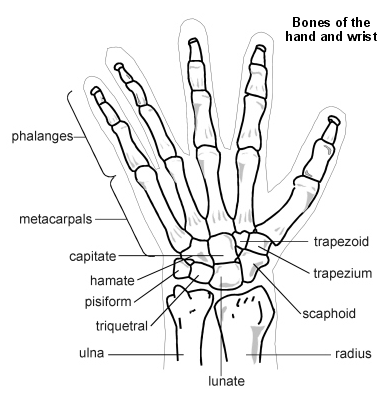
There are two bones in the part of the arm between the elbow and the wrist (the forearm). These bones are called the radius and the ulna.
The radius is on the thumb side of the wrist and the ulna is on the little finger side.
In the hand, there are eight small bones known as the carpal bones. They are arranged in two rows, one on top of the other.
The proximal row is the row that is closest to the arm. In the proximal row are the scaphoid, lunate, triquetrum and pisiform bones. The distal row is the row below this nearest to the hand. In the distal row are the hamate, capitate, trapezoid and trapezium bones.
The scaphoid bone is one of the largest of the carpal bones and is on the thumb side of the wrist. It looks a bit like a cashew nut and is roughly the same size. It links the two rows of carpal bones together and actually helps to stabilise them. The scaphoid bone and the lunate bone connect with the radius at the wrist joint.
Selecciones del paciente para Fracturas

Huesos, articulaciones y músculos
Recuperación de una fractura pélvica
Es probable que una fractura pélvica grave requiera una larga terapia física y rehabilitación. Los tiempos de recuperación también dependen de otros daños que hayas experimentado, particularmente en los nervios que van a tus piernas.
por el Dr. Colin Tidy, MRCGP

Huesos, articulaciones y músculos
Fracturas pélvicas
The pelvis is a ring of bone at hip level, made up of several separate bones. A fracture in the pelvis is a break in any one of those bones. A pelvic fracture usually involves more than one break; this is because of the shape of the pelvis - it is impossible to make one break in a circle. Sometimes a small crack on the edge of a pelvic bone can occur alone.
por la Dra. Toni Hazell, MRCGP
Preguntas frecuentes
What is the typical recovery period for a scaphoid fracture?
If a scaphoid fracture is treated with a cast, it is usually worn for 6-12 weeks until the bone heals. In some cases, it might be needed for longer. If surgery is chosen, some argue it allows normal wrist movement to return more quickly, enabling a faster return to usual activities.
Will I experience ongoing problems with my wrist after a scaphoid fracture has healed?
A scaphoid fracture usually heals well if treated early. However, complications can occur, such as ongoing pain and loss of function if left untreated. Even with treatment, issues like delayed union, non-union, malunion (bones healing in the wrong position), or avascular necrosis can lead to long-term problems, including osteoarthritis.
What does 'non-union' mean in the context of a scaphoid fracture?
Non-union means that the scaphoid fracture has not healed at all, and the fragments of the bone remain completely separated. This can happen if treatment is delayed, or due to the specific position of the fracture, whether it's displaced, or if avascular necrosis is present.
Is it always easy to tell if I've broken my scaphoid bone?
No, it can sometimes be quite difficult to diagnose a scaphoid fracture. The symptoms, such as pain, bruising, or swelling around the wrist, can be mild. Many people mistakenly think they just have a wrist sprain and might not seek medical attention for some time, delaying the diagnosis.
Why might a doctor suggest a CT or MRI scan if an X-ray doesn't clearly show a scaphoid fracture?
Standard X-rays may not always show a scaphoid fracture, sometimes because the bone can be hidden by others, or because the fracture might not appear on an X-ray until 10-14 days after the injury. If there's still uncertainty after initial X-rays and a repeat X-ray, a CT or MRI scan might be suggested as they offer more detailed images to look for the fracture.
What is avascular necrosis and why is it a concern with scaphoid fractures?
Avascular necrosis happens when the blood supply to part of the scaphoid bone is cut off, causing that part of the bone to 'die', collapse, and break up. This is a concern because the primary blood supply to the scaphoid enters at its narrowest part (the waist), which is a common site for fractures. If this blood supply is disrupted, it impairs the bone's ability to heal properly.
Lecturas adicionales y referencias
- Mallee WH, Wang J, Poolman RW, et al; Computed tomography versus magnetic resonance imaging versus bone scintigraphy for clinically suspected scaphoid fractures in patients with negative plain radiographs. Cochrane Database Syst Rev. 2015 Jun 5;(6):CD010023. doi: 10.1002/14651858.CD010023.pub2.
- Clementson M, Bjorkman A, Thomsen NOB; Acute scaphoid fractures: guidelines for diagnosis and treatment. EFORT Open Rev. 2020 Feb 26;5(2):96-103. doi: 10.1302/2058-5241.5.190025. eCollection 2020 Feb.
- Mallee WH, Walenkamp MMJ, Mulders MAM, et al; Detecting scaphoid fractures in wrist injury: a clinical decision rule. Arch Orthop Trauma Surg. 2020 Apr;140(4):575-581. doi: 10.1007/s00402-020-03383-w. Epub 2020 Mar 3.
- Seltser A, Suh N, MacDermid JC, et al; The Natural History of Scaphoid Fracture Malunion: A Scoping Review. J Wrist Surg. 2020 Apr;9(2):170-176. doi: 10.1055/s-0039-1693658. Epub 2019 Jul 21.
- Backer HC, Wu CH, Strauch RJ; Systematic Review of Diagnosis of Clinically Suspected Scaphoid Fractures. J Wrist Surg. 2020 Feb;9(1):81-89. doi: 10.1055/s-0039-1693147. Epub 2019 Jul 21.
- Grewal R, Suh N, MacDermid JC; The Missed Scaphoid Fracture-Outcomes of Delayed Cast Treatment. J Wrist Surg. 2015 Nov;4(4):278-83. doi: 10.1055/s-0035-1564983.
- Jain R, Jain N, Sheikh T, et al; Early scaphoid fractures are better diagnosed with ultrasonography than X-rays: A prospective study over 114 patients. Chin J Traumatol. 2018 Aug;21(4):206-210. doi: 10.1016/j.cjtee.2017.09.004. Epub 2018 Jan 31.
Continúa leyendo abajo
Sobre el autorVer biografía completa

Dra. Toni Hazell, MRCGP
MBBS, BSc, MRCGP, DFSRH, Dip GU med, DRCOG, DCH (London, UK, 2000)
La Dra. Toni Hazell se graduó de la Escuela de Medicina del Hospital St. Mary y realizó su VTS en el Hospital Northwick Park.
Acerca del revisorVer biografía completa

Dr Colin Tidy, MRCGP
Médico General, Autor Médico
MBBS, MRCGP, MRCP (Paediatrics), DCH
El Dr. Colin Tidy es un médico del NHS, con sede en Oxfordshire.
Historial del artículo
La información en esta página está escrita y revisada por pares por clínicos calificados.
Próxima revisión: 13 de septiembre de 2028
15 Sept 2023 | Última versión

Pregunta, comparte, conecta.
Navega por discusiones, haz preguntas y comparte experiencias en cientos de temas de salud.

¿Te sientes mal?
Evalúa tus síntomas en línea de forma gratuita
Suscríbete al boletín de Patient
Tu dosis semanal de consejos de salud claros y confiables, escritos para ayudarte a sentirte informado, seguro y en control.
Al suscribirte aceptas nuestros Política de Privacidad. Puedes darte de baja en cualquier momento. Nunca vendemos tus datos.