Quiste pilonidal
Revisado por pares por Dr Surangi Mendis, MRCGPÚltima actualización por Dr Philippa Vincent, MRCGPÚltima actualización 10 Ago 2023
Cumple con las directrices editoriales
- DescargarDescargar
- Compartir
- Language
- Discusión
- Versión en audio
A pilonidal sinus is an infected tract under the skin between the buttocks. Treatment commonly involves an operation. After the operation it is advised that the area should be kept the area free of growing hair by regular shaving or other means of hair removal.
En este artículo:
Videos seleccionados para Otras infecciones
Continúa leyendo abajo
What is a pilonidal sinus?
Diagram detailing the natal cleft
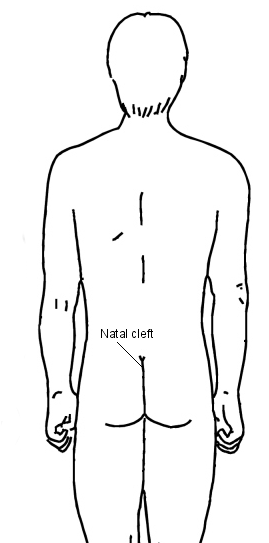
Pilonidal means a 'nest of hairs'.
A sinus tract is a narrow tunnel (a small abnormal channel) in your body. A sinus tract typically goes between a focus of infection in deeper tissues to the skin surface. This means that the tract may discharge pus from time to time on to the skin.
A pilonidal sinus is a sinus tract which commonly contains hairs. It occurs under the skin between the buttocks (the natal cleft) a short distance above the back passage (anus). The sinus tract goes in a vertical direction between the buttocks. Rarely, a pilonidal sinus occurs in other sites of the body.
The pilonidal sinus usually starts as a pilonidal cyst. This is the lump before the sinus develops. However in practice the terms tend to be used interchangeably.
What causes a pilonidal sinus?
Volver al contenidoThe exact cause is not clear. There are various theories including:
Birth abnormality
One theory is that the problem may develop from a minor abnormality in the skin between the buttocks that was present at birth. This may explain why the condition tends to run in some families. Part of the abnormality in this part of the skin may be that the hairs grow into the skin rather than outwards.
Skin dimples
Another theory is that skin dimples (skin pits) may develop in the skin between the buttocks as a result of local pressure or friction causing damage to the small structures below the skin, responsible for making hairs (the hair follicles). Because of local pressure, hair growing in the natal cleft may become pushed into the skin pits.
Whatever the cause, once hair fragments become 'stuck' in the skin they irritate it and cause inflammation. Inflamed skin quickly becomes infected and so a repeated (recurrent) or persistent infection tends to develop in the affected area. The infection causes the sinus (which often contains broken pieces of hair) to develop .
(A similar condition can occur between the fingers of hairdressers which is caused by customers' hairs entering moist, damaged skin.)
Continúa leyendo abajo
How common is pilonidal sinus?
Volver al contenidoThis condition affects around 26 in 100,000 people each year in the UK. It is rare in children and in people over the age of 40. It is four times more common in men than in women (as men tend to have more body hair than women).
Certain factors increase the risk of developing the condition and include:
Having a job involving a lot of sitting (a sedentary occupation).
Being overweight or obese.
Having a previous persistent irritation or injury to the affected area.
Having a hairy, deep natal cleft.
Having a family history of the condition.
This condition used to be called 'jeep seat' as it was common in army jeep drivers. This was probably a result of many hours of driving and 'bouncing' on a hard seat, which caused irritation, minor injury and pressure around the natal cleft.
It used to be thought that excessive sweating was one of the causes but recent studies have not shown this.
Pilonidal sinus symptoms
Volver al contenidoA pilonidal sinus may not cause any symptoms at first. Some people notice a painless lump at first in the affected area when washing. However, in most cases, symptoms develop at some stage and can be 'acute' or 'chronic'.
Rapid-onset (acute) symptoms
Pain and swelling may develop over a number of days as a ball of pus with surrounding skin infection (an infected abscess) develops in and around the sinus. This can become very painful and tender.
Persistent (chronic) symptoms
Around 4 in 10 people have a repeated (recurrent) pilonidal sinus. Some pain may develop which is less intense than the acute symptoms. Usually the sinus discharges some pus which releases the pressure and so the pain tends to ease off and not become severe. However, the infection does not clear completely. This can mean that the symptoms of pain and discharge can last long-term, or flare up from time to time, until the sinus is treated by an operation.
Continúa leyendo abajo
Is pilonidal sinus dangerous?
Volver al contenidoPilonidal sinuses are not dangerous in themselves. Recurrent infections can be painful and require multiple courses of antibiotics. There is some evidence that untreated, recurrently infected pilonidal sinuses can develop into a squamous cell carcinoma of the skin. This is a very rare complication.
Pilonidal sinus treatment
Volver al contenidoIf you have no symptoms
If there are no symptoms then keeping the affected area clear of hairs (by shaving, etc) and keeping the area clean with good personal hygiene may be all that is required.
If you have rapid-onset (acute) symptoms
If there is an infection then antibióticos will usually be prescribed. Painkillers (such as paracetamol y/o ibuprofeno) may be very helpful to improve the pain. An emergency operation is sometimes required. This procedure punctures (incises) and drains the ball of pus with the surrounding skin infection (abscess).
If you have persistent (chronic) symptoms
In most cases, an operation will be advised. There are various operations which are done to cure this problem. A surgeon will be able to give the details and the pros and cons of each operation. The options include the following:
Wide excision and healing by secondary intention.
This operation involves cutting out (excision of) the sinus but also cutting out a wide margin of skin which surrounds the sinus. The wound is not closed but just left open to heal by natural healing processes (healing by 'secondary intention'). This usually requires several weeks of regular dressing changes until it heals fully. The advantage of this method is that all inflamed tissue is removed and the chance of the condition coming back (a recurrence) is low.
Excision and primary closure.
This means taking out the section of skin which contains the sinus. This is done by cutting out an oval-shaped (ellipse) flap of skin either side of the sinus, which takes out the sinus. The two sides of the ellipse are then stitched together.
The advantage for this is that, if successful, the wound heals quite quickly. The risk of a recurrence or of developing a wound infection after the operation is higher than with the above procedure. This risk may be reduced by using a wound technique in which the line of stitches is moved away from between the buttocks.
A plastic surgery technique
In some cases, where the sinus recurs or is extensive, plastic surgery may be advised to remove the sinus and refashion the nearby skin.
There are variations on the above procedures, depending on the circumstances, the size and extent of the sinus, and whether it is a first or recurrent problem. A surgeon will be able to discuss the most suitable type of operation.
New techniques are being researched to try to improve the recovery after having an operation.
After your operation
Volver al contenidoThe surgeon will usually advise that the wound should be kept clean and any hair growing near it be shaved or removed by other means. Some surgeons recommend that, even when the wound is healed, the area should be kept free of hair growing by shaving the area every few weeks, or by other methods to remove the hair. This reduces the chance of the problem coming back (recurring).
Selecciones del paciente para Otras infecciones

Infecciones
Osteomielitis
Osteomyelitis is an infection of a bone. Symptoms include pain and tenderness over the affected area of bone, and feeling unwell. It is a serious infection which needs prompt treatment with antibiotic medication. Surgery may be needed if the infection becomes severe or persistent.
por la Dra. Surangi Mendis, MRCGP

Infecciones
enfermedad de Lyme
Lyme disease is an infection caused by being bitten by an infected tick. The first and most common symptom is a rash that spreads out from the site of the tick bite. Left untreated, the germs (bacteria) can spread to other areas of the body. In some cases this can cause serious symptoms - often months after the initial tick bite. A course of antibiotic medication will usually clear the infection.
por la Dra. Philippa Vincent, MRCGP
Lecturas adicionales y referencias
- de Parades V, Bouchard D, Janier M, et al; Pilonidal sinus disease. J Visc Surg. 2013 Sep;150(4):237-47. doi: 10.1016/j.jviscsurg.2013.05.006. Epub 2013 Aug 1.
- Garg P, Menon GR, Gupta V; Laying open (deroofing) and curettage of sinus as treatment of pilonidal disease: a systematic review and meta-analysis. ANZ J Surg. 2016 Jan;86(1-2):27-33. doi: 10.1111/ans.13377. Epub 2015 Nov 27.
- Mahmood F, Hussain A, Akingboye A; Pilonidal sinus disease: Review of current practice and prospects for endoscopic treatment. Ann Med Surg (Lond). 2020 Aug 1;57:212-217. doi: 10.1016/j.amsu.2020.07.050. eCollection 2020 Sep.
- Rethinking the causes of pilonidal sinus disease; Doll et al
- Pandey MK, Gupta P, Khanna AK; Squamous cell carcinoma arising from pilonidal sinus. Int Wound J. 2014 Aug;11(4):354-6. doi: 10.1111/j.1742-481X.2012.01096.x. Epub 2012 Oct 11.
Continúa leyendo abajo
Historial del artículo
La información en esta página está escrita y revisada por pares por clínicos calificados.
Próxima revisión: 8 de agosto de 2028
10 Ago 2023 | Última versión

Pregunta, comparte, conecta.
Navega por discusiones, haz preguntas y comparte experiencias en cientos de temas de salud.

¿Te sientes mal?
Evalúa tus síntomas en línea de forma gratuita
Suscríbete al boletín de Patient
Tu dosis semanal de consejos de salud claros y confiables, escritos para ayudarte a sentirte informado, seguro y en control.
Al suscribirte aceptas nuestros Política de Privacidad. Puedes darte de baja en cualquier momento. Nunca vendemos tus datos.