Dermatitis seborreica infantil
Revisado por pares por Dr Krishna Vakharia, MRCGPÚltima actualización por Dr Colin Tidy, MRCGPÚltima actualización 15 de diciembre de 2022
Cumple con las directrices editoriales
- DescargarDescargar
- Compartir
- Language
- Discusión
- Versión en audio
- Agregar a fuentes preferidas en Google
Profesionales Médicos
Los artículos de Referencia Profesional están diseñados para ser utilizados por profesionales de la salud. Están escritos por médicos del Reino Unido y se basan en evidencia de investigación, así como en guías del Reino Unido y Europa. Puede encontrar el Dermatitis seborreica en bebés artículo más útil, o uno de nuestros otros artículos de salud.
Synonym: cradle cap
What is seborrhoeic dermatitis?1
Seborrhoeic dermatitis is a common skin condition in infants, adolescents, and adults. The characteristic symptoms-scaling, erythema, and itching-occur most often on the scalp, face, chest, back, axilla, and groin.
In infants, seborrhoeic dermatitis typically causes yellow crusty greasy scaling. This is most frequently found on the scalp and, when confined to the scalp, is known as 'cradle cap'.
In adults, seborrhoeic dermatitis usually starts around puberty.
Ver el separado Dermatitis Seborreica artículo.
Patogénesis1
Seborrhoeic dermatitis is a papulosquamous disorder affecting the areas with most sebum, such as the scalp, face, and trunk. There is known to be an association with skin yeasts of Malassezia spp. This is thought to be due to a reaction to the yeast, rather than a simple infection. Overactivity of the sebaceous glands in the newborn may be a factor.
How common is seborrhoeic dermatitis in infants? (Epidemiology)2
Seborrhoeic dermatitis is extremely common in infants. Many children with the condition are not brought to the attention of the medical services and so the precise incidence is unknown. It most commonly presents in the first six weeks, and the majority resolve over the next few weeks. Less commonly, it persists for 6-9 months or more.
Seborrhoeic dermatitis symptoms3
Seborrhoeic dermatitis presenting in infancy is a very common condition which may be brought to the attention of the health visitor or GP.
In the majority of cases it is a benign self-limiting condition which usually clears spontaneously during the first 6-12 months of life but, in a small number, it can be particularly troublesome and require treatment.
Infant seborrhoeic dermatitis occurs most commonly in the lipid-rich areas of skin and, in infants, occurs predominantly on the scalp and upper face, producing an appearance which may give rise to some concern from parents. It may also occur behind the ears and in the creases of the neck, axillae and groins.
Cradle cap
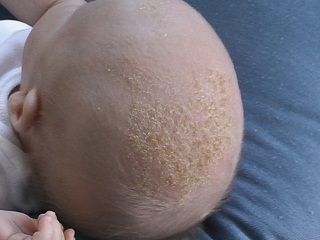
© Image via Wikimedia Commons
Cradle cap is very common and usually appears in the first few weeks of life. There are greasy, yellow scaling patches that may eventually coalesce to a thick, scaly layer. The condition is not usually itchy and the child is not distressed by it. There may be loss of small amounts of hair in the area of scalp affected. There may be some areas of redness around the plaques. It tends to be very scaly on the scalp, whereas in the flexural areas it may be more erythematous in nature4 .
Diagnóstico diferencial3 4
Areas of reddened skin with scales may be mistaken for atopic eczema.
If the plaques become infected, they may resemble impétigo.
Nappy rash or candidiasis in the groin and perianal areas (the rash of seborrhoeic dermatitis is usually sharply demarcated and brightly erythematous).
La psoriasis may cause confusion and can look extremely similar in babies.5 . Indeed there are some who are of the opinion that seborrhoeic dermatitis in the nappy area is in fact psoriasis.6 .
Fungal infections - eg, tinea.
Irritant or contact dermatitis.
Investigaciones
Usually no investigation is required and the diagnosis is made on clinical appearance alone.
Infant seborrhoeic dermatitis is uncommon in pre-adolescent children and tinea capitis is uncommon after adolescence. Dandruff in a child is more likely to represent a fungal infection. A fungal culture may aid the diagnosis but the disease may occur with a negative culture and a positive culture is not diagnostic.
Infant seborrhoeic dermatitis treatment3
Reassurance - typically resolves spontaneously within a few months.
Scalp is affected ( most common presentation):
Advise massage a topical emollient onto the scalp to loosen scales, brush gently with a soft brush and wash off with shampoo.
If not effective, consider topical imidazole cream (clotrimazole 1% or miconazole 2% cream) daily for up to 4 weeks.
If symptoms persist longer than 4 weeks with treatment, seek specialist advice.
Areas other than the scalp (including the nappy area):
Advise bathing the infant every day using an emollient as a soap substitute. Avoid soaps/detergents and vigorous cleansing.
Encourage frequent nappy changes and use of barrier emollients such as Zinc and Castor Oil ointment BP, or white soft paraffin BP ointment.
Consider a topical imidazole (clotrimazole 1% or miconazole 2%) for up to 4 weeks until symptoms resolve.
If symptoms persist longer than 4 weeks with treatment, seek specialist advice.
Low potency topical corticosteroids (such as 1% hydrocortisone) may be helpful for some infants with nappy rash.
Derivación3
Consider referral to a dermatologist/paediatrician if there is:
Severe or widespread seborrhoeic dermatitis: consider possible underlying conditions such as immunodeficiency.
Incertidumbre diagnóstica.
Failure to respond to routine treatment.
Complicaciones3 7
Secondary infection can occur occasionally.
Leiner's disease (severe generalised seborrhoeic dermatitis - lesions become confluent and there is widespread redness and scaling). The child becomes unwell with diarrhoea, vomiting and anaemia.
Pronóstico
This condition usually resolves spontaneously within three to four months.8 In some it takes 6-9 months or longer. The majority of children with infant seborrhoeic dermatitis will have complete resolution and have no further skin disease. It is not known whether they have an increased risk of seborrhoeic dermatitis later in life.4
Actualizaciones exclusivas para profesionales de la salud
Mantente informado con las últimas actualizaciones clínicas, perspectivas profesionales y orientación basada en evidencia. El boletín de Patient Pro selecciona contenido esencial para profesionales de la salud, entregado directamente en tu bandeja de entrada.
Al suscribirte aceptas nuestros Política de Privacidad. Puedes darte de baja en cualquier momento. Nunca vendemos tus datos.
Lecturas adicionales y referencias
- Clark GW, Pope SM, Jaboori KA; Diagnosis and treatment of seborrheic dermatitis. Am Fam Physician. 2015 Feb 1;91(3):185-90.
- Cradle cap (infantile seborrhoeic dermatitis); DermNet NZ
- Dermatitis seborreica; NICE CKS, noviembre 2024 (acceso solo en el Reino Unido)
- O'Connor NR, McLaughlin MR, Ham P; Piel del recién nacido: Parte I. Erupciones comunes. Am Fam Physician. 1 de enero de 2008;77(1):47-52.
- Sampaio AL, Mameri AC, Vargas TJ, et al; Seborrheic dermatitis. An Bras Dermatol. 2011 Nov-Dec;86(6):1061-71; quiz 1072-4.
- Seborrhoeic eczema; Sociedad de Dermatología de Atención Primaria (PCDS)
- Leiner disease; DermNet NZ
- Gary G; Optimizing treatment approaches in seborrheic dermatitis. J Clin Aesthet Dermatol. 2013 Feb;6(2):44-9.
Sobre el autorVer biografía completa

Dr Colin Tidy, MRCGP
Médico General, Autor Médico
MBBS, MRCGP, MRCP (Paediatrics), DCH
El Dr. Colin Tidy es un médico del NHS, con sede en Oxfordshire.
Acerca del revisorVer biografía completa

Dr Krishna Vakharia, MRCGP
Director Médico de Salud, Optum UK
MBChB, MRCGP(2013), BMedSci (hons), DFSRH, DRCOG, PGDipDerm (Distn)
La Dra. Krishna Vakharia es una médica general del NHS. También es examinadora habitual del Diploma de Posgrado en Dermatología Práctica en la Universidad de Cardiff, además de ser la Directora Médica de salud en Optum UK.
Historial del artículo
La información en esta página está escrita y revisada por pares por clínicos calificados.
Artículo también disponible en Inglés, Alemán, Español, Francés, Italiano, Portugués, Hindi, Hebreo, Árabe, y Sueco.
Próxima revisión: 14 de diciembre de 2027
15 de diciembre de 2022 | Última versión

Pregunta, comparte, conecta.
Navega por discusiones, haz preguntas y comparte experiencias en cientos de temas de salud.

¿Te sientes mal?
Evalúa tus síntomas en línea de forma gratuita
Más en pediatría
- Otitis media aguda en niños
- Infecciones antenatales y sus consecuencias
- Dolor de espalda en niños
- Tratamiento a ciegas de infección bacteriana
- Nutrición infantil
- Tos crónica en niños
- Síndrome de rubéola congénita
- Retraso en el caminar
- Depresión en niños y adolescentes
- Erythema marginatum rheumatica
- Síndrome de alcoholismo fetal
- Malabsorción gastrointestinal
- Trastornos del almacenamiento de glucógeno
- Púrpura de Henoch-Schönlein
- Síndrome de talla baja hiperfágica
- PANDAS
- Pubertad precoz
- Rotavirus y vacunación contra el rotavirus
- Baja estatura
- Problemas de sueño en niños