Arthroscopy and arthroscopic surgery
Peer reviewed by Dr Toni Hazell, FRCGPLast updated by Dr Rachel Hudson, MRCGPLast updated 20 Oct 2024
Meets Patient’s editorial guidelines
- DownloadDownload
- Share
- Language
- Discussion
- Audio Version
- Add to preferred sources on Google
In this series:Joint painDislocation
Arthroscopy is a surgical procedure which uses a thin telescope with a light source (an arthroscope) to look inside joints. As well as being able to look inside, the surgeon can use an arthroscope to perform keyhole surgery. Arthroscopy is most often used to investigate or treat knee problems. Arthroscopy can also be used for other joints, including the shoulder, hip, elbow, wrist and ankle joints, and even for hand or foot problems.
Note: the information below is a general guide only. The arrangements, and the way tests are performed, may vary between different hospitals. Always follow the instructions given by your doctor or local hospital.
At a glance
An arthroscopy uses a thin telescope to look inside a joint.
Keyhole surgery can be done through small cuts in the skin during an arthroscopy.
This procedure can remove damaged tissue or repair torn ligaments.
Compared to traditional surgery, arthroscopy usually causes less pain and allows quicker recovery.
Recovery time varies from one week to several months.
See a doctor urgently if you have worsening pain or swelling, a high temperature, or fluid coming from the cut.
What is an arthroscopy?
Arthroscopy is a procedure to look inside a joint by using an arthroscope. An arthroscope is like a thin telescope with a light source. It is used to light up and magnify the structures inside a joint. An arthroscope is passed through a small cut (incision) in the skin and into a joint.
Arthroscopy may be done to investigate symptoms such as pain, swelling, or instability of a joint. An arthroscopy may show damage to cartilage or ligaments within a joint, fragments of bone or cartilage which have broken off (loose bodies), or signs of arthritis.
What is arthroscopic surgery?
In addition to simply looking inside, a doctor can use fine instruments which are also passed into the joint through a small incision in the skin (keyhole surgery). These instruments are used to cut, trim, take a sample to be studied under a microscope (biopsy), grab, etc, inside the joint. Arthroscopic surgery can be used for various procedures which include:
Taking out small bits of bone or cartilage that have broken off into the joint space.
Repairing or taking out torn ligaments.
Removing damaged cartilage.
Removing tissue surrounding the joint (synovium), which has become inflamed.
About 17 in 20 arthroscopic procedures are done on the knee joint, about 2 in 20 involve the shoulder, and a small number are done on other joints, including the ankle, elbow, wrist and hip.
Why is it done?
Arthroscopic surgery can often treat or repair joints without the need for a more traditional open surgery of a joint, which involves a large cut (incision). As a rule, compared with traditional surgery of a joint, with arthroscopic surgery there is usually:
Less pain following the procedure.
Less risk of complications.
A shorter hospital stay (it is often done as a day-case procedure).
A quicker recovery.
How is it done?
Arthroscopy and arthroscopic surgery may be done under local or general anaesthesia. The type of anaesthesia chosen depends on the joint being examined and on various other considerations. The skin over the joint will be cleaned. You will be asked to adopt a position best suited for the procedure.
For example, you may need to lie on your back with your knee bent for knee procedures, or lie on your side for shoulder procedures, etc. For arthroscopy of the knee a pressure band (tourniquet) may be put around the upper part of the leg to restrict blood flow.
The surgeon makes a small cut (incision) next to the joint - just a few millimetres long. The thin telescope with a light source (the arthroscope) is pushed through the incision into the joint. An arthroscope used for the knee joint is about the width of a pencil. A thinner one is used for smaller joints such as the wrist and ankle. One or more separate incisions are made to enable the surgeon to insert:
A thin examining probe into the joint; or
Fine instruments which are used for surgery; or
Fluid to make viewing easier and to flush out the joint.
The arthroscope transmits pictures through a camera attachment on to a viewing screen. By looking at the screen, the surgeon can see inside the joint, including the ends of the probe or operating instruments. So, for much of the time, the surgeon is watching the viewing screen to guide him or her in manipulating the instruments within the joint.
When the procedure is finished, the arthroscope and other instruments are removed. The incisions may need a stitch or two but stitches are often not needed, as the incisions are so small. A sterile dressing is put over the incisions. An ice pack may be applied for a while to minimise any swelling. Depending on what was done and the problem you have, a knee joint may then be covered with a large bandage or other knee support.
Many people can go home shortly after the procedure. The type of problems differ. Therefore, instructions for follow-up and what you should and should not do will be given to you by a doctor or nurse. (For example, if you should have physiotherapy, or if you should rest, or if you should exercise, etc.)
Recovery
Recovery from arthroscopy can take as little as a week, or up to several months, depending on what procedure was done, which joint was operated on, if there are any complications, and your general health and fitness otherwise.
Understanding joints
Cross-section diagram of a normal joint
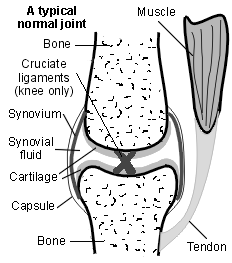
The place where two bones meet is called a joint. Joints allow movement and flexibility of various parts of the body. The movement of the bones is caused by muscles which pull on tendons that are attached to bone.
Cartilage covers the end of bones. Between the cartilage of two bones which form a joint there is a small amount of thick fluid called synovial fluid. This fluid lubricates the joint which allows smooth movement between the bones.
The synovial fluid is made by the tissue surrounding a joint (the synovium). The outer part of the synovium is called the capsule. This is tough, gives the joint stability and stops the bones from moving 'out of joint'. Surrounding ligaments and muscles also help to give support and stability to joints.
In the knee joint, the cartilage covering the lower part of the joint is thickened in the inner and outer part of the joint. These two areas of cartilage are sometimes called menisci. The menisci act like shock absorbers in the knee and are sometimes torn following a knee injury. Also, there are two strong cross-shaped (cruciate) ligaments in the middle of the knee joints, which are attached to the ends of the calf bone (tibia) and the thigh bone (femur). These also can be torn following a knee injury.
Are there any possible complications?
In most cases the procedure is done without any problems. Complications are generally rare but can include:
Accidental damage to structures inside or near to the joint.
Excessive bleeding inside the joint which can cause a lot of swelling and pain.
Infection within the joint - this can be serious.
As with any operation, there is a risk of allergy to local anaesthetics, or complications of anaesthesia if a general anaesthetic is used.
After arthroscopy or arthroscopic surgery, see a doctor urgently if you:
Have pain or swelling in the joint, which becomes worse. In particular, if the joint is also hot, tender and red. (This may indicate bleeding or infection in the joint.)
Develop a high temperature.
See fluid, pus or blood coming from the site of the cut (incision).
Develop numbness or tingling near to the joint (which may indicate nerve damage).
Patient picks for General surgery and procedures

Surgery and procedures
Vasectomy
Vasectomy is a a form of birth control where a man undergoes a small operation to cut the end of the vas deferens tube. This is the tube that takes sperm from the testicles (testes) to the penis. Sperm are made in the testes. Once the vas deferens is cut, sperm can no longer get into the semen that comes out (is ejaculated) during sexual intercourse. Vasectomy is very reliable - but not quite 100%. Even after a successful operation about 1 in 2,500 men who have had a vasectomy will become fertile again at some point in the future. This is because, rarely, the two ends of the cut vas deferens re-unite over time.
by Dr Philippa Vincent, MRCGP

Surgery and procedures
Colposcopy and cervical treatments
Colposcopy is a detailed examination of the neck of the womb (cervix). It is usually carried out in a colposcopy clinic by a doctor or specialist nurse.
by Dr Philippa Vincent, MRCGP
Frequently asked questions
What is the difference between an arthroscopy and arthroscopic surgery?
An arthroscopy is a diagnostic procedure where a surgeon looks inside a joint using a thin telescope (arthroscope) to investigate symptoms like pain or swelling. Arthroscopic surgery, on the other hand, involves using fine instruments passed through small incisions in addition to the arthroscope to perform surgical tasks like repairing torn ligaments or removing damaged cartilage.
Which joints can be examined or operated on using arthroscopy?
While about 17 out of 20 arthroscopic procedures are performed on the knee joint and about 2 out of 20 on the shoulder, this procedure can also be used for other joints. These include the ankle, elbow, wrist, and hip joints.
How big are the incisions made during an arthroscopy?
The surgeon makes very small incisions, typically just a few millimetres long, next to the joint. These small cuts allow for the insertion of the arthroscope and other fine surgical instruments.
What is the role of the viewing screen during an arthroscopy?
During the procedure, the arthroscope transmits pictures to a viewing screen. The surgeon watches this screen to see inside the joint and guide their instruments, enabling precise manipulation within the joint without needing a large open incision.
What kind of support might I need for my knee after an arthroscopy?
Depending on the specific procedure and your condition, your knee joint might be covered with a large bandage or other knee support after an arthroscopy. You will receive specific instructions from your doctor or nurse regarding its use.
Further reading and references
- Crawford R, Walley G, Bridgman S, et al; Magnetic resonance imaging versus arthroscopy in the diagnosis of knee pathology, concentrating on meniscal lesions and ACL tears: a systematic review. Br Med Bull. 2007;84:5-23. Epub 2007 Sep 3.
- Harris JD, Brophy RH, Siston RA, et al; Treatment of chondral defects in the athlete's knee. Arthroscopy. 2010 Jun;26(6):841-52.
About the authorView full bio

Dr Rachel Hudson, MRCGP
General Practitioner and Medical Author
MBChB, MRCGP (2008), BSc (Medical Science), DFSRH, DRCOG, DCH
Dr Rachel Hudson, is an NHS GP working in the North West of England.
About the reviewerView full bio

Dr Toni Hazell, FRCGP
MBBS, BSc, FRCGP, DFSRH, Dip GU med, DRCOG, DCH (London, UK, 2000)
Dr. Toni Hazell qualified from St. Mary’s Hospital Medical School and did her VTS at Northwick Park Hospital.
Article history
The information on this page is written and peer reviewed by qualified clinicians.
Article also available in English, German, Spanish, French, Italian, Portuguese, Hindi, Hebrew, Arabic, and Swedish.
Next review due: 19 Oct 2027
20 Oct 2024 | Latest version
Join the conversation
Share your thoughts or experiences with others in our patient communities.

Ask, share, connect.
Browse discussions, ask questions, and share experiences across hundreds of health topics.

Feeling unwell?
Assess your symptoms online for free
Sign up to the Patient newsletter
Your weekly dose of clear, trustworthy health advice - written to help you feel informed, confident and in control.
By subscribing you accept our Privacy Policy. You can unsubscribe at any time. We never sell your data.
More in surgery and procedures
- Anaesthesia
- Anaesthetic for hip or knee replacement
- Bone marrow biopsy and aspiration
- Botox
- Breast reduction
- Hysterectomy
- Kidney transplant
- Laparoscopy and laparoscopic surgery
- Laser hair removal
- Lip enhancement
- Liver biopsy
- Local anaesthesia for your eye operation
- Nasoendoscopy
- Nerve damage after epidural injection
- Nose reduction surgery (rhinoplasty)
- Post-dural puncture headache
- Post-operative chest infection
- Pulmonary embolism
- Vasectomy
- Video-assisted thoracoscopic surgery