Verrugas seborréicas
Revisado por pares por Dr Doug McKechnie, MRCGPÚltima actualización por Dr Colin Tidy, MRCGPÚltima actualización 19 Jul 2024
Cumple con las directrices editoriales
- DescargarDescargar
- Compartir
- Language
- Discusión
- Versión en audio
- Agregar a fuentes preferidas en Google
En esta serie:Verrugas y verrugas plantares
Las verrugas seborréicas son proliferaciones verrugosas benignas que aparecen en la piel. Por lo general, no requieren ningún tratamiento.
De un vistazo
Seborrhoeic warts are greasy or crusty spots that look like they are stuck on the skin.
They are usually dark brown or black, round, and vary in size.
They commonly appear after age 40 and are not infectious.
Seborrhoeic warts are normally harmless and do not become cancerous.
They can be removed if they itch, interfere with clothing, or are unsightly.
See your doctor if a seborrhoeic wart changes or if many suddenly appear.
What are seborrhoeic warts?
Seborrhoeic warts are also known as seborrhoeic keratoses or basal cell papillomas. In the past they were also called senile warts.
They usually look like greasy or crusty spots which seem to be stuck on to the skin. The colour varies but usually they are darkish brown or black. Seborrhoeic warts can occur almost anywhere on the body, but particularly on the face, chest, scalp, back and groin.
Dermatosis papulosa nigra are multiple, small, 1–5 mm diameter, smooth, firm, black or dark brown papules on face and neck. They common in people with darker skin tones. Their appearance is identical to small seborrhoeic warts.
What do seborrhoeic warts look like?
They are usually round although they can also be oval in shape. Some seborrhoeic warts have an irregular shape. Their size can vary from around one centimetre to several centimetres in diameter.
Black pigmented verrucous lesion
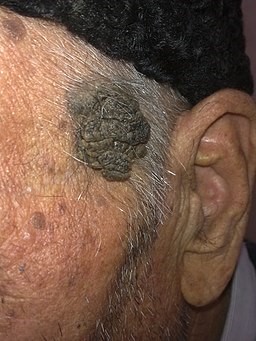
© Alborz Fallah, CC BY-SA 3.0, vía Wikimedia Commons
Queratosis seborreica
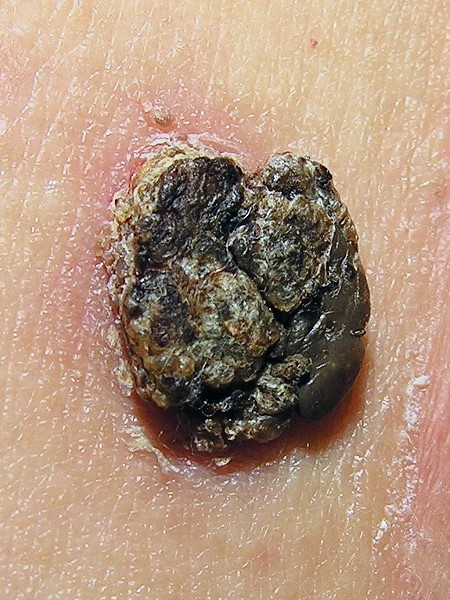
© Lmbuga, Public domain, via Wikimedia Commons
What causes seborrhoeic warts?
Seborrhoeic warts tend first to appear around the age of 40. They can sometimes run in families. The actual cause of seborrhoeic warts is unknown. It can be common to develop several seborrhoeic warts as you become older. Also, as time goes by, each wart tends to grow slightly and become darker. They can occur anywhere on your body, other than on your palms or soles, and there may be multiple lesions.
Are seborrhoeic warts serious?
No. Seborrhoeic warts are always benign. That means they do not spread and they are not cancerous. The main problem is that they can sometimes look unsightly, particularly if they develop on your face.
However, rarely, seborrhoeic warts may be associated with various cancers. The Leser-Trélat sign is rare and refers to the sudden appearance of multiple seborrhoeic warts. This sign is associated with a number of different cancers, particularly bowel, breast, or stomach, and has also been associated with cancers of the liver, kidney and pancreas.
Very rare cases have been reported of a type of skin cancer called melanoma developing within a seborrhoeic wart. It is not known if this is just a coincidence or whether it represents a true cancer change in the seborrhoeic wart. If you do notice a change in a seborrhoeic wart, it is worth asking your doctor to examine it.
Nota: although they are called warts, they are not caused by the wart virus. They are not infectious.
How are seborrhoeic warts diagnosed?
Doctors can often diagnose seborrhoeic warts by their appearance. However, if there is any doubt about the diagnosis, especially if the possibility of a more serious diagnosis such as skin cancer is suspected, then dermatoscopy may be used for a closer look at the structure of the lesion.
Dermatoscopy is a technique to examine the skin with a magnifying lens and a light. It can help diagnose skin lesions by accurate assessment of their colour, structures, patterns and borders.
Sometimes a biopsy or removal of the lesion may be needed so that the diagnosis can be confirmed by the detailed structure of the lesion (histology).
What is the treatment for seborrhoeic warts?
If they do not cause any problems then it is best that they be left alone. Without treatment, they usually continue to grow and can become darker and more crusty. However, they do increase in size very slowly.
If required, however, they can be removed quite easily. Seborrhoeic warts are usually removed because they itch, they interfere with clothing or jewellery or they are unsightly.
Two commonly used methods to remove them are:
By using a curette. This involves 'freezing' the surrounding skin with local anaesthetic. The seborrhoeic warts are then scraped off with a sharp surgical instrument called a curette.
Tratamiento con nitrógeno líquido. Liquid nitrogen is very cold and anything it touches is killed by the cold. Small amounts of liquid nitrogen can be sprayed on to small seborrhoeic warts. The seborrhoeic warts are killed and drop off a few days later. Normal skin replaces the area left behind. Liquid nitrogen is not suitable for larger warts.
Once seborrhoeic warts have been removed, they usually do not return.
Complications of seborrhoeic warts
Seborrhoeic warts do not become cancerous and are benign, unless there is a sudden appearance of multiple seborrhoeic warts, which may be associated with various cancers (see Leser-Trélat sign above).
Seborrhoeic warts way cause minor local complications such as infection, bleeding or surrounding dermatitis (eczema).
Selecciones del paciente para Otras condiciones de la piel
Salud de la piel, uñas y cabello
Sol y quemaduras solares
Este folleto discute los riesgos y beneficios de la luz solar para tu piel. Ofrece consejos sobre cómo disfrutar del sol de manera segura para que te haga bien y reduzca el riesgo de causar daño. Es muy importante proteger a los niños del sol. La piel delicada de un niño es más sensible al daño solar que la piel de un adulto.
por la Dra. Caroline Wiggins, MRCGP

Salud de la piel, uñas y cabello
Albinismo
El albinismo es una condición hereditaria (genética) rara que reduce la cantidad de pigmento de melanina en la piel, el cabello y/o los ojos. Las personas con albinismo suelen ser pálidas, con iris de color claro. Sin embargo, hay muchos tipos de albinismo y las personas pueden verse afectadas en diferentes grados.
por la Dra. Hayley Willacy, FRCGP
Preguntas frecuentes
Can seborrhoeic warts be confused with other skin conditions?
Yes, doctors often diagnose seborrhoeic warts by their appearance. However, if there is any uncertainty, especially if a more serious condition like skin cancer is suspected, further examination techniques like dermatoscopy or a biopsy might be used to confirm the diagnosis.
What should I do if a seborrhoeic wart changes in appearance?
Although seborrhoeic warts are typically benign, very rarely, a type of skin cancer called melanoma has been reported to develop within them. If you notice any change in a seborrhoeic wart, it is advisable to ask your doctor to examine it.
How long does it take for seborrhoeic warts to grow?
Seborrhoeic warts increase in size very slowly over time. They tend to grow slightly and become darker as you get older.
Are there any natural remedies for seborrhoeic warts?
The article does not discuss natural remedies for seborrhoeic warts. It focuses on medical removal options if the warts are causing problems.
If I have seborrhoeic warts, does it mean I am more likely to get cancer?
No, seborrhoeic warts themselves are benign and do not cause cancer. However, in extremely rare cases, the sudden appearance of multiple seborrhoeic warts (known as the Leser-Trélat sign) can be associated with certain internal cancers. This is a rare occurrence.
If I get a seborrhoeic wart removed, will it leave a scar?
The article states that when liquid nitrogen is used for removal, normal skin replaces the area left behind. It does not specifically mention scarring for either removal method, but the aim of such procedures is generally to minimise cosmetic impact.
Lecturas adicionales y referencias
- Seborrheic Keratosis; DermIS (Sistema de Información de Dermatología)
- Seborrhoeic Keratoses; DermNet NZ
- Queratosis seborreica; Sociedad de Dermatología de Atención Primaria
Sobre el autorVer biografía completa

Dr Colin Tidy, MRCGP
Médico General, Autor Médico
MBBS, MRCGP, MRCP (Paediatrics), DCH
El Dr. Colin Tidy es un médico del NHS, con sede en Oxfordshire.
Acerca del revisorVer biografía completa

Dr Doug McKechnie, MRCGP
Redactor Médico
MA, MBBS, MSc, DRCOG, MRCP(UK), MRCGP(2021), FHEA
El Dr. Doug McKechnie es un médico de cabecera del NHS que trabaja en Londres. Trabaja a tiempo completo en la práctica clínica y también es el Subdirector del módulo de Práctica Clínica y Profesional en la Escuela de Medicina del University College London.
Historial del artículo
La información en esta página está escrita y revisada por pares por clínicos calificados.
Artículo también disponible en Inglés, Alemán, Español, Francés, Italiano, Portugués, Hindi, Hebreo, Árabe, y Sueco.
Próxima revisión: 18 Jul 2027
19 Jul 2024 | Última versión

Pregunta, comparte, conecta.
Navega por discusiones, haz preguntas y comparte experiencias en cientos de temas de salud.

¿Te sientes mal?
Evalúa tus síntomas en línea de forma gratuita
Suscríbete al boletín de Patient
Tu dosis semanal de consejos de salud claros y confiables, escritos para ayudarte a sentirte informado, seguro y en control.
Al suscribirte aceptas nuestros Política de Privacidad. Puedes darte de baja en cualquier momento. Nunca vendemos tus datos.
Más sobre la salud de la piel, uñas y cabello
- Acné
- Pie de atleta
- Eccema atópico
- Emolientes y cremas para el eczema
- Quistes epidermoides y pilares
- Infección fúngica en la ingle
- Sarpullido por calor y sudamina
- Picadura de medusa
- Depilación láser
- Liquen plano
- Esclerodermia localizada
- Milia
- Psoriasis ungueal
- Dermatitis perioral
- Mancha de vino de Oporto
- Tiña
- Rosácea
- Herpes zóster
- Síndrome de la mejilla abofeteada