Condones para mujeres
Revisado por pares por Dr Jacqueline Payne, FRCGPÚltima actualización por Dra. Mary Harding, MRCGPÚltima actualización 22 Nov 2018
Cumple con las directrices editoriales
- DescargarDescargar
- Compartir
- Language
- Discusión
- Versión en audio
- Agregar a fuentes preferidas en Google
Esta página ha sido archivada.
No se ha revisado recientemente y no está actualizado. Los enlaces externos y las referencias pueden ya no funcionar.
The first female condom (Femidom®) was introduced in 1992. It is made of a soft plastic material. It fits into the vagina and lines the inside walls.
De un vistazo
The female condom is a barrier method of contraception and protection against STIs.
It is a soft plastic pouch that lines the vagina.
When used perfectly, about 5 women in 100 will become pregnant each year.
Always check the 'use by' date and use each condom only once.
Always read the instructions that come with the packet for correct use.
It is available for free at family planning clinics in the UK.
Do not use a male and female condom together.
The female condom is an effective method of contraception if used correctly. It also helps to protect against sexually transmitted infections.
What is the female condom?
The first female condom (Femidom®) was introduced in 1992. It is made of a soft plastic material. It fits into the vagina and lines the inside walls. It therefore forms a barrier between the man's sperm and the woman's womb.
Condón femenino
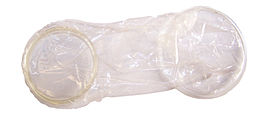
© By Ceridwen (Own work), via Wikimedia Commons
How effective is the female condom?
When no contraception is used more than 80 out of 100 sexually active women become pregnant within one year.
About 5 women in 100 will become pregnant each year, if female condoms are used perfectly for contraception. In comparison about 2 women in 100 will become pregnant each year if masculino condones are used perfectly for contraception.
Nearer to 21 women in 100 will become pregnant with normal (not perfect) usage.
Correct use means using the condom every time you have sex. It is very important to avoid any contact between the penis and the vaginal area before the condom is inserted.
How do I use a female condom?
How do you use a female condom?
You should read the instructions that come with the packet. The following is a general guide:
Check the condom is within its 'use by' date.
Use each condom only once.
Insert the closed end of the condom into the vagina. Do this by holding the inner ring between your finger and thumb and placing it as far in the vagina as possible. Then put one or two fingers inside the condom, up to the inner ring. Then push it in the vagina as far as it will go. The outer ring should then lie against the outside of the vagina.
Unlike the male condom, it is loose-fitting and will move during sex. If the outer ring gets pushed inside the vagina then stop and put it back in the right place.
Make sure the penis enters the condom during sex and does not go between the condom and the wall of the vagina.
After sex, a slight twist and pull will remove the condom. Take care not to spill any semen on to the vagina. Don't flush it down the toilet. Wrap it up and put it in a bin.
Nota: DO NOT use a male and female condom at the same time. This is more likely to result in slippage or splitting of one or both condoms. This increases your risk of getting pregnant or getting a sexually transmitted infection.
What are the advantages of the female condom?
It is safe for anybody to use a female condom and there are no side-effects or risks.
It is easy to obtain and to use.
It helps to protect against sexually transmitted infections.
It may help to protect against cancer of the neck of the womb (cervix).
It is less likely to split than the male condom.
What are the disadvantages of the female condom?
It is more expensive than the male condom to buy. Female condoms are cheaper if bought in a multi-pack or online, but cost around £1-£2 each. However, both types of condom are available for free at family planning clinics in the UK.
The outer ring may be pushed into the vagina during sex. It then becomes less effective.
Some people feel that condoms can interfere with sensation during sex.
Common errors when using a female condom
The penis may leak sperm before the man 'comes' (ejaculates). If there is any contact with the vaginal area before the condom is inserted, the woman may become pregnant.
The penis may go between the condom and the wall of the vagina. If the man ejaculates whilst the penis is there, the woman may become pregnant.
If you have already had sex, there may be sperm still on the man's penis. If there is any contact with the vagina before a new condom is inserted, the woman may become pregnant.
Damage to the condom may cause the condom to split - for example, when handled by women with sharp fingernails.
Nota: if any of the above happen then you should obtain emergency contraception within 72 hours. It is more effective the sooner it is taken after sexual intercourse.
See the separate leaflet called Emergency Contraception for more details.
Selecciones del paciente para Anticoncepción

Salud sexual
Señales de que estás tomando la píldora anticonceptiva incorrecta
La píldora anticonceptiva a menudo tiene mala reputación por su variedad de efectos secundarios potenciales, que pueden ir desde levemente inconvenientes hasta francamente debilitantes. Sin embargo, vale la pena señalar que hay alrededor de 30 tipos diferentes de píldoras anticonceptivas actualmente disponibles en el Reino Unido, y no todas las píldoras son iguales.
por Sarah Graham

Salud sexual
Esterilización
Sterilisation is a permanent method of contraception. It involves an operation. Either a man or a woman can be sterilised.
por la Dra. Toni Hazell, FRCGP
Preguntas frecuentes
What is a femidom?
The Femidom is the brand name of the first female condom, introduced in 1992. It is constructed from a soft plastic material specifically designed to fit inside the vagina. Its purpose is to line the internal walls of the vagina, creating a physical barrier to prevent sperm from reaching the womb.
Lecturas adicionales y referencias
- Trussell J; Fallo anticonceptivo en los Estados Unidos, Anticoncepción, 2011
- Métodos de barrera para la anticoncepción y prevención de ITS; Facultad de Salud Sexual y Reproductiva (agosto 2012 - actualizado octubre 2015)
- Contraception - barrier methods and spermicides; NICE CKS, April 2016 (UK access only)
- Beksinska M, Greener R, Kleinschmidt I, et al; A randomized noninferiority crossover controlled trial of the functional performance and safety of new female condoms: an evaluation of the Velvet, Cupid2, and FC2. Contraception. 2015 Sep;92(3):261-7. doi: 10.1016/j.contraception.2015.05.008. Epub 2015 May 20.
Sobre el autorVer biografía completa

Dr Mary Harding, MRCGP
Médico General, Autor Médico
BA, MA, MB, BChir, MRCGP, DFFP
La Dra. Mary Harding se graduó de la facultad de medicina de la Universidad de Cambridge en 1989.
Acerca del revisorVer biografía completa

Dr Jacqueline Payne, FRCGP
Médico General, Autor Médico
MB, BS, DFFP, DRCOG, FRCGP
Jacqueline fue médica de cabecera en Kendal, Cumbria durante 25 años, donde formó a jóvenes médicos de cabecera para el RCGP y fue Doctora Instructora para el FSRH.
Historial del artículo
La información en esta página está escrita y revisada por pares por clínicos calificados.
Artículo también disponible en Inglés, Alemán, Español, Francés, Italiano, Portugués, Hindi, Hebreo, Árabe, y Sueco.
22 Nov 2018 | Última versión

Pregunta, comparte, conecta.
Navega por discusiones, haz preguntas y comparte experiencias en cientos de temas de salud.

¿Te sientes mal?
Evalúa tus síntomas en línea de forma gratuita
Suscríbete al boletín de Patient
Tu dosis semanal de consejos de salud claros y confiables, escritos para ayudarte a sentirte informado, seguro y en control.
Al suscribirte aceptas nuestros Política de Privacidad. Puedes darte de baja en cualquier momento. Nunca vendemos tus datos.
Más sobre salud sexual
- Balanitis
- Clamidia
- Anticoncepción para mujeres mayores de 40
- Anillo vaginal anticonceptivo
- Dispareunia
- Anticoncepción de emergencia
- Disforia de género
- Herpes genital
- Verrugas genitales
- Síndrome de Klinefelter
- Anticonceptivos reversibles de larga duración
- Migraña y anticoncepción hormonal combinada
- Métodos de planificación familiar natural
- Uretritis no gonocócica
- Píldora anticonceptiva solo de progestágeno
- Agresión sexual
- Análisis de semen
- Sífilis
- Candidiasis en hombres
- Flujo vaginal