Queratosis pilaris
Revisado por Dr Toni Hazell, FRCGPÚltima actualización por Dr Jo SealeÚltima actualización 29 Nov 2022
Cumple con las directrices editoriales
- DescargarDescargar
- Compartir
- Language
- Discusión
- Ask Patient
- Versión en audio
- Agregar a fuentes preferidas en Google
Profesionales Médicos
Los artículos de Referencia Profesional están diseñados para ser utilizados por profesionales de la salud. Están escritos por médicos del Reino Unido y se basan en evidencia de investigación, así como en guías del Reino Unido y Europa. Puede encontrar el Queratosis pilaris artículo más útil, o uno de nuestros otros artículos de salud.
Synonyms: hyperkeratosis, folliculocentric keratotic papules, follicular keratotic papules
Keratosis pilaris is a very common skin condition characterised by the presence of follicular keratotic papules, sometimes associated with baseline erythema on the affected areas. Keratosis pilaris is often described in association with other dry skin conditions.
How common is keratosis pilaris? (Epidemiology)
It affects nearly 50-80% of all adolescents and approximately 40% of adults.1
Most people with keratosis pilaris are asymptomatic and are often unaware of the condition.
There is no racial bias but females are affected more often than males.
It tends to present in the first decade of life. It may become worse in adolescence and often improves or disappears in adult life.
Around half of cases have a positive family history.
There have been reports of genetic syndromes, such as chromosome 18p deletion, which may manifest as prominent and extensive keratosis pilaris.2
Factores de riesgo
There is an association with ichthyosis and atopy. It tends to improve in the summer. There may be a chronic course of exacerbations and remissions. It is worse with dry skin.
Other associations of keratosis pilaris include scarring alopecia, ectodermal dysplasia, obesity and Down's syndrome.1 3
Keratosis pilaris symptoms3
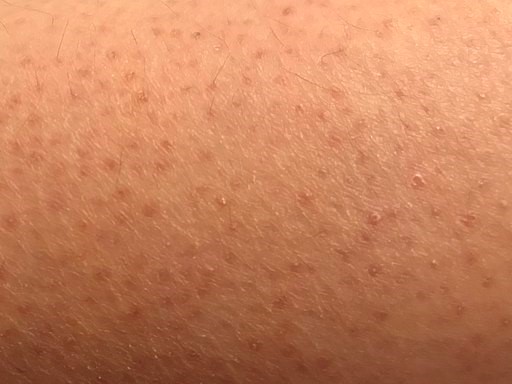
There is a rough, goose-flesh appearance of the skin.
There are small papules of keratosis that are one to two millimetres in diameter.
There may be some erythema around the lesions or they may be a normal skin colour. A coiled hair may be apparent beneath the papule.
Pruritus may also be present
Keratosis pilaris can affect all skin surfaces where hair grows. However, it is more common on the proximal and extensor surfaces of extremities and convex areas such as cheeks and buttocks.
Keratosis pilaris - moderate
Diagnóstico diferencial
Eruptive vellus hair cysts.
Keratosis follicularis (Darier's disease).
Kyrle's disease.
Lichen nitidus.
Lichen spinulosus.
Perforating folliculitis.
Investigaciones
The diagnosis is purely clinical and no investigations are required. In very exceptional atypical cases a skin biopsy with histopathological examination may be used to confirm diagnosis.
Keratosis pilaris treatment and management
Current treatment options for keratosis pilaris can temporarily improve the condition although they do not cure it.4 Treatment options vary, focusing on avoiding skin dryness using emollients and adding keratolytic agents when necessary.5
The British Association of Dermatologists recommends the following:4
Avoid excessive dryness of the skin; emollients and moisturisers can help soften the skin.
Creams with salicylic acid, lactic acid or urea may be of use in flattening the bumps on the skin
Expensive cosmetic or vitamin creams have not been shown to be effective.
An abrasive pad may be helpful.
Take tepid showers rather than hot baths.
Laser treatment has been shown to lead to significant improvements in skin texture and roughness or bumpiness in keratosis pilaris patients.6
Complicaciones
Complications are uncommon. Pigmentary changes and even scarring can sometimes occur.
Pronóstico
It often resolves spontaneously over time but there may be exacerbations and remissions over many years. The outcome can be quite variable between cases.
Actualizaciones exclusivas para profesionales de la salud
Mantente informado con las últimas actualizaciones clínicas, perspectivas profesionales y orientación basada en evidencia. El boletín de Patient Pro selecciona contenido esencial para profesionales de la salud, entregado directamente en tu bandeja de entrada.
Al suscribirte aceptas nuestros Política de Privacidad. Puedes darte de baja en cualquier momento. Nunca vendemos tus datos.
Lecturas adicionales y referencias
- Queratosis pilaris; DermNet
- Thomas M, Khopkar US; Keratosis pilaris revisited: is it more than just a follicular keratosis? Int J Trichology. 2012 Oct;4(4):255-8. doi: 10.4103/0974-7753.111215.
- Carvalho CA, Carvalho AV, Kiss A, et al; Keratosis pilaris and ulerythema ophryogenes in a woman with monosomy of the short arm of chromosome 18. An Bras Dermatol. 2011 Jul-Aug;86(4 Suppl 1):S42-5.
- Wang JF, Orlow SJ; Keratosis Pilaris and its Subtypes: Associations, New Molecular and Pharmacologic Etiologies, and Therapeutic Options. Am J Clin Dermatol. 2018 Oct;19(5):733-757. doi: 10.1007/s40257-018-0368-3.
- Keratosis Pilaris; Asociación Británica de Dermatólogos
- Hwang S, Schwartz RA; Keratosis pilaris: a common follicular hyperkeratosis. Cutis. 2008 Sep;82(3):177-80.
- Maghfour J, Ly S, Haidari W, et al; Treatment of keratosis pilaris and its variants: a systematic review. J Dermatolog Treat. 2022 May;33(3):1231-1242. doi: 10.1080/09546634.2020.1818678. Epub 2020 Sep 14.
Sobre el autorVer biografía completa
Actualizado por

Dr Jo Seale
Acerca del revisorVer biografía completa

Dr Toni Hazell, FRCGP
MBBS, BSc, FRCGP, DFSRH, Dip GU med, DRCOG, DCH (London, UK, 2000)
La Dra. Toni Hazell se graduó de la Escuela de Medicina del Hospital St. Mary y realizó su VTS en el Hospital Northwick Park.
Acceso sencillo a tratamientos y servicios de salud confiables en línea.
Common conditions
Get help with common conditions through the NHS, without a GP appointment.
 Sinusitis aguda
 Amigdalitis bacteriana
 Impetigo
 Picaduras de insectos
 Herpes zósterInfección del tracto urinario (ITU)
Más en dermatología
- Carcinoma de células basales
- Síndrome de Birt-Hogg-Dubé
- Nevus azul
- Candidiasis
- Lesión por frío
- Historia y examen dermatológico
- Nevus epidérmico y sus síndromes
- Eritema nodoso
- Eritrodermia
- Infecciones fúngicas de las uñas
- Hiposensibilización
- Dermatosis plantar juvenil
- Léntigo
- Pénfigo
- Tiña versicolor
- ActualizadoPrurigo nodularis
- Psoriasis de manos y pies
- Carcinoma de células escamosas de la piel
- Púrpura trombocitopénica trombótica
- Deficiencia, exceso y suplementación de zinc