Punción lumbar
Spinal tap
Revisado por pares por Dr Colin Tidy, MRCGPÚltima actualización por Dr Toni Hazell, MRCGPÚltima actualización 10 Feb 2023
Cumple con las directrices editoriales
- DescargarDescargar
- Compartir
- Language
- Discusión
- Versión en audio
Una punción lumbar se utiliza para diagnosticar meningitis y algunos otros trastornos del cerebro y la médula espinal.
En este artículo:
Videos seleccionados para Otras pruebas e investigaciones
Nota: the information below is a general guide only. The arrangements, and the way tests are performed, may vary between different hospitals. Always follow the instructions given by your doctor, specialist, or local hospital.
Continúa leyendo abajo
What is a lumbar puncture?
A lumbar puncture (sometimes called a spinal tap) is a procedure where a sample of cerebrospinal fluid (CSF) is taken for testing. CSF is the fluid that surrounds the brain (cerebrum) and spinal cord. This test is most commonly used to diagnose meningitis (an infection of the meninges - the structure that surrounds the brain and spinal cord). It is also used to help diagnose some other conditions of the brain, spinal cord and central nervous system, including a subarachnoid haemorrhage which is a type of bleed inside the brain.
When is a lumbar puncture needed?
Volver al contenidoIf you, or your child, is admitted to hospital with symptoms that could be caused by meningitis then a lumbar puncture may be done urgently, either in the emergency department or very soon after your admission to a ward. Alternatively, you might be admitted for a planned lumbar puncture, as part of the diagnostic process for a long-term (chronic) neurological condition.
Continúa leyendo abajo
How is a lumbar puncture done?
Volver al contenidoUsually you lie on a couch on your side with your knees pulled up against your chest. Sometimes it is done with you sitting up and leaning forwards on some pillows. The doctor or nurse will clean an area of your lower back with antiseptic.
They will then inject some local anaesthetic into a small area of skin which lies over a space between two lower spinal bones (vertebrae). This stings a little at first but then makes the skin numb.
The doctor then pushes a thin hollow needle through the skin and tissues between two vertebrae into the space around the spinal cord which is filled with CSF. Because the skin is numbed with local anaesthetic, most people do not feel pain. You may feel pressure as the needle is inserted. However, some people do have a sharp feeling in the back or leg when the needle is pushed through.
Procedure method
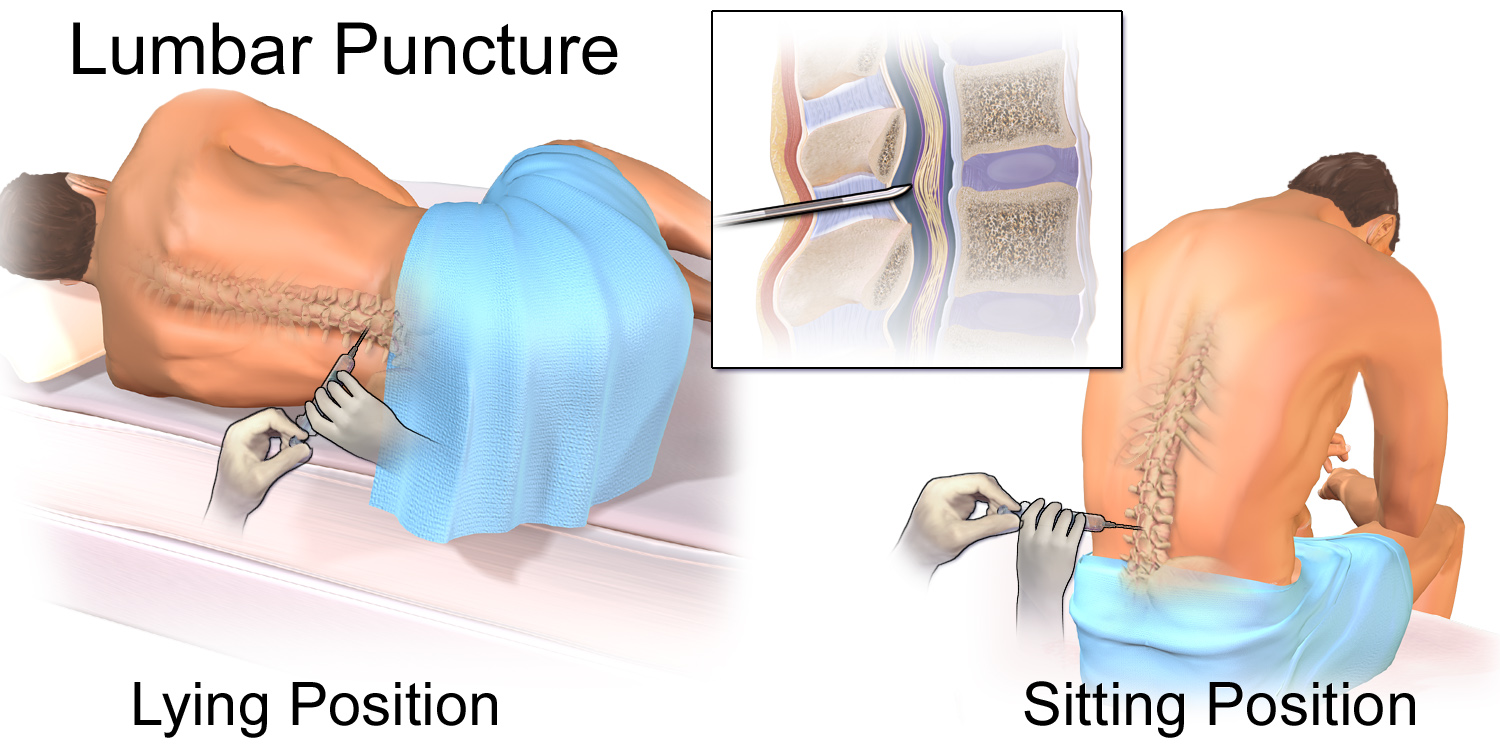
© Blausen.com staff, "Blausen gallery 2014", Wikiversity Journal of Medicine, via Wikimedia Commons
Some fluid leaks back through the needle and is collected in a sterile pot. If you have possible meningitis, this fluid sample is sent to the laboratory to be examined under the microscope to look for germs (bacteria), red blood cells and white blood cells, which are a sign of infection. It is also 'cultured' to see if any bacteria grow and what type they are.
The fluid can also be tested for protein, sugar and other chemicals if necessary. Sometimes the doctor will also measure the fluid pressure. This is done by attaching a special tube to the needle, which can measure the pressure of the fluid coming out.
The needle is usually in for about 1-2 minutes. As soon as the required amount of fluid is collected, the needle is taken out and a sticking plaster put over the site of needle entry.
How long does a lumbar puncture take?
Volver al contenidoIn total the procedure will take about 30-45 minutes; this includes the time to get you ready in the correct position and set up all the equipment.
Continúa leyendo abajo
Are there any side-effects or risks from a lumbar puncture?
Volver al contenidoSome people develop a post lumbar puncture headache. This usually goes after a few hours. It is best to lie down for a few hours after the test, as this makes a headache less likely to develop. There is also risk of infection or bleeding at the needle puncture site and although rare, some damage to the spinal cord or brain may occur as a result on a lumbar puncture. It is very important that you tell the doctor if you are taking anticoagulants (blood-thinning drugs) so that they can take any necessary precautions to reduce the risk of bleeding.
Recovering from a lumbar puncture
Volver al contenidoIt is sensible to stay lying flat for a period of time after a lumbar puncture - the doctor who does it will tell you how long. They will usually advise you not to operate heavy machinery or drive for at lest 24 hours and not to play sport or do any strenuous activities for at least a week.
Selecciones del paciente para Otras pruebas e investigaciones

Pruebas e investigaciones
Audiología
Si usted o un miembro de su familia sospechan que tienen un problema de audición, generalmente un audiólogo realizará una evaluación y también puede participar en la prestación del tratamiento necesario. Algunas condiciones que causan dificultades de equilibrio o mareos pueden surgir debido a problemas en el oído, y los audiólogos pueden realizar pruebas especializadas para investigar estos problemas también.
por la Dra. Surangi Mendis, MRCGP

Pruebas e investigaciones
Aspiración con aguja fina
La aspiración con aguja fina utiliza una aguja delgada y hueca para tomar una muestra de células de un órgano o bulto bajo la piel. Luego, las células se analizan bajo un microscopio. Nota: la información a continuación es solo una guía general. La organización y la forma en que se realizan las pruebas pueden variar entre diferentes hospitales. Siempre siga las instrucciones proporcionadas por su médico o hospital local.
por el Dr. Roger Henderson, MBBS
Lecturas adicionales y referencias
- Bacterial meningitis and meningococcal septicaemia: Management of bacterial meningitis and meningococcal septicaemia in children and young people younger than 16 years in primary and secondary care; NICE Clinical Guideline (last updated February 2015)
- Meningococcal disease: guidance, data and analysis; UK Health Security Agency (last updated April 2022)
- Sepsis - reconocimiento, diagnóstico y manejo temprano; Guía NICE (julio 2016 - actualizada enero 2024)
- Viallon A, Botelho-Nevers E, Zeni F; Clinical decision rules for acute bacterial meningitis: current insights. Open Access Emerg Med. 2016 Apr 19;8:7-16. doi: 10.2147/OAEM.S69975. eCollection 2016.
- Cognat E, Koehl B, Lilamand M, et al; Preventing Post-Lumbar Puncture Headache. Ann Emerg Med. 2021 Sep;78(3):443-450. doi: 10.1016/j.annemergmed.2021.02.019. Epub 2021 May 7.
Continúa leyendo abajo
Historial del artículo
La información en esta página está escrita y revisada por pares por clínicos calificados.
Próxima revisión: 9 de febrero de 2028
10 Feb 2023 | Última versión

Pregunta, comparte, conecta.
Navega por discusiones, haz preguntas y comparte experiencias en cientos de temas de salud.

¿Te sientes mal?
Evalúa tus síntomas en línea de forma gratuita
Suscríbete al boletín de Patient
Tu dosis semanal de consejos de salud claros y confiables, escritos para ayudarte a sentirte informado, seguro y en control.
Al suscribirte aceptas nuestros Política de Privacidad. Puedes darte de baja en cualquier momento. Nunca vendemos tus datos.