Dedo en martillo
Revisado por pares por Dr Colin Tidy, MRCGPÚltima actualización por Dr Hayley Willacy, FRCGP Última actualización 15 Sept 2024
Cumple con las directrices editoriales
- DescargarDescargar
- Compartir
- Language
- Discusión
- Versión en audio
- Agregar a fuentes preferidas en Google
A finger that bends down at the end joint and cannot be straightened is called a mallet finger. It is caused by an injury to the tendon that straightens (extends) the finger. A splint worn day and night for 6-8 weeks will cure the problem in most cases.
De un vistazo
A mallet finger is when the end of a finger bends towards the palm and cannot straighten.
It is caused by an injury that tears the tendon responsible for straightening the fingertip.
Symptoms include pain, swelling, and the inability to straighten the end of the finger.
Treatment usually involves wearing a splint continuously for 6-8 weeks.
Surgery may be needed if splinting does not work or if there is a cut to the finger.
What is a mallet finger?
A mallet finger describes a condition in which the end of a finger is bent (flexed) towards the palm and cannot straighten.
What causes a mallet finger?
The usual cause is an injury to the end of the finger. The injury tears the tendon that straightens (extends) the end of the finger.
It is sometimes called baseball finger, as it is a common injury when trying to catch a fast, hard ball. If the catch is missed slightly then the ball hits the straight finger. This may force the end of the finger to bend (flex) further than normal and tear the tendon. Without the use of this tendon, the finger stays bent (flexed).
Diagram of the hand showing mallet finger
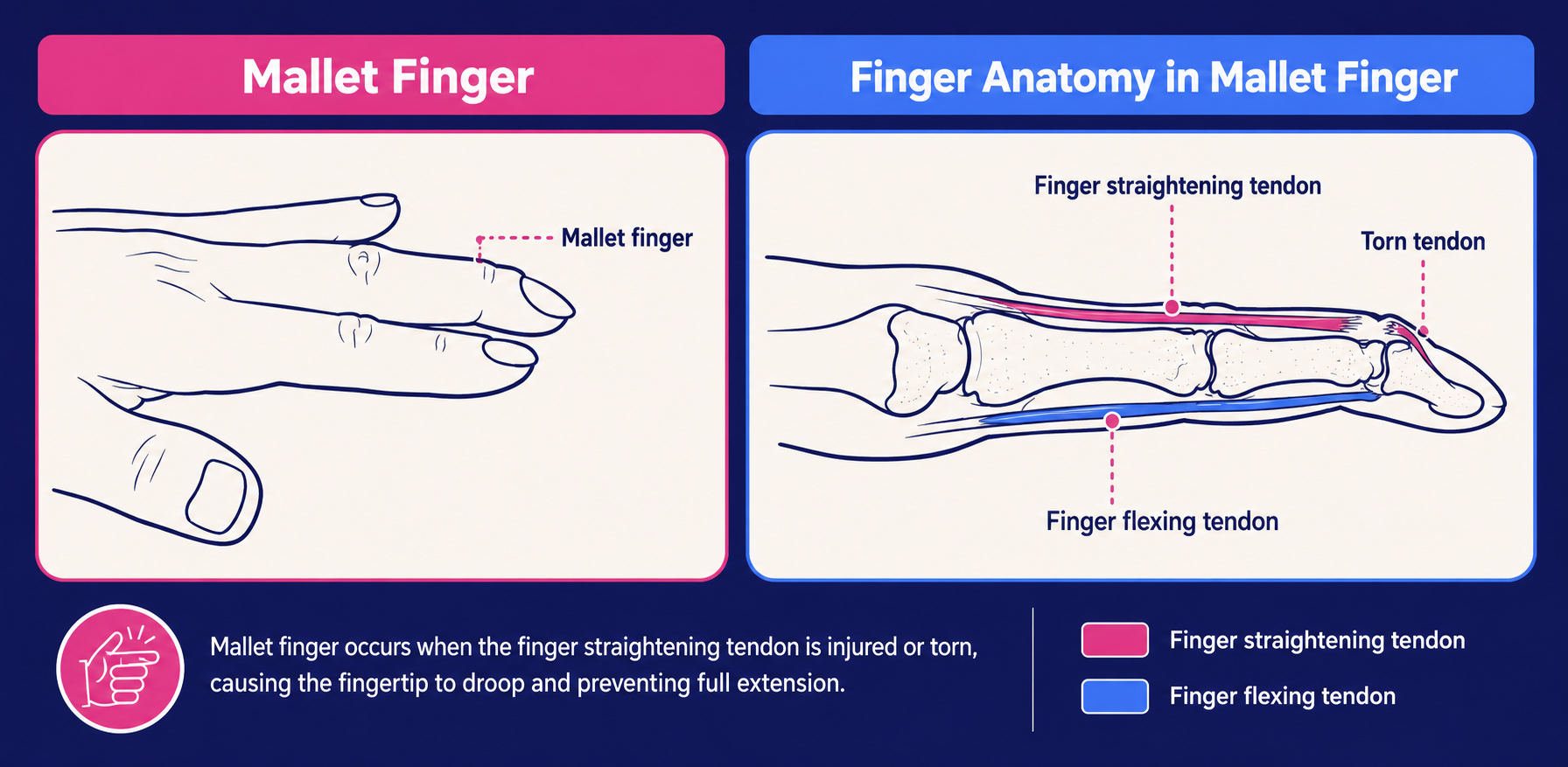
Lesiones deportivas are a common cause of mallet finger. However, any injury that forces the end joint of a finger to over-bend can cause it. (Sometimes the tendon does not tear but the injury causes a piece of bone to be pulled off the finger where the tendon is attached. This is called an avulsion fracture. The result is the same, as the tendon then cannot pull on the bone.)
What are the symptoms of a mallet finger?
After the injury, the end of your finger may:
Be painful and swollen.
Lie in a bent (flexed) position.
Not be able to straighten (extend) at the end.
Dedo en martillo
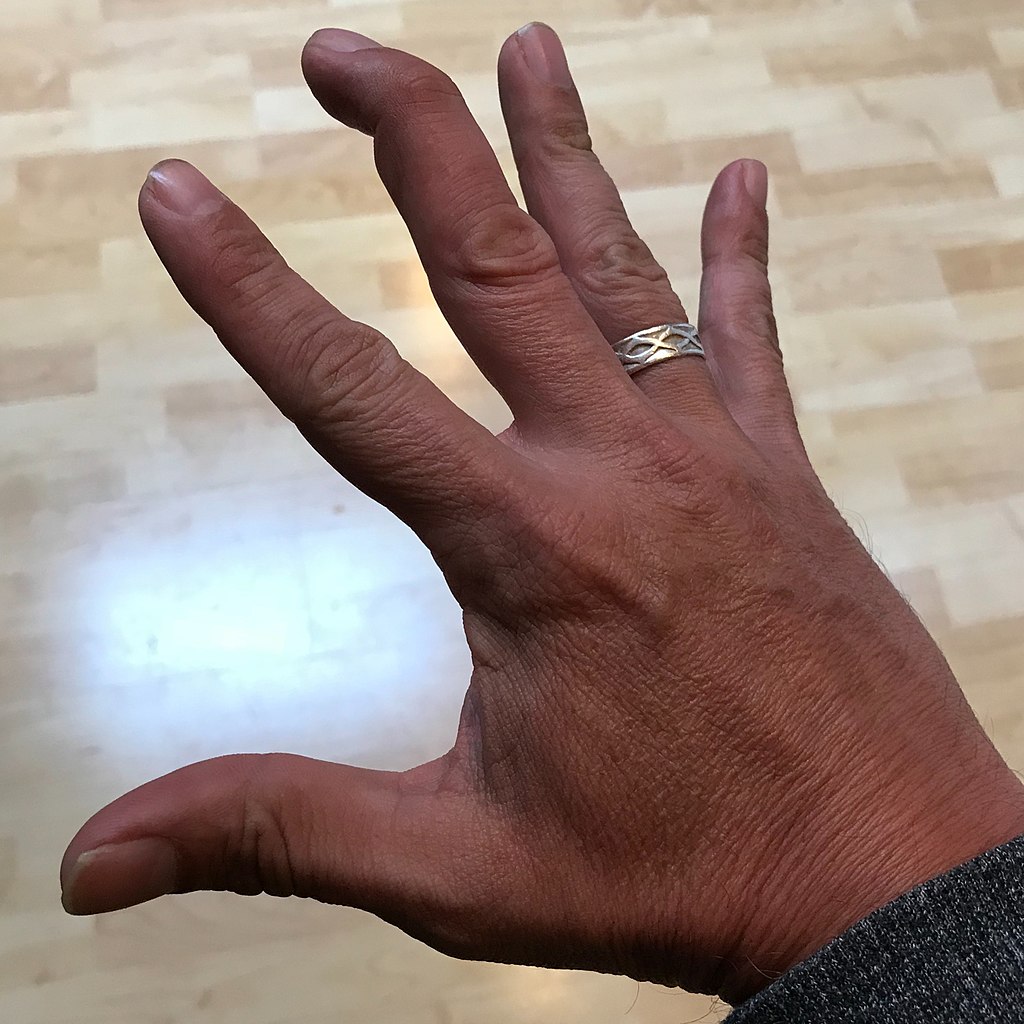
© Clappstar, CC BY-SA 4.0, via Wikimedia Commons
How is mallet finger diagnosed?
The clinician can usually diagnose a mallet finger from listening to how the injury occurred and how the finger looks and feels when examined. If there is any doubt they may request an x-ray.
What is the treatment for mallet finger?
Splint
A splint is worn for 6-8 weeks to keep the finger straight with the end joint bent backwards slightly (overextended). It must be worn all the time, day and night.
There are many different types of splints available. The type of splint given often depends on the size and shape of your finger. You must not take the splint off at any time during this treatment. If you have to take it off (for example, to wash) then you must keep that finger straight and not allow it to bend (flex).
Keeping the finger straight constantly allows the two ends of the torn tendon or bone to stay together and heal. About three in four cases heal well with this treatment.
Cirugía
Surgery is needed to repair the torn tendon if the above fails. (Surgery may be advised straightaway if there is a cut to your finger; however, most injuries that cause mallet finger do not cut the skin.)
Recovering from mallet finger
It may take several months for your finger to fully recover its function. Any redness, swelling and tenderness of your skin over the end of your finger may persist for the first few months after the injury. These symptoms will usually improve eventually.
Can mallet finger be prevented?
As most mallet finger injuries occur during sports, taking care when playing with a hard ball is advisable but prevention may not always be possible. You can prevent the deformity returning by using the splint exactly as directed by your clinician.
Selecciones del paciente para Dolor articular

Huesos, articulaciones y músculos
Hombro congelado
El hombro congelado (en términos médicos, capsulitis adhesiva del hombro) es una condición en la que el hombro se vuelve doloroso y rígido, a menudo sin una razón particular. Los movimientos del hombro se reducen, a veces completamente 'congelados'. Por lo general, solo afecta a un hombro, pero puede afectar a ambos. Se cree que se debe a la formación de tejido similar a cicatrices en la cápsula del hombro. Sin tratamiento, los síntomas generalmente desaparecen, pero esto puede llevar mucho tiempo, hasta tres años en algunos casos. Varios tratamientos pueden aliviar el dolor y mejorar el movimiento de su hombro.
por la Dra. Philippa Vincent, MRCGP

Huesos, articulaciones y músculos
Problemas de cadera
Los problemas de cadera son bastante comunes. La causa puede ser evidente, como una lesión que aparece de repente mientras practicas deportes. A veces, la causa no es tan clara y necesitarás que un médico o fisioterapeuta te examine.
por la Dra. Rachel Hudson, MRCGP
Preguntas frecuentes
What should I do immediately after getting a mallet finger injury?
The article suggests that after the injury, the end of your finger may be painful, swollen, and bent. While it doesn't give immediate first aid advice, generally for an injury that causes pain and swelling, it's advisable to avoid bending the affected finger and seek medical attention to confirm the diagnosis and receive appropriate treatment.
Are there different kinds of splints used for mallet finger?
Yes, there are many different types of splints available for mallet finger. The specific type you receive often depends on the size and shape of your finger.
How do I care for my skin if I'm wearing a splint for 6-8 weeks?
The article states that you must not take the splint off at any time during treatment, even to wash. However, if you absolutely have to remove it, you must keep the affected finger straight and not allow it to bend. This implies that cleaning around the splint or the finger itself would need to be done very carefully to ensure the finger remains straight.
What are the chances of my finger healing well with splint treatment?
About three in four cases of mallet finger heal well with splint treatment, provided it is worn exactly as directed.
When might surgery be considered as a first option for mallet finger?
Surgery may be advised straightaway if there is a cut to your finger. However, most injuries that cause mallet finger do not involve a cut through the skin.
After the splint is removed, can the mallet finger deformity come back?
Yes, the deformity can return. To prevent this, it's crucial to use the splint exactly as directed by your clinician throughout the entire treatment period.
Lecturas adicionales y referencias
- Yee J, Waseem M; Mallet Finger Injuries.
- Handoll HH, Vaghela MV; Interventions for treating mallet finger injuries. Cochrane Database Syst Rev. 2004;(3):CD004574.
- Salazar Botero S, Hidalgo Diaz JJ, Benaida A, et al; Review of Acute Traumatic Closed Mallet Finger Injuries in Adults. Arch Plast Surg. 2016 Mar;43(2):134-44. doi: 10.5999/aps.2016.43.2.134. Epub 2016 Mar 18.
Sobre el autorVer biografía completa

Dr Hayley Willacy, FRCGP
Médico General, Autor Médico
MBChB (1992), DRCOG, DFFP, MRCOG (Part 1) MRCGP (2007), DFSRH (2013), MSc - medical education (2020)
La Dra. Hayley Willacy fue una médica general del NHS que trabajaba en el noroeste de Inglaterra, quien se retiró de la práctica clínica en 2022 después de 30 años.
Acerca del revisorVer biografía completa

Dr Colin Tidy, MRCGP
Médico General, Autor Médico
MBBS, MRCGP, MRCP (Paediatrics), DCH
El Dr. Colin Tidy es un médico del NHS, con sede en Oxfordshire.
Historial del artículo
La información en esta página está escrita y revisada por pares por clínicos calificados.
Artículo también disponible en Inglés, Alemán, Español, Francés, Italiano, Portugués, Hindi, Hebreo, Árabe, y Sueco.
Próxima revisión: 14 de septiembre de 2027
15 Sept 2024 | Última versión

Pregunta, comparte, conecta.
Navega por discusiones, haz preguntas y comparte experiencias en cientos de temas de salud.

¿Te sientes mal?
Evalúa tus síntomas en línea de forma gratuita
Suscríbete al boletín de Patient
Tu dosis semanal de consejos de salud claros y confiables, escritos para ayudarte a sentirte informado, seguro y en control.
Al suscribirte aceptas nuestros Política de Privacidad. Puedes darte de baja en cualquier momento. Nunca vendemos tus datos.
Más sobre huesos, articulaciones y músculos
- Anestesia para reemplazo de cadera o rodilla
- Artritis
- Quiste de Baker
- Bisfosfonatos
- Depósito de pirofosfato de calcio
- Lesión de isquiotibiales
- Síndrome de vibración mano-brazo
- Reemplazo de rodilla
- Dolor lumbar
- Desgarros meniscales
- Osteomielitis
- Enfermedad ósea de Paget
- Polimialgia reumática
- Recuperación de una fractura pélvica
- Fractura de escafoides en la muñeca
- Anestesia espinal
- Esguinces y distensiones
- Trastorno de la Articulación Temporomandibular (TMD)
- Tendinopatía y tenosinovitis
- Deficiencia de vitamina D