Evaluación del plexo braquial y lesiones comunes
Revisado por Dr Toni Hazell, FRCGPÚltima actualización por Dr Philippa Vincent, MRCGPÚltima actualización 1 Oct 2026
Cumple con las directrices editoriales
- DescargarDescargar
- Compartir
- Language
- Discusión
- Ask Patient
- Versión en audio
- Agregar a fuentes preferidas en Google
Profesionales Médicos
Los artículos de Referencia Profesional están diseñados para ser utilizados por profesionales de la salud. Están escritos por médicos del Reino Unido y se basan en evidencia de investigación, así como en guías del Reino Unido y Europa. Puede encontrar uno de nuestros artículos de salud más útil.
The nerve supply to the arm is from nerve roots C5-T1 via the brachial plexus. The nerves pass under the clavicle and end in the axilla.12
Plexo braquial
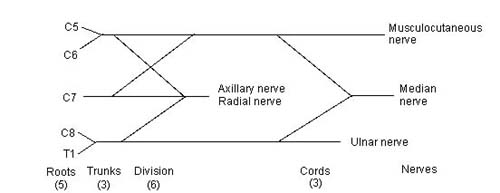
Lesiones del plexo braquial en adultos3
Severe brachial plexus injuries cause dramatic consequences to the motor and sensory functions of the upper limb.4 Road traffic accidents have resulted in a significant increase in brachial plexus injuries.3
Milder injuries of the brachial plexus can occur, with transient symptoms and with a full recovery. Milder injuries are more common in some sports, such as martial arts, though severe brachial plexus injuries are uncommon in sports medicine.5
Epidemiología6
Non-obstetric brachial plexus injuries are most common in young men between the ages of 15 and 25.
There is a "law of 7 70s" described by Naraka.
70% of brachial plexus injuries are due to road traffic accidents. 70% of these involve a motorcycle or a bicycle. Of these, 70% sustain multiple injuries.
70% of patients sustain a lesion of the supraclavicular plexus, of which 70% will have one or several avulsion of the plexus roots; 70% of these patients will also sustain root avulsions of the lower plexus, of whom 70% will experience chronic pain.
Ballistic trauma is the second most common cause of brachial plexus injuries in the United States.
However, a Scottish study showed that a fall from standing height was the most common mechanism of injury, suggesting that injury types are likely to vary depending on the population.7
Obstetric brachial plexus injuries are rare and decreasing in incidence due to the increasing number of Caesarean sections being performed in higher income countries.8 The incidence is reported to be 1.5 per 1000 live births in the United States9 and 0.42 per 1000 live births in the UK,10 although the risk is significantly higher in lower income countries, being reported in 14.7% of births in one Ghanian study.11 Risks of brachial plexus injuries are 100 times higher in shoulder dystocia, 14 times higher in babies who are large for gestational age and 9 times higher in forceps deliveries.12
Children born in low-resource settings are more likely both to have brachial plexus injuries and to have delayed referral for specialist management.13
Signos y síntomas6
A thorough history and examination is essential. Significant bruising and swelling may suggest vascular trauma which should be assessed by examining the radial, ulnar, and brachial pulses.
Precise examination findings depend on the injury site within the brachial plexus. Upper brachial plexus injuries can present clinically as an Erb palsy, and lower plexus injuries can present with a Klumpke palsy. C5/C6 involvement leads to paralysis of the shoulder and biceps muscles. C7 involvement leads to paralysis in extending the wrist and hand muscles. C8/T1 involvement leads to paralysis of the forearm flexors and hand intrinsic muscles.14
Examen
Vea también el separado Examen neurológico de las extremidades superiores artículo.
Nervios sensoriales
Pinch the nail base, pull the finger outwards, and ask about feeling anything. A burning feeling indicates continuity in the following nerves; absence does not necessarily mean the nerve is divided but may be due to neurapraxia instead.
Pulgar - prueba el nervio mediano suministrado por C6.
Dedo medio - prueba el nervio mediano suministrado por C7.
Meñique - prueba el nervio cubital suministrado por C8.
Nervios motores
El examen puede ser complicado por la distribución anómala de los nervios, incluyendo la contribución de C4 al plexo braquial y también porque muchos músculos están inervados por más de una neurona motora. Evaluación de la pérdida de función motora en la raíz cervical:
C5: movimiento del hombro en todas las direcciones, flexión del codo (hasta cierto grado).
C6: flexión del codo, rotación del antebrazo, flexión de la muñeca (en cierto grado).
C7: principalmente un tronco sensorial. (Produce una pérdida generalizada de movimiento en el brazo, sin parálisis total en ningún grupo muscular específico. Siempre suministra al dorsal ancho.)
C8: extensión y flexión de los dedos, flexión de la muñeca, movimiento de la mano.
T1: músculos intrínsecos de la mano - por ejemplo, aducción o abducción de los dedos.
Lesiones del plexo braquial en neonatos
Obstetric palsy is classically defined as a brachial plexus injury during delivery. Caesarean delivery or being one of a multiple pregnancy is protective.12
Many cases are temporary, with full function recovering within one week (although more recent studies suggest that some neurological impairment may persist and recommend physiotherapy and occupational therapy to reduce these risks).13 However, permanent injury is not uncommon, with one study suggesting that 18.4% persisted beyond a year.15 A recent Turkish study showed that 14.3% of babies had a permanent injury.16 Vea también el separado Lesiones de nacimiento en el bebé artículo.
There are two types of brachial plexus paralysis in neonates: upper plexus injury or Erb's palsy, and lower plexus injury or Klumpke's palsy.
Examen
Prompt evaluation and referral is recommended.13
Parálisis de Erb (Lesión C5-C6) - el brazo se mantiene característicamente aducido y rotado internamente con el antebrazo en pronación, la mano y la muñeca flexionadas (posición de 'propina del camarero'). El bebé no puede mover el brazo ni el hombro. Ver el separado Parálisis de Erb artículo.
Parálisis de Klumpke - Síndrome de Horner está presente, es decir, meiosis, ptosis, anhidrosis.
Investigaciones317
Plain x-rays, myelography, CT myelography, and MRI may all be indicated for the evaluation of brachial plexus. Electrodiagnostic and nerve conduction studies in association with the clinical findings can provide information regarding the location of the lesion, the severity of trauma, and expected clinical outcome.
Manejo18
Nerve damage causes a multifaceted clinical picture consisting of sensorimotor disturbances (pain, muscle atrophy, muscle weakness, secondary deformities). Brachial plexus injury may result in severe and chronic impairments for both adults and children. Therefore, early treatment and extensive rehabilitation are required. Psychological problems associated with brachial plexus injury may limit rehabilitation effects and increase disability.
Medidas generales
Adult trauma:
Rehabilitation plays an important role in reducing disability. Patients who are unable or unwilling to take part in rigorous and long-lasting physiotherapy are less likely to recover.6
Pain management is essential.19
Lower energy brachial plexus injuries are more likely to spontaneously resolve and therefore conservative management is more appropriate.
Whilst urgent surgical exploration may be required if a root avulsion or laceration injury to the plexus is suspected or in cases of open injury, retained foreign body, or vascular injury requiring vessel repair, in lower intensity brachial plexus injuries this may be delayed for 3-6 months if recovery fails to materialise.6
Obstetric trauma:
Neonatal: spontaneous recovery usually occurs and can start within days but can take months.
Occupational and physiotherapy is recommended to improve the rates of recovery. Splinting has also been shown to be of benefit.13
Other treatments include botulinum toxin injection20 although its value is debated. 13
Quirúrgico17
Specialist surgical repair in tertiary centres: options include nerve transfers, nerve grafting, muscle transfers, and neurolysis of scar around the brachial plexus.21
Phrenic nerve transfer has shown useful recovery of arm function in some patients; however, there is very little information about long-term functional and quality-of-life outcomes. There is also some evidence of consequent impairment of respiratory function. However, because patients with brachial plexus injuries are often very disabled and treatment options may be limited, the National Institute for Health and Care Excellence (NICE) recommends that phrenic nerve transfer may be considered as a treatment option.22
NICE guidance states that the evidence on the safety of free-functioning gracilis transfer to restore upper limb function in brachial plexus injury shows well-recognised complications (pain, bleeding, infection, and graft failure). However evidence on its efficacy is adequate to support the use of this procedure. This procedure should only be performed in a specialist brachial plexus unit by a multidisciplinary team including specialised physiotherapists, with input from microvascular surgeons.23
La artrodesis del hombro puede considerarse, pero mucho más raramente, en vista de los avances con transferencias de nervios, tendones y músculos libres. La artrodesis de la muñeca también puede considerarse para el dolor de muñeca y proporciona estabilidad a la mano.
In neonates, surgery is recommended as an early intervention, as outcome is best if repair is undertaken within six months and can be impaired if surgery is delayed until after 18 months.13
Actualizaciones exclusivas para profesionales de la salud
Mantente informado con las últimas actualizaciones clínicas, perspectivas profesionales y orientación basada en evidencia. El boletín de Patient Pro selecciona contenido esencial para profesionales de la salud, entregado directamente en tu bandeja de entrada.
Al suscribirte aceptas nuestros Política de Privacidad. Puedes darte de baja en cualquier momento. Nunca vendemos tus datos.
Lecturas adicionales y referencias
- Orebaugh SL, Williams BA; Anatomía del plexo braquial: normal y variante. ScientificWorldJournal. 28 de abril de 2009;9:300-12.
- Luo TD, Levy ML, Li Z; Lesiones del Plexo Braquial. StatPearls, agosto de 2021.
- Leinberry CF, Wehbe MA; Anatomía del plexo braquial. Hand Clin. 2004 Feb;20(1):1-5.
- The Brachial Plexus; O Jones; Teach Me Anatomy
- Sakellariou VI, Badilas NK, Mazis GA, et al; Lesiones del plexo braquial en adultos: evaluación y enfoque diagnóstico. ISRN Orthop. 9 de febrero de 2014;2014:726103. doi: 10.1155/2014/726103. eCollection 2014.
- Brachial plexus injuries in the contact athlete: a narrative review; R Windmueller et al; Annals of Joint
- Belviso I, Palermi S, Sacco AM, et al; Lesiones del Plexo Braquial en Medicina Deportiva: Evaluación Clínica, Enfoques Diagnósticos, Opciones de Tratamiento e Intervenciones Rehabilitadoras. J Funct Morphol Kinesiol. 30 de marzo de 2020;5(2). pii: jfmk5020022. doi: 10.3390/jfmk5020022.
- Dean T, Levy ML, Luo TD, et al; Brachial Plexus Injuries.
- Traumatic brachial plexus injuries: a national review of epidemiology in the Scottish population over a 10-year period; C E Warwick and T Hems; Journal of Hand Surgery
- Epidemiology and surgical management of obstetric brachial plexus injury: a national cohort study; T A Sargut et al; Journal of Neurosurgery
- A brief overview of obstetric brachial plexus palsy; A Swift; British Journal of Midwifery
- Doumouchtsis SK, Arulkumaran S; ¿Son todas las lesiones del plexo braquial causadas por distocia de hombro? Obstet Gynecol Surv. 2009 Sep;64(9):615-23.
- Prevalence and predisposing factors of brachial plexus birth palsy in a Regional hospital in Ghana: A five year retrospective study; C Yarfi et al; Pan African Medical Journal
- Foad SL, Mehlman CT, Ying J; The epidemiology of neonatal brachial plexus palsy in the United States. J Bone Joint Surg Am. 2008 Jun;90(6):1258-64. doi: 10.2106/JBJS.G.00853.
- Khabyeh-Hasbani N, O'Brien DM, Meisel EM, et al; Current Concepts in Brachial Plexus Birth Injuries: A Comprehensive Narrative Review. Plast Reconstr Surg Glob Open. 2024 Aug 22;12(8):e6083. doi: 10.1097/GOX.0000000000006083. eCollection 2024 Aug.
- Lesión del plexo braquial; H Knipe; Radiopaedia
- Mapping Population-Level Differences in Brachial Plexus Birth Injury: An International Meta-Analysis; H Cordray et al; The Journal of Hand Surgery
- Arslan O, Giray B, Tug N; Obstetric brachial plexus injury: risk factors and clinical follow-up results. J Turk Ger Gynecol Assoc. 2025 Sep 3;26(3):204-211. doi: 10.4274/jtgga.galenos.2025.2025-3-3. Epub 2025 Aug 22.
- Management of Adult Brachial Plexus Injuries; J R Hill et al; The Journal of Hand Surgery
- Pejkova S, Filipce V, Peev I, et al; Lesiones del Plexo Braquial - Revisión de la Anatomía y las Opciones de Tratamiento. Pril (Makedon Akad Nauk Umet Odd Med Nauki). 23 de abril de 2021;42(1):91-103. doi: 10.2478/prilozi-2021-0008.
- Review of rehabilitation protocols for brachial plexus injury; H Li et al; Frontiers in Neurology
- Ramachandran M, Eastwood DM; Toxina botulínica y sus aplicaciones ortopédicas. J Bone Joint Surg Br. 2006 Ago;88(8):981-7.
- Hale HB, Bae DS, Waters PM; Conceptos actuales en el manejo de la parálisis del plexo braquial al nacer. J Hand Surg Am. 2010 Feb;35(2):322-31.
- Transferencia del nervio frénico en lesión del plexo braquial; Guía de procedimientos intervencionistas de NICE, Nov 2013
- Transferencia libre del músculo grácil para restaurar la función del miembro superior en lesión del plexo braquial; Guía de procedimientos intervencionistas [IPG687]. Marzo 2021.
Sobre el autorVer biografía completa
Actualizado por

Dra. Philippa Vincent, MRCGP
Médico General, Autor Médico
MB BS, Bsc, MRCGP (2000), DCH, DFSRH, DRCOG
Dra Philippa Vincent es un médico de cabecera del NHS que trabaja en el norte de Londres.
Acerca del revisorVer biografía completa

Dr Toni Hazell, FRCGP
MBBS, BSc, FRCGP, DFSRH, Dip GU med, DRCOG, DCH (London, UK, 2000)
La Dra. Toni Hazell se graduó de la Escuela de Medicina del Hospital St. Mary y realizó su VTS en el Hospital Northwick Park.
Acceso sencillo a tratamientos y servicios de salud confiables en línea.
Common conditions
Get help with common conditions through the NHS, without a GP appointment.
 Sinusitis aguda
 Amigdalitis bacteriana
 Impetigo
 Picaduras de insectos
 Herpes zósterInfección del tracto urinario (ITU)
Más en neurología
- Disección aórtica
- Enfermedad de Charcot-Marie-Tooth
- Síndrome de dolor regional complejo
- Síndrome de Cornelia de Lange
- Delirio
- Dislexia
- Epilepsia y embarazo
- Dolor facial
- Demencia frontotemporal
- Síndrome de Guillain-Barré
- Articulaciones neuropáticas
- Trastorno de pesadillas
- Hinchazón del disco óptico
- Hinchazones orbitales
- Cefalea primaria asociada con la actividad sexual
- Sarcoidosis
- Espina bífida
- Lesión de la médula espinal
- Enfermedad de Werdnig-Hoffmann