Pelvic floor exercises (Kegel exercises) and stress incontinence
Revisado por pares por Dr Hannah Gronow, MBACPÚltima actualización por Dr Jacqueline Payne, FRCGPÚltima actualización 20 Sept 2017
Cumple con las directrices editoriales
- DescargarDescargar
- Compartir
- Language
- Discusión
- Versión en audio
Pelvic floor exercises, also known as Kegel exercises, have numerous benefits and may help cure stress incontinence. Pelvic floor exercises are also useful to prevent incontinence for women who have had children. In addition, some people feel that having strong pelvic floor muscles heightens the pleasure when having sex.
En este artículo:
Videos seleccionados para Vejiga
Continúa leyendo abajo
What are the pelvic floor muscles?
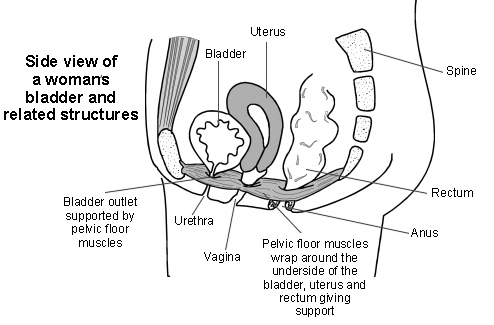
The pelvic floor muscles are a group of muscles that wrap around the underneath of the bladder and rectum. Your doctor may advise that you strengthen your pelvic floor muscles:
If you develop stress incontinence. In stress incontinence, urine leaks when there is a sudden extra pressure ('stress') on the bladder. Urine tends to leak most when you cough, laugh, or exercise (like jump or run). Strengthening the pelvic floor muscles can often cure stress incontinence.
After childbirth. The common reason for the pelvic floor muscles to become weakened is childbirth. If you do pelvic floor muscle exercises after childbirth, it may prevent stress incontinence developing later in life.
Female urinary system
Pelvic floor exercises to treat stress incontinence
Volver al contenidoYour doctor may refer you to a continence advisor or physiotherapist for advice on the exercises in the case of stress incontinence. They may ask you to do a pelvic floor exercise while they examine you internally, to make sure you are doing them correctly
Continúa leyendo abajo
How do you do pelvic floor exercises correctly?
Volver al contenidoSiéntate en una silla con las rodillas ligeramente separadas. Imagina que estás tratando de evitar que el viento escape de tu pasaje trasero (ano). Tendrás que apretar el músculo justo por encima de la entrada al ano. Deberías sentir algún movimiento en el músculo. No muevas los glúteos ni las piernas.
Ahora imagina que estás orinando e intentas detener el flujo. Te darás cuenta de que estás usando partes ligeramente diferentes de los músculos del suelo pélvico en comparación con el primer ejercicio (los que están más cerca del frente). Estos son los que debes fortalecer.
Si no estás segura de que estás ejercitando los músculos correctos, introduce un par de dedos en tu vagina. Deberías sentir una ligera presión al hacer el ejercicio. Otra forma de comprobar que estás haciendo los ejercicios correctamente es usar un espejo. El área entre tu vagina y tu ano se alejará del espejo cuando aprietes.
Las primeras veces que intentes estos ejercicios, puede que te resulte más fácil hacerlos acostado.
How to do pelvic floor exercises (Kegels)
Volver al contenidoYou need to do the exercises every day.
Sit, stand or lie with your knees slightly apart. Slowly tighten your pelvic floor muscles under the bladder as hard as you can. Hold to the count of five, then relax. These are called slow pull-ups or long squeezes.
Then do the same exercise quickly and immediately let go again. These are called fast pull-ups or short squeezes.
The aim is to do a long squeeze followed by ten short squeezes, and repeat this cycle at least eight times. It should only take about five minutes.
Aim to do the above exercises at least three times a day.
Ideally, do each set of exercises in different positions. That is, sometimes when sitting, sometimes when standing and sometimes when lying down.
As the muscles become stronger, increase the length of time you hold each slow pull-up or long squeeze. You are doing well if you can hold it each time for a count of 10 (about 10 seconds).
Do not squeeze other muscles at the same time as you squeeze your pelvic floor muscles. For example, do not use any muscles in your back, thighs, or buttocks.
Some people find it difficult to remember to do their exercises; a chart or a reminder on your phone may help.
Try to get into the habit of doing your exercises at other times too, whilst going about everyday life. For example, when brushing your teeth, waiting for the kettle to boil, when washing up, etc.
You may find it helpful to do a 'squeeze' just before you do something that would otherwise cause you to leak, like coughing or lifting.
After several weeks the muscles will start to feel stronger. You may find you can squeeze the pelvic floor muscles for much longer without the muscles feeling tired.
Continúa leyendo abajo
Do pelvic floor exercises make a difference?
Volver al contenidoIt takes time, effort and practice to become good at pelvic floor exercises/Kegels. It is best do these exercises for at least three months to start with. You should start to see benefits after a few weeks. However, it often takes two to five months for most improvement to occur. After this time you may be cured of stress incontinence. If you are not sure that you are doing the correct exercises, ask a doctor, physiotherapist or continence advisor for advice.
If possible, continue exercising as a part of everyday life for the rest of your life. Once incontinence has gone, you may only need to do one or two bouts of exercise each day to keep the pelvic floor muscles strong and toned up and to prevent incontinence from coming back.
Other ways to strengthen the pelvic floor muscles
Volver al contenidoSometimes a continence advisor or physiotherapist will advise extra methods if you are having problems or need some extra help performing the pelvic floor exercises. These are además to the above exercises. For example:
Electrical stimulation. Sometimes a special electrical device is used to stimulate the pelvic floor muscles with the aim of making them contract and become stronger.
Biofeedback. This is a technique to help you make sure that you exercise the correct muscles. For this, a physiotherapist or continence advisor inserts a small device into your vagina when you are doing the exercises. When you squeeze the right muscles, the device makes a noise (or some other signal such as a display on a computer screen) to let you know that you are squeezing the correct muscles.
Vaginal cones. These are small plastic cones that you put inside your vagina for about 15 minutes, twice a day. The cones come in a set of different weights. At first, the lightest cone is used. You will naturally use your pelvic floor muscles to hold the cone in place. This is how they help you to exercise your pelvic floor muscles. Once you can hold on to the lightest one comfortably, you move up to the next weight and so on.
Other devices. There are various other devices that are sold to help with pelvic floor exercises. Basically, they all rely on placing the device inside the vagina with the aim of helping the pelvic muscles to exercise and squeeze. There is little research evidence to show how well these devices work. It is best to get the advice from a continence advisor or physiotherapist before using any. One general point is that if you use one, it should be in addition to, not instead of, the standard pelvic floor exercises described above.
Pelvic floor exercise tips
Volver al contenidoIf you are not used to doing pelvic floor exercises then perhaps do the exercises as often as described above for the first three months or so. This will strengthen up the pelvic floor muscles. Thereafter, a five-minute spell of pelvic floor exercises once or twice a day should keep the muscles strong and toned up which may help to prevent incontinence from developing in later life.
Selecciones del paciente para Vejiga

Riñón y tracto urinario
Bladder problems men shouldn't ignore
Urinary problems in middle-aged men can be frustrating and embarrassing, and are often caused by an enlarged prostate. However, they may also be indicative of something more serious such as prostate cancer. Our two experts explain why vigilance is important and share their self-help tips.
por Julian Turner

Riñón y tracto urinario
Bad bladder habits to avoid
All too many of us have bad bladder habits. LUTS, or lower urinary tract symptoms, get more common with age. The way we treat our bladders can lead to disturbed nights and accidents.
por la Dra. Sarah Jarvis MBE, FRCGP
Continúa leyendo abajo
Historial del artículo
La información en esta página es revisada por pares por clínicos calificados.
20 Sept 2017 | Última versión

Pregunta, comparte, conecta.
Navega por discusiones, haz preguntas y comparte experiencias en cientos de temas de salud.

¿Te sientes mal?
Evalúa tus síntomas en línea de forma gratuita
Suscríbete al boletín de Patient
Tu dosis semanal de consejos de salud claros y confiables, escritos para ayudarte a sentirte informado, seguro y en control.
Al suscribirte aceptas nuestros Política de Privacidad. Puedes darte de baja en cualquier momento. Nunca vendemos tus datos.