¿Qué es el sueño polifásico o bifásico, y es bueno para ti?
Revisado por Dra. Sarah JarvisEscrito por Danny ChadburnPublicado originalmente 9 Feb 2019
Cumple con las directrices editoriales
- DescargarDescargar
- Compartir
- Language
- Discusión
- Ask Patient
- Versión en audio
- Agregar a fuentes preferidas en Google
We've all done stupid things on New Year's Eve. But could arguing with a friend that I only needed five hours of sleep a night - and that I could prove it - be the dumbest of all?
Selecciones de videos para Sueño e insomnioBiblioteca de videos
As someone who'd never really been the best of pals with sleep, changing my habits had been something I'd been mulling over for a while. Even after the heaviest of nights out as a teenager, I'd be up with the larks while my peers dozed until gone noon. And as I grew up, life took its toll and a mobile phone became inseparable from my hand, so that getting to sleep became a lengthy process too.
What are the effects of lack of sleep?
Wouldn't it be frustrating if every time you plugged in your phone, it took 10 minutes before it started to recharge itself? The art of getting to sleep is one that some people struggle with greatly, and it's a self-perpetuating problem as the more you worry about it, the less likely you are to be able to achieve slumber.
That can bring on anxiety, leading to insomnio, and it's been proven that not enough sleep leads to lowered immunity and reduced concentration.
The average person spends around 33 years of their life in bed. 26 of those years are spent sleeping. That statistic is surprising enough, but when you factor in a further seven years of tossing, turning and trying to get to sleep, that's when it really hits home just what a dent it can be on your days on Earth.
What is biphasic sleep?
The vast majority of people operate on a monophasic sleep cycle. Mono means one, so you go to bed at night, wake up in the morning and your sleep for the day is considered complete.
However, some major countries operate a biphasic sleep cycle (bi = two) where sleep is split into separate chunks.
In China, it's a constitutional right for workers to take a break for an hour-long nap after lunch.
In Italy, the riposo is a common practice, with many businesses and public buildings closing for a couple of hours in the early afternoon.
In Spain, the siesta is widely adopted and often accommodates eating and socialising as well as napping.
There's a lot of historical evidence that suggests biphasic sleep used to be the norm around the rest of the world too in the pre-industrial age. References to biphasic sleep, such as 'first and second sleep' have occurred in many forms of literature, with people getting up in the middle of the night to sew, chop wood, read or have sex. The 'waking period' was considered a very fertile time to conceive.
Controlling your body clock
A complete sleep cycle lasts approximately 90 minutes Here you'll go from the lightest stage through the deepest stage of sleep and back again.
If you sleep for 7.5 hours, you'll have gone through five cycles, each with its own characteristics in terms of depth and dreaming. So if you only really get a decent sleep during the first two cycles, are the subsequent 270 minutes a waste of time?
Polyphasic sleep
Further research into this area led me to the practice of polyphasic sleep (poly = many) which is becoming a popular option for many, with a vibrant online community.
This struck a chord with me. I don't work an average 9-5, I can be productive at any hour of the day, and I'm starting a new business venture (deskvillage.com if you're interested) so polyphasic sleep could give me a few extra hours in the day.
As well as biphasic sleep, there are various alternative sleep schedules to select from:
Everyman - one core sleep accompanied by up to three top-up naps.
Dual-core - similar to biphasic sleep, but two periods of core sleep sometimes with an additional nap.
Tri-core - three sleeps of roughly equal duration.
Dymaxion/Uberman/Tesla - extreme methods of four to six 20- to 30-minute naps throughout the day.
The 'everyman' sleep schedule seemed the most suited to me, offering both flexibility and a longish core sleep so the transition wasn't too jarring.
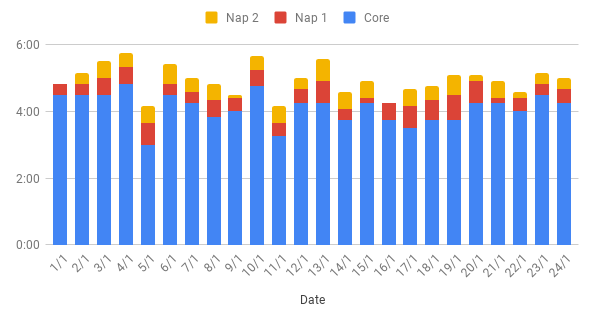
So since 2019 rolled around, I've enjoyed an average of 4h 56m of sleep, broken down into a 4h 05m core sleep and a couple of naps averaging 26 minutes each. Here's how that has developed over the course of the month so far:
Everyman sleep schedule example
The practicalities have taken a bit of getting used to. I've tried sleep tracking apps with inbuilt alarms, automated screen downtime, and even an attempted (an ultimately fruitless) nap-lap around the Circle line. The past few weeks though have taught me that two things are important: flexibility and an eye mask.
Have polyphasic and biphasic sleep schedules made me healthier?
Personally, I'd say yes. Especially in the salud mental department. The long hours spent trying to get back to sleep, and all the worry that brings, have disappeared. I have a better relationship with sleep, and I'm more in control of both my day and my body since adopting polyphasic sleeping. I certainly feel healthier knowing I'm going to get five hours of sleep instead of intentando (and invariably failing) to get seven.
I discussed my schedule with Professor Adrian Williams of The London Sleep Centre.
How much sleep is enough?
"It's not necessarily about the number of hours you get per night, but the number you get per day." he says. "While being able to function well on anything under seven isn’t within the normally accepted range, everyone operates in a different way. Good sleep reflects itself in better physical well-being and weight regulation, so if you're not showing 'adverse' effects in any of those areas, then there's no reason why it wouldn't be a healthy option.”
We also discussed the various studies that have been done into the subject. For obvious human and animal rights reasons, no controlled observations around sleep deprivation have been conducted in recent years. However, some of the pioneering research into the subject in Russia found that dogs survived longer without water than they did on no sleep, and rats who didn't get adequate amounts of REM became hypersexual.
"Is it then that the siesta, with its association with less REM sleep, is in part responsible for the stereotype of a Latin lothario?" comments Williams.
The nights are spent writing or researching, and a 6am nap means I'm freshly risen for when the kids wake up. The second nap has taken some getting used to (both in terms of switching off and finding a suitable time slot) but as the graph above shows, there's an equilibrium becoming clear.
Can you function on five hours sleep a day?
Well, it's 3:34 am and I've just finished writing and proofreading this article. You be the judge.
Selecciones del paciente para Sueño e insomnio
Vida saludable
Diario de sueño
Please answer questions A to S each day over the next two weeks. There should be three sheets of paper for answers to be written in boxes. The aim is to measure the pattern and quality of your sleep, and factors that may affect your sleep over the course of two weeks.
por Danny Chadburn
Vida saludable
¿Por qué no puedo dormir? 12 causas comunes y qué hacer
Luchar por conciliar el sueño puede ser frustrante. Ya sea que estés despierto durante horas, te despiertes repetidamente durante la noche o te encuentres completamente despierto a las 3 am, hay muchas razones posibles detrás del mal sueño. En algunos casos, los hábitos de vida como beber demasiado café o usar el teléfono antes de dormir pueden ser los culpables. En otros, las condiciones de salud subyacentes o los cambios hormonales pueden afectar tu capacidad para descansar bien por la noche.
por Heather Ainsworth
Sobre el autor
Escrito por

Danny Chadburn
Jefe de Contenido
Danny fue el anterior Jefe de Contenido en Patient.
Acerca del revisorVer biografía completa

Dra. Sarah Jarvis
Consultora Clínica
MA (Cantab), BM, BCh (Oxon), DRCOG, FRCGP, MBE
Después de formarse en medicina en Cambridge y Oxford, la Dra. Sarah Jarvis MBE se convirtió en médica general.
Historial del artículo
Artículo también disponible en Inglés, Alemán, Español, Francés, Italiano, Portugués, Hindi, Hebreo, Árabe, y Sueco.
9 Feb 2019 | Publicado originalmente
Escrito por:
Danny Chadburn
Revisado por
Dra. Sarah Jarvis
Comparte tus pensamientos o experiencias con otros en nuestro comunidades de pacientes.
Suscríbete al boletín de Patient
Tu dosis semanal de consejos de salud claros y confiables, escritos para ayudarte a sentirte informado, seguro y en control.
Al suscribirte aceptas nuestros Política de Privacidad. Puedes darte de baja en cualquier momento. Nunca vendemos tus datos.