Examen de hombro
Revisado por Dr Toni Hazell, FRCGPÚltima actualización por Dr Hayley Willacy, FRCGP Última actualización 30 Ene 2023
Cumple con las directrices editoriales
- DescargarDescargar
- Compartir
- Language
- Discusión
- Ask Patient
- Versión en audio
- Agregar a fuentes preferidas en Google
Profesionales Médicos
Los artículos de Referencia Profesional están diseñados para ser utilizados por profesionales de la salud. Están escritos por médicos del Reino Unido y se basan en evidencia de investigación, así como en guías del Reino Unido y Europa. Puede encontrar uno de nuestros artículos de salud más útil.
What is a shoulder examination?
Shoulder examination is a practical skill which requires background knowledge of anatomy, of normal shoulder function and of abnormalities affecting the shoulder. The likely diagnosis will have been derived from the history. The necessary skills can be developed by examining colleagues or patients. The background knowledge can be learned with the help of pictures and video clips.
Manguito rotador
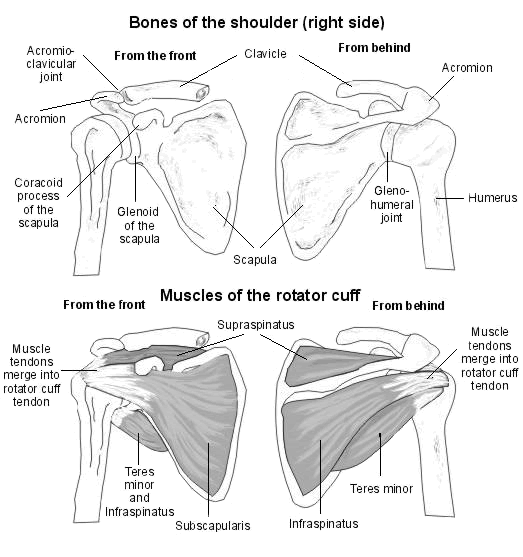
Inspection
View from the rear, with the patient standing straight. Look for lateral symmetry, swelling, position of scapula and signs of muscle wasting.
Palpación
Palpate all over the shoulder girdle, acromioclavicular joint, deltoid and supraspinatus muscles and scapular borders feeling for pain and tenderness, crepitus, effusions, deformities and abnormal muscle development.1
Range of movement
Perform the following with the patient seated:2
External rotation - with the patient's elbow at right angles and held into side, turn the arm outwards as far as possible (expected 70°).
Internal rotation - with the patient's elbow held into side, raise the arm as far as possible up the patient's back (expected level T5).
Forward flexion - start with the patient's arm at their side and lift the arm forwards and upwards as far as possible (expected 150-170°).
Extension - with the arm by the patient's side, lift the arm backwards as far as possible (expected 40°).
Abduction - with the arm at the patient's side, lift the arm away from the body as far as possible, continuing past the horizontal by allowing the shoulder to rotate externally, bringing the hand behind the head (expected 160-180°).
Adduction - draw the patient's arm across the anterior chest wall as far as possible (expected 30-40°).
Signs in individual joint problems3
Acromioclavicular joint
Ask the patient to place their hand on their opposite shoulder. If gentle pressure on the joint elicits pain, this is indicative of acromioclavicular joint inflammation (cross-arm horizontal adduction test).
Glenohumeral joint
With the patient lying on their back and their arm at right angles over the edge of the couch, gently push their wrist downwards. The patient will complain if the joint is unstable (apprehension test). With the patient lying on their back and the scapula stable, support their elbow and gently move the humeral head up and down in the glenoid fossa, by pressing anteriorly and posteriorly on the upper humerus, to assess laxity.
Impingement tests4
Turn the patient's arm so that the thumb points downwards and lift their arm outwards and upwards. With the patient standing and their arm abducted at right angles, support the elbow and rotate the forearm internally. In both tests, pain on movement indicates impingement of the rotator cuff.
Rotator cuff tests5
With the patient seated and elbows tucked into their sides, ask the patient to push both outwards and inwards, against resistance, in order to assess strength.
Supraspinatus
Ask the patient to hold both arms stretched out straight and level with the shoulders and thumbs pointed downwards. Assess strength by asking the patient to push the forearms both upwards and downwards against resistance.
Actualizaciones exclusivas para profesionales de la salud
Mantente informado con las últimas actualizaciones clínicas, perspectivas profesionales y orientación basada en evidencia. El boletín de Patient Pro selecciona contenido esencial para profesionales de la salud, entregado directamente en tu bandeja de entrada.
Al suscribirte aceptas nuestros Política de Privacidad. Puedes darte de baja en cualquier momento. Nunca vendemos tus datos.
Lecturas adicionales y referencias
- Shoulder Examination - OSCE Guide; Geeky Medics
- Yang S, Kim TU, Kim DH, et al; Understanding the physical examination of the shoulder: a narrative review. Ann Palliat Med. 2021 Feb;10(2):2293-2303. doi: 10.21037/apm-20-1808. Epub 2021 Feb 2.
- Gismervik SO, Drogset JO, Granviken F, et al; Physical examination tests of the shoulder: a systematic review and meta-analysis of diagnostic test performance. BMC Musculoskelet Disord. 2017 Jan 25;18(1):41. doi: 10.1186/s12891-017-1400-0.
- Shoulder Examination; A Practical Guide to Clinical Medicine 2005, University of California
- Range of Movement; Sports Coach
- Cotter EJ, Hannon CP, Christian D, et al; Comprehensive Examination of the Athlete's Shoulder. Sports Health. 2018 Jul-Aug;10(4):366-375. doi: 10.1177/1941738118757197. Epub 2018 Feb 14.
- Garving C, Jakob S, Bauer I, et al; Impingement Syndrome of the Shoulder. Dtsch Arztebl Int. 2017 Nov 10;114(45):765-776. doi: 10.3238/arztebl.2017.0765.
- Ujsasi D, Filipovic K, Zvekic-Svorcan J, et al; The Applicability of Provocative Functional Tests in the Diagnosis of Rotator Cuff Muscle Injuries of the Best University Athletes. Biomed Res Int. 2022 Oct 13;2022:7728277. doi: 10.1155/2022/7728277. eCollection 2022.
Sobre el autorVer biografía completa
Actualizado por

Dr Hayley Willacy, FRCGP
Médico General, Autor Médico
MBChB (1992), DRCOG, DFFP, MRCOG (Part 1) MRCGP (2007), DFSRH (2013), MSc - medical education (2020)
La Dra. Hayley Willacy fue una médica general del NHS que trabajaba en el noroeste de Inglaterra, quien se retiró de la práctica clínica en 2022 después de 30 años.
Acerca del revisorVer biografía completa

Dr Toni Hazell, FRCGP
MBBS, BSc, FRCGP, DFSRH, Dip GU med, DRCOG, DCH (London, UK, 2000)
La Dra. Toni Hazell se graduó de la Escuela de Medicina del Hospital St. Mary y realizó su VTS en el Hospital Northwick Park.
Acceso sencillo a tratamientos y servicios de salud confiables en línea.
Common conditions
Get help with common conditions through the NHS, without a GP appointment.
 Sinusitis aguda
 Amigdalitis bacteriana
 Impetigo
 Picaduras de insectos
 Herpes zósterInfección del tracto urinario (ITU)
Más en historia y examen
- Deshidratación en niños
- Diplopía y lesiones de los nervios craneales III, IV y VI
- Eritema nodoso
- Bultos
- Historia y examen neurológico
- Trastorno de pesadillas
- Osteocondrosis
- Taquicardia supraventricular pediátrica
- Enfermedad arterial periférica
- Secuencia de Pierre Robin
- Mastitis puerperal
- Examen rectal
- Escalofríos
- Discapacidad visual severa y parcial
- Síndrome de Sjögren
- Roncar
- Hemorragia subconjuntival
- Tromboflebitis superficial
- Taquicardia supraventricular en adultos
- Síncope