Irak
Consejos de salud para viajeros, vacunas y riesgos
Revisado por pares por Red y Centro Nacional de Salud para el Viajero (NaTHNaC)Última actualización por Red y Centro Nacional de Salud para el Viajero (NaTHNaC)Última actualización 3 Jun 2026
Cumple con las directrices editoriales
- DescargarDescargar
- Compartir
- Language
- Discusión
- Versión en audio
- Agregar a fuentes preferidas en Google
Travellers are drawn to Iraq for Tigris river heritage, archaeological sites and date-palm groves. Give yourself time to explore local culture and landscapes as distances and climates can vary. For peace of mind, look over vaccine advice and other health precautions before travelling.
Archivo de datos del país
País | Irak |
Idioma oficial | Arabic; Kurdish |
Capital | Baghdad |
Unidad monetaria | Iraqi dinar (ID) |
Longitud | 43.679291 |
Latitud | 33.223191 |
Consejos de viaje del Ministerio de Asuntos Exteriores |
Información general
La información en estas páginas debe utilizarse para investigar riesgos de salud e informar la consulta previa al viaje.
Los viajeros deben verificar el Página de consejos de viaje específicos por país de la Oficina de Asuntos Exteriores, Commonwealth y Desarrollo (FCDO) (donde esté disponible) que proporciona información sobre los requisitos de entrada para viajar, además de consejos de seguridad.
Los viajeros deberían idealmente concertar una cita con su profesional de salud al menos cuatro a seis semanas antes del viaje. Sin embargo, incluso si el tiempo es corto, una cita sigue siendo valiosa. Esta cita ofrece la oportunidad de evaluar los riesgos para la salud teniendo en cuenta varios factores, incluyendo el destino, el historial médico y las actividades planeadas. Para aquellos con problemas de salud preexistentes, se recomienda una cita más temprana.
Todos los viajeros deben asegurarse de tener seguro de salud de viaje adecuado.
Una lista de recursos útiles, incluyendo consejos sobre cómo reducir el riesgo de ciertos problemas de salud, está disponible a continuación
Recursos
What vaccinations do I need for Iraq?
Se proporcionan a continuación los detalles de las recomendaciones y requisitos de vacunación.
Todos los viajeros
Los viajeros deben estar al día con los cursos de vacunación de rutina y refuerzos recomendados en el Reino Unido según su edad, historial médico y riesgos individuales.
Calendario actual de vacunación rutinaria en el Reino Unido
La consulta de salud para viajeros ofrece la oportunidad de verificar si las vacunas de rutina están actualizadas, como las de MMR/MMRV y las vacunas contra la difteria-tétanos-polio. El siguiente enlace proporciona información sobre las recomendaciones actuales calendario de vacunación recomendado en el Reino Unido.
No se proporcionan recomendaciones específicas para la difteria por país aquí. La difteria, el tétanos y la polio se combinan en una sola vacuna en el Reino Unido. Por lo tanto, cuando se recomienda un refuerzo de tétanos para los viajeros, también se administra la vacuna contra la difteria. En caso de un brote de difteria en un país, se proporcionarán directrices específicas de vacunación contra la difteria.
Vacunación de individuos con inmunización incierta o incompleta
Para las personas con un historial de inmunización incierto o incompleto, por favor encuentre orientación para los profesionales de la salud aquí Vacunación de individuos con inmunización incierta o incompleta.
UKHSA proporciona una herramienta de comparación de inmunización para individuos que pueden haber sido vacunados en el extranjero Herramienta de comparación de calendarios de vacunación del Reino Unido e internacionales.
Programas de inmunización selectiva
Aquellos que puedan tener un mayor riesgo de contraer una enfermedad infecciosa debido a su trabajo, elección de estilo de vida o ciertos problemas de salud subyacentes deben estar al día con las vacunas adicionales recomendadas. Consulte las recomendaciones de vacunas para estos grupos al final del 'Calendario completo de vacunación rutinaria' documento. Los capítulos individuales de enfermedades del 'Libro Verde' Inmunización contra enfermedades infecciosas proporciona más detalles.
Requisitos de certificado
No hay requisitos de certificados según el Reglamento Sanitario Internacional.
La mayoría de los viajeros
Las vacunas en esta sección son recomendadas para la mayoría de los viajeros que visitan este país. La información sobre estas vacunas se puede encontrar haciendo clic en la flecha azul. Las vacunas están listadas alfabéticamente.
Hepatitis A
La hepatitis A es una infección viral transmitida a través de alimentos y agua contaminados o por contacto directo con una persona infectada. Los síntomas suelen ser leves o ausentes en niños pequeños, pero la enfermedad puede ser más grave con el avance de la edad. La recuperación puede variar de semanas a meses. Después de la infección por hepatitis A, la inmunidad es de por vida.
Prevención
Todos los viajeros deben tener cuidado con la higiene personal, de los alimentos y del agua.
Vacunación contra la Hepatitis A
Como la vacuna contra la hepatitis A es bien tolerada y ofrece una protección duradera, se recomienda para todos los viajeros que no hayan sido vacunados previamente.
Tétanos
El tétanos es causado por una toxina liberada por Clostridium tetani bacterias y ocurre en todo el mundo. Las bacterias del tétanos están presentes en el suelo y el estiércol y pueden introducirse a través de heridas abiertas como una herida punzante, quemadura o rasguño.
Prevención
Los viajeros deben limpiar a fondo todas las heridas y buscar atención médica para lesiones como mordeduras/arañazos de animales, quemaduras o heridas contaminadas con tierra.
Vacunación contra el tétanos
Los viajeros deben haber completado un curso de vacunación contra el tétanos según el calendario del Reino Unido.
Si viaja a un país o área donde las instalaciones médicas pueden ser limitadas, se recomienda una dosis de refuerzo de una vacuna que contenga tétanos si la última dosis fue hace más de diez años, incluso si se han administrado cinco dosis de la vacuna anteriormente.
La información específica del país sobre instalaciones médicas se puede encontrar en la sección de 'salud' del Consejos de viaje al extranjero del FCDO páginas.
Fiebre tifoidea
La fiebre tifoidea es una infección bacteriana transmitida a través de alimentos y agua contaminados. Haber tenido fiebre tifoidea anteriormente puede solo proteger parcialmente contra una reinfección.
Se recomienda la vacunación para la mayoría de los viajeros, especialmente aquellos que visitan amigos y familiares, los que están en contacto con una persona infectada, niños pequeños, viajeros frecuentes o de larga estancia que visitan áreas donde es probable que la higiene y la sanidad alimentaria sean deficientes, y el personal de laboratorio que pueda manipular las bacterias en su trabajo.
Prevención
Todos los viajeros deben tener cuidado con la higiene personal, de los alimentos y del agua.
Vacunación contra la fiebre tifoidea
Las vacunas contra la fiebre tifoidea, tanto orales como inyectables, están disponibles.
Algunos viajeros
Las vacunas en esta sección se recomiendan para algunos viajeros que visitan este país. Las vacunas están listadas alfabéticamente.
Colera
El cólera es una infección bacteriana que se propaga a través de alimentos y agua contaminados. El cólera puede causar diarrea acuosa severa, aunque las infecciones leves son comunes. El riesgo de cólera para la mayoría de los viajeros es bajo.
Prevención
Todos los viajeros deben tener cuidado con la higiene personal, de los alimentos y del agua.
Vacunación contra el cólera
Esta vacuna oral se recomienda para aquellos cuyas actividades o historial médico los ponen en mayor riesgo de infección o complicaciones. Esto incluye:
trabajadores de ayuda humanitaria
personas que van a áreas con brotes de cólera y tienen acceso limitado a agua potable y atención médica
otros viajeros a áreas de riesgo de cólera, para quienes la vacunación se considera potencialmente beneficiosa (por ejemplo, debido a su ocupación, actividades o problemas de salud subyacentes)
Hepatitis B
La hepatitis B es una infección viral que se transmite a través de la sangre, el semen y los fluidos vaginales. Esto ocurre principalmente durante el contacto sexual o como resultado del contacto de sangre a sangre (por ejemplo, por equipos contaminados durante procedimientos médicos y dentales, tatuajes o procedimientos de perforación corporal, y el uso compartido de agujas intravenosas). Las madres con el virus también pueden transmitir la infección a su bebé durante el parto.
Este país se considera que tiene una prevalencia intermedia o alta de hepatitis B.
Prevención
Los viajeros deben evitar el contacto con sangre o fluidos corporales. Esto incluye:
Evitar las relaciones sexuales sin protección.
Evitar tatuajes, piercings, afeitado público y acupuntura (a menos que se utilice equipo estéril).
No compartir agujas u otro equipo de inyección.
Seguir las precauciones universales si se trabaja en un entorno de atención médica u otro entorno de mayor riesgo.
Un kit de equipo médico estéril puede ser útil al viajar a áreas con pocos recursos.
Vacunación contra la Hepatitis B
La vacunación podría considerarse para todos los viajeros y se recomienda para aquellos cuyas actividades o historial médico los pongan en mayor riesgo. Esto incluye:
Aquellos que puedan tener relaciones sexuales sin protección.
Aquellos que pueden estar expuestos a agujas contaminadas a través del uso de drogas inyectables.
Aquellos que puedan estar expuestos a sangre o fluidos corporales a través de su trabajo (por ejemplo, trabajadores de la salud y de ayuda).
Aquellos con alto riesgo de requerir procedimientos médicos o dentales o hospitalización, por ejemplo, aquellos con condiciones médicas preexistentes, aquellos que puedan necesitar viajar para recibir atención médica en el extranjero, o aquellos que viajan para visitar a familiares o parientes.
Viajeros de larga estancia.
Aquellos que participan en deportes de contacto.
Familias que adoptan niños de este país.
Sarampión
El sarampión es una enfermedad viral altamente infecciosa, que se transmite por vía aérea o por gotas (tos, estornudos, gotas de la boca/nariz). El sarampión generalmente comienza con síntomas similares a los del resfriado, por ejemplo, fiebre, tos, secreción nasal y conjuntivitis (ojos rojos y doloridos). Esto es seguido por una erupción manchada que comienza en la cara/cabeza y se extiende al resto del cuerpo.
Las complicaciones de la infección por sarampión pueden incluir infecciones de oído, diarrea, neumonía y convulsiones. Complicaciones potencialmente mortales como la encefalitis (inflamación cerebral) pueden ocurrir en raras ocasiones. El sarampión puede tener consecuencias graves, especialmente en niños menores de 1 año, individuos inmunosuprimidos (aquellos con un sistema inmunológico debilitado) y durante el embarazo.
El sarampión es 'endémico' (transmisión continua en un período de 12 meses) y/o se evalúa que el riesgo de sarampión es mayor que en el Reino Unido debido a brotes actuales, conflictos, infraestructura dañada, casos relacionados con viajes o baja cobertura de vacunación.
Prevención
Todos los viajeros deben seguir buenas prácticas de higiene respiratoria reglas y evite el contacto con personas infectadas con sarampión.
Vacunación contra el sarampión
Todos los viajeros deben asegurarse de estar al día con el sarampión, paperas y rubéola (SPR) o sarampión, paperas, rubéola y varicela (MMRV) vacunas, según las recomendaciones actuales del Reino Unido.
La orientación sobre la vacunación de adultos se puede encontrar en Sarampión: el capítulo del libro verde – GOV.UK.
Considere la vacunación temprana contra el Sarampión, Paperas y Rubéola (MMR)/Sarampión, Paperas, Rubéola y Varicela (MMRV) para bebés y niños.
Los bebés a partir de los seis meses de edad que probablemente estén en contacto con personas locales, deben recibir una vacuna MMR vacuna. La MMRV la vacuna se puede administrar a partir de los nueve meses de edad si la MMR no está disponible en el momento de la cita.
No todos los niños responderán a la vacuna MMR/MMRV administrada en el primer año de vida. Cuando la vacuna se ha administrado antes de cumplir un año, esta dosis debe ser descontada y se deben administrar dos dosis adicionales de MMR/MMRV en las edades recomendadas.
Los niños que están viajando y ya han recibido una dosis de MMR/MMRV a la edad rutinaria deben adelantar la segunda dosis a al menos un mes después de la primera.
Si a un niño se le administra la segunda dosis menos de tres meses después de la primera dosis y tiene menos de 18 meses de edad, entonces se debe administrar la dosis rutinaria de 18 meses (que constituiría una tercera dosis) para proporcionar una protección óptima.
Rabia
La rabia es una infección viral que generalmente se transmite tras el contacto con la saliva de un animal infectado, más a menudo a través de una mordedura, rasguño o lamida en una herida abierta o membrana mucosa (como en el ojo, nariz o boca). Aunque muchos animales diferentes pueden transmitir el virus, la mayoría de los casos siguen a una mordedura o rasguño de un perro infectado. En algunas partes del mundo, los murciélagos son una fuente importante de infección.
Los síntomas de la rabia pueden tardar un tiempo en desarrollarse, pero cuando lo hacen, la condición es casi siempre fatal.
El riesgo de exposición aumenta con ciertas actividades y la duración de la estancia (ver abajo). Los niños están en mayor riesgo ya que es menos probable que eviten el contacto con animales y que informen sobre una mordedura, rasguño o lamida.
Rabies in Iraq
La rabia se considera un riesgo y se ha reportado en animales domésticos en este país. Los murciélagos también pueden portar virus similares a la rabia.
Prevención
Los viajeros deben evitar el contacto con todos los animales. La rabia es prevenible con un tratamiento post-exposición oportuno.
Tras una posible exposición, las heridas deben limpiarse a fondo y se debe buscar una evaluación médica local urgente, incluso si la herida parece trivial.
El tratamiento y el asesoramiento post-exposición deben estar de acuerdo con las directrices nacionales.
Vacunación contra la rabia
Un curso completo de vacunas pre-exposición simplifica y acorta el tratamiento post-exposición y elimina la necesidad de inmunoglobulina antirrábica, que escasea a nivel mundial.
Se recomiendan las vacunas pre-exposición para los viajeros cuyas actividades los ponen en mayor riesgo, incluyendo:
aquellos en riesgo debido a su trabajo (por ejemplo, personal de laboratorio que trabaja con el virus, aquellos que trabajan con animales o trabajadores de la salud que pueden estar cuidando a pacientes infectados).
aquellos que viajan a áreas donde el acceso al tratamiento post-exposición y la atención médica es limitado.
aquellos que planean actividades de mayor riesgo, como correr o andar en bicicleta.
viajeros de larga estancia (más de un mes).
Tuberculosis
La TB es una infección bacteriana que afecta más comúnmente a los pulmones, pero puede afectar cualquier parte del cuerpo. Cuando una persona con TB en los pulmones o la garganta tose o estornuda, podría transmitir la TB a otras personas. La TB es curable, pero puede ser grave si no se trata.
La vacunación BCG ayuda a proteger a algunas personas, especialmente a los bebés y niños pequeños que están en mayor riesgo de contraer tuberculosis.
Este país ha reportado una incidencia anual de TB mayor o igual a 40 casos por cada 100,000 habitantes al menos una vez en los últimos cinco años (más detalles).
Prevención
Los viajeros deben evitar el contacto cercano con personas que se sabe tienen TB pulmonar (pulmón) o laríngea (garganta) infecciosa.
Aquellos en riesgo durante su trabajo (como los trabajadores de la salud) deben tomar las precauciones adecuadas de control y prevención de infecciones.
Vacunación contra la tuberculosis (BCG)
La vacuna BCG se recomienda para aquellos con mayor riesgo de desarrollar una enfermedad grave y/o de exposición a la infección por TB. Consulte la Agencia de Seguridad Sanitaria del Reino Unido Inmunización contra enfermedades infecciosas, el 'Libro Verde'.
Para los viajeros, se recomienda la vacuna BCG para:
Niños no vacunados, menores de 16 años, que van a vivir más de 3 meses en este país. Se requiere una prueba cutánea de tuberculina antes de la vacunación para todos los niños a partir de los 6 años y puede recomendarse para algunos niños más pequeños.
Individuos no vacunados y negativos en la prueba cutánea de tuberculina que están en riesgo debido a su trabajo, como trabajadores de la salud o de laboratorio que tienen contacto directo con pacientes de TB o material clínico potencialmente infeccioso, así como veterinarios y trabajadores de mataderos que manejan material animal que podría estar infectado con TB.
Existen contraindicaciones específicas para la vacuna BCG. Los profesionales de la salud deben estar capacitados y evaluados como competentes para administrar esta vacuna por vía intradérmica.
Después de la administración, no se deben administrar más vacunas en el mismo miembro durante 3 meses.
La vacuna BCG se administra solo una vez, no se recomiendan dosis de refuerzo.
Is there a malaria risk in Iraq?
La malaria es una enfermedad grave causada por la infección de los glóbulos rojos con un parásito llamado Plasmodium. La enfermedad se transmite por mosquitos que se alimentan predominantemente entre el anochecer y el amanecer.
Los síntomas generalmente comienzan con fiebre (alta temperatura) de 38°C (100°F) o más. Otros síntomas pueden incluir sensación de frío y escalofríos, dolor de cabeza, náuseas, vómitos y dolores musculares. Los síntomas pueden aparecer entre ocho días y un año después de la picadura del mosquito infectado.
Se requiere un diagnóstico y tratamiento rápidos ya que las personas con malaria pueden deteriorarse rápidamente. Aquellos con mayor riesgo de malaria, o de complicaciones graves por malaria, incluyen a mujeres embarazadas, bebés y niños pequeños, ancianos, viajeros que no tienen un bazo funcional y aquellos que visitan a amigos y familiares.
Prevención
Los viajeros deben seguir una guía ABCD para prevenir la malaria:
AConciencia del riesgo: el riesgo depende de la ubicación específica, la temporada de viaje, la duración de la estancia, las actividades y el tipo de alojamiento.
SPrevención de picaduras: los viajeros deben tomar medidas para evitar las picaduras de mosquitos.
Chemoprofilaxis – Los viajeros deben tomar antipalúdicos (tabletas de prevención de la malaria) si es apropiado para la zona (ver abajo). Ningún antipalúdico es 100% efectivo, pero tomarlos en combinación con medidas para evitar picaduras de mosquitos proporcionará una protección sustancial contra la malaria.
Diagnóstico – Los viajeros que desarrollen fiebre de 38°C [100°F] o más, más de una semana después de haber estado en una zona de riesgo de malaria, o que desarrollen cualquier síntoma sugestivo de malaria dentro de un año de su regreso, deben buscar atención médica inmediata. Se puede considerar un tratamiento de emergencia para aquellos que vayan a áreas remotas con acceso limitado a atención médica.
Áreas de riesgo
There is a very low risk of malaria in the rural northern area of Iraq below 1,500m, from May to November: conciencia del riesgo y evitar picaduras recomendado.
There is no risk in the rest of Iraq.
Mapa de recomendaciones antimaláricas
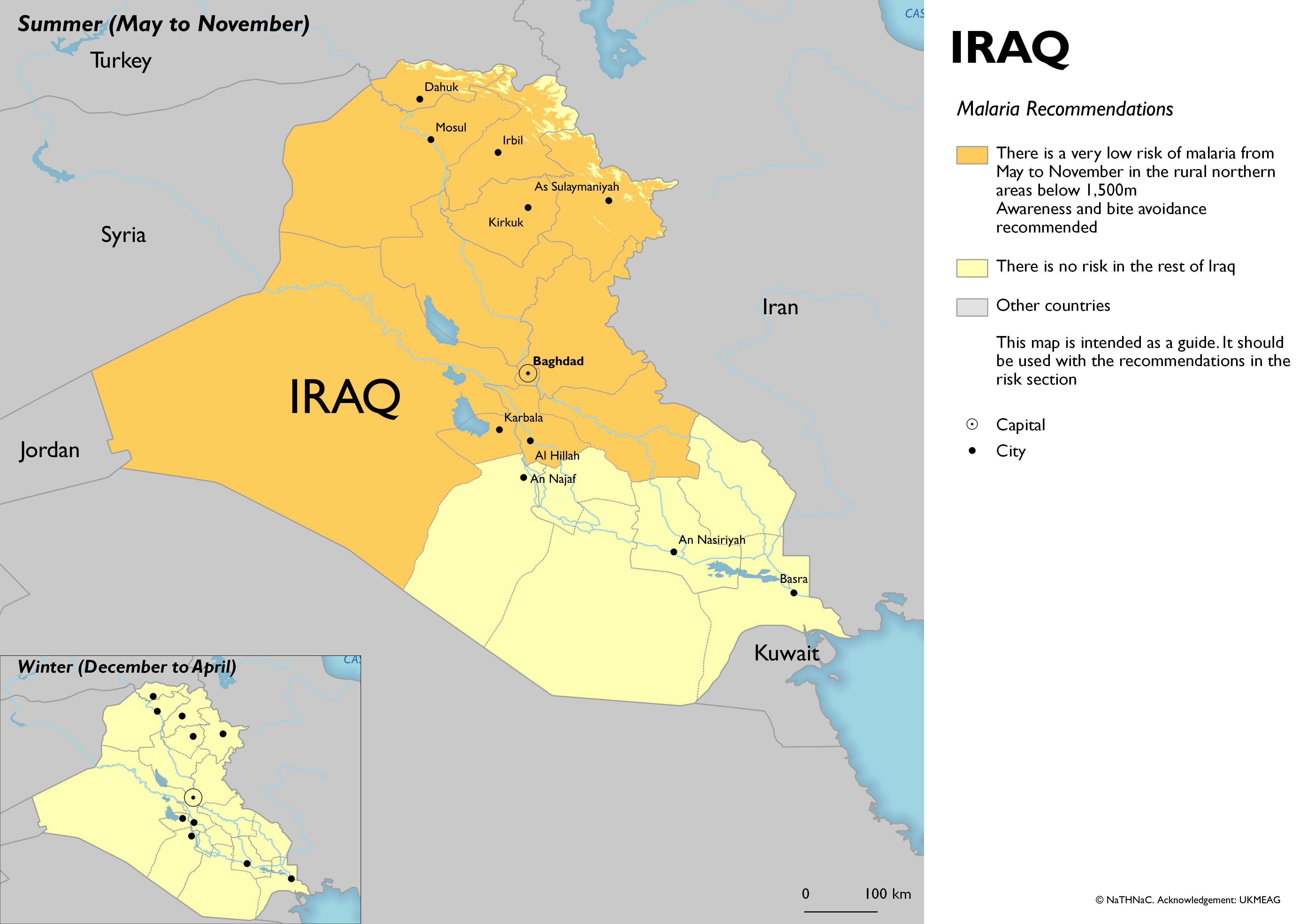
Haz clic en el mapa para abrir en una nueva ventana
There are no antimalarial drugs recommended for Iraq.
Recursos
What other health risks are there in Iraq?
Existen algunos riesgos que son relevantes para todos los viajeros, independientemente del destino. Estos pueden incluir, por ejemplo, accidentes de tráfico y otros accidentes, enfermedades transmitidas por insectos o garrapatas, enfermedades transmitidas por alimentos y agua contaminados, o problemas de salud relacionados con el calor o el frío.
Algunos riesgos adicionales (que pueden estar presentes en todo o parte de este país) se mencionan a continuación y se presentan alfabéticamente.
Altitud
Existe un riesgo de mal de altura al viajar a destinos de 2,500 metros (8,200 pies) o más. Factores de riesgo importantes son la altitud alcanzada, la velocidad de ascenso y la altitud al dormir. Un ascenso rápido sin un período de aclimatación pone al viajero en mayor riesgo.
Existen tres síndromes: mal agudo de montaña (MAM), edema cerebral de gran altitud (HACE) y edema pulmonar de gran altitud (HAPE). HACE y HAPE requieren un descenso inmediato y tratamiento médico.
Altitude illness in Iraq
Hay un punto de elevación en este país superior a 2,500 metros.
Prevención
Los viajeros deben pasar unos días a una altitud inferior a 3,000 m.
Siempre que sea posible, los viajeros deben evitar viajar desde altitudes inferiores a 1,200 m a altitudes superiores a 3,500 m en un solo día.
El ascenso por encima de los 3,000m debe ser gradual. Los viajeros deben evitar aumentar la altitud de pernocta en más de 500m por día y asegurarse de tener un día de descanso (a la misma altitud) cada tres o cuatro días.
El acetazolamida puede usarse para ayudar con la aclimatación, pero no debe reemplazar el ascenso gradual.
Los viajeros que desarrollen síntomas de AMS (dolor de cabeza, fatiga, pérdida de apetito, náuseas y alteraciones del sueño) deben evitar seguir ascendiendo. En ausencia de mejoría o con la progresión de los síntomas, la primera respuesta debe ser descender.
El desarrollo de síntomas de HACE o HAPE requiere un descenso inmediato y tratamiento médico de emergencia.
Enfermedad de altitud en resumen
Insectos que pican o garrapatas
Las picaduras de insectos o garrapatas pueden causar irritación e infecciones en la piel en el lugar de la picadura. También pueden transmitir ciertas enfermedades.
Enfermedades en Asia Occidental
There is a risk of insect or tick-borne diseases in some areas of Western Asia. This includes diseases such as fiebre hemorrágica de Crimea-Congo, leishmaniasis, fiebre del Valle del Rift y el virus del Nilo Occidental.
Prevención
Todos los viajeros deben evitar las picaduras de insectos y garrapatas tanto de día como de noche.
No hay vacunas (o medicamentos) para prevenir estas enfermedades.
Se puede encontrar más información sobre enfermedades específicas transmitidas por insectos o garrapatas para este país, si corresponde, en esta página, en otras secciones de las páginas de información del país y en el hoja informativa sobre la prevención de picaduras de insectos y garrapatas.
Influenza
La influenza estacional es una infección viral del tracto respiratorio y se propaga fácilmente de persona a persona a través de gotitas respiratorias al toser y estornudar. Los síntomas aparecen rápidamente e incluyen fiebre, dolores musculares, dolor de cabeza, malestar (sensación de indisposición), tos, dolor de garganta y secreción nasal. En individuos sanos, los síntomas mejoran sin tratamiento dentro de dos a siete días. La enfermedad grave es más común en personas de 65 años o más, menores de 2 años, o en aquellos que tienen condiciones médicas subyacentes que aumentan su riesgo de complicaciones por influenza.
Seasonal influenza in Iraq
La influenza estacional ocurre en todo el mundo. En el hemisferio norte (incluido el Reino Unido), la mayoría de los casos de influenza ocurren desde octubre hasta marzo. En el hemisferio sur, la influenza ocurre principalmente entre abril y septiembre. En los trópicos, la influenza puede ocurrir durante todo el año.
Prevención
Todos los viajeros deben:
Evita el contacto cercano con personas sintomáticas
Evita las condiciones de aglomeración siempre que sea posible
Lávese las manos con frecuencia
Practicar la ‘higiene de la tos’: estornudar o toser en un pañuelo y desecharlo de manera segura de inmediato, y lavarse las manos
Evite viajar si se siente mal con síntomas similares a la gripe
Una vacuna está disponible en ciertas circunstancias (ver abajo)*
*En el Reino Unido, la vacuna contra la influenza estacional se ofrece de manera rutinaria cada año a aquellos con mayor riesgo de desarrollar una enfermedad grave tras la infección por influenza, y a ciertos grupos adicionales como trabajadores de la salud y niños como parte del calendario nacional del Reino Unido (ver información sobre vacunación). Para aquellos que no pertenecen a estos grupos, la vacunación puede estar disponible de forma privada.
Si las personas con mayor riesgo de enfermedad grave tras una infección por influenza viajan a un país donde es probable que la influenza esté circulando, deben asegurarse de haber recibido una vacuna contra la gripe en los últimos 12 meses.
La vacuna utilizada en el Reino Unido protege contra las cepas que se prevé que ocurran durante los meses de invierno del hemisferio norte. No es posible obtener la vacuna para el hemisferio sur en el Reino Unido, pero la vacuna utilizada durante la temporada de influenza en el Reino Unido aún debería proporcionar una protección importante contra las cepas que probablemente ocurran durante la temporada de influenza del hemisferio sur y en los trópicos.
Influenza aviar
Los virus de la gripe aviar rara vez pueden infectar y causar enfermedades en humanos. Tales casos suelen estar asociados con una exposición cercana a poblaciones de aves o animales infectados. Cuando sea apropiado, la información sobre estos estará disponible en las secciones de brotes y noticias de las páginas de los países relevantes. Las vacunas contra la gripe estacional no proporcionarán protección contra la gripe aviar.
Coronavirus del síndrome respiratorio de Oriente Medio
MERS-CoV es una infección viral que se propaga por contacto directo o indirecto con camellos infectados o productos relacionados con camellos. También se ha reportado una transmisión limitada de persona a persona a través de la tos y los estornudos de personas infectadas, típicamente en entornos de atención médica.
Los síntomas incluyen fiebre y tos que pueden progresar a una grave dificultad para respirar y problemas respiratorios. Se han reportado muertes, con un riesgo que aumenta con la edad avanzada o condiciones médicas subyacentes.
MERS-CoV is presumed to be a risk in this country.
Prevención
Todos los viajeros, especialmente aquellos con condiciones médicas crónicas, deben practicar buenas medidas generales de salud, como lavarse las manos regularmente con agua y jabón en todo momento, pero especialmente después de visitar granjas, establos o áreas de mercado. Deben:
Evite el contacto con camellos.
Evite la leche de camello cruda y/o productos de camello.
Evite el consumo de cualquier tipo de leche cruda, productos de leche cruda y cualquier alimento que pueda estar contaminado con secreciones animales, a menos que estén pelados y limpios y/o completamente cocidos.
Actualmente no hay vacuna para prevenir el MERS-CoV.
Calidad del aire exterior
La mala calidad del aire es un problema de salud pública significativo en muchas partes del mundo. La exposición a altos niveles de contaminación del aire durante períodos cortos de tiempo (por ejemplo, minutos/horas/días) y períodos más largos (por ejemplo, años) está vinculada a muchos problemas de salud agudos y crónicos diferentes. Estos efectos se manifiestan principalmente en los sistemas respiratorio (pulmones y vías respiratorias) y cardiovascular (función cardíaca y circulación sanguínea).
La información actual sobre la calidad del aire mundial está disponible en el proyecto del índice mundial de calidad del aire.
Prevención
Los viajeros con problemas de salud que puedan hacerlos más vulnerables a los efectos de la contaminación del aire y que viajen a áreas de alta contaminación deberían:
discutir sus planes de viaje con su médico y llevar un suministro adecuado de su medicación habitual.
tomen precauciones sensatas para minimizar su exposición a altos niveles de contaminación del aire.
verificar los datos de calidad del aire local y ajustar sus actividades en consecuencia.
tome nota de cualquier aviso de salud publicado por el Ministerio de Salud local y el Departamento de Medio Ambiente, y siga las indicaciones proporcionadas.
No está claro si las mascarillas son beneficiosas para reducir la exposición y pueden dificultar la respiración para aquellos con condiciones pulmonares preexistentes. Aquellos que elijan usar una deben asegurarse de que la mascarilla se ajuste bien y saber cómo usarla correctamente.
Calidad del aire exterior en resumen
Esquistosomiasis
La esquistosomiasis es una infección parasitaria. Las larvas de Schistosoma son liberadas por caracoles de agua dulce infectados y pueden penetrar la piel humana intacta tras el contacto con agua dulce contaminada. Los viajeros pueden estar expuestos durante actividades como vadear, nadar, bañarse o lavar ropa en arroyos, ríos o lagos de agua dulce.
La infección por esquistosomiasis puede no causar síntomas, pero los síntomas tempranos pueden incluir una erupción y picazón en la piel ('picazón del nadador'), fiebre, escalofríos, tos o dolores musculares. Si no se trata, puede causar problemas de salud graves a largo plazo, como enfermedades intestinales o de la vejiga.
Existe un riesgo de esquistosomiasis en este país.
Prevención
No hay vacuna ni tabletas para prevenir la esquistosomiasis.
Todos los viajeros deben evitar vadear, nadar o bañarse en agua dulce. Nadar en agua adecuadamente clorada o en agua de mar no representa un riesgo de esquistosomiasis.
Bebe agua que esté hervida, filtrada o embotellada.
La aplicación de repelente de insectos antes de la exposición a agua dulce, o secarse con una toalla después de una posible exposición a la esquistosomiasis, no son métodos confiables para prevenir la infección.
Todos los viajeros que puedan haber estado expuestos a la esquistosomiasis deben someterse a un chequeo de salud para detectar la infección por esquistosomiasis.
Infecciones de transmisión sexual
Las infecciones de transmisión sexual (ITS) son un grupo de infecciones virales, bacterianas y parasitarias que se propagan durante las relaciones sexuales o por contacto íntimo. Ciertas ITS pueden ser más difíciles de tratar debido a niveles más altos de resistencia a los antibióticos y algunas ITS que son raras en el Reino Unido pueden ser más comunes en otras regiones del mundo.
Cualquiera que sea sexualmente activo está en riesgo de contraer una ITS dondequiera que se encuentren en el mundo.
El riesgo es mayor para los viajeros que:
tener relaciones sexuales sin condón
tener relaciones sexuales con parejas nuevas o casuales
participar en turismo sexual
tener relaciones sexuales bajo la influencia de drogas o alcohol
Los síntomas de las ITS varían según el tipo de infección; algunas pueden causar solo síntomas leves o imperceptibles. Si los síntomas ocurren, pueden incluir erupciones, secreción, picazón, ampollas, llagas o verrugas en las áreas genitales y/o anales, dolor al orinar y síntomas similares a los de la gripe.
Si no se tratan, las ITS pueden causar problemas de salud graves a largo plazo, como problemas de fertilidad, enfermedad inflamatoria pélvica y complicaciones en el embarazo.
Prevención
Usar condones de manera consistente y correcta con parejas nuevas o casuales es la forma más efectiva de reducir el riesgo de ITS.
Los viajeros también pueden reducir su riesgo de ITS al:
asegurándose de que estén al día con todas las vacunas recomendadas en el Reino Unido, incluyendo si es apropiado gonorrea, hepatitis B, mpox y vacunas contra el virus del papiloma humano (VPH) las vacunas
considerando Profilaxis Preexposición al VIH (PrEP) si corresponde
Los viajeros deben buscar consejo médico y proporcionar su historial de viajes si creen que pueden tener una ITS, incluso si no tienen síntomas. También deben hacerse una prueba de ITS si han tenido relaciones sexuales sin preservativos con una pareja nueva o casual mientras estaban en el extranjero.
En el Reino Unido las pruebas de ITS es gratuito y confidencial.
Fuente y descargo de responsabilidad
Esta información sobre salud en viajes se basa en datos proporcionados por NaTHNaC (el Centro y Red Nacional de Salud para Viajes). Todos los derechos de propiedad intelectual sobre los datos son propiedad de NaTHNaC. No debe copiarse, reproducirse, distribuirse, modificarse ni ofrecerse para la venta sin el consentimiento previo por escrito de NaTHNaC.
Patient.info asegura que esta información se revisa y actualiza al menos semanalmente. Sin embargo, los datos de NaTHNaC son precisos solo en la fecha en que fueron preparados, y Patient.info es el único responsable de mantener su precisión y completitud después de esa fecha. NaTHNaC no acepta responsabilidad por el uso de estos datos por parte de Patient.info o sus usuarios.
Selecciones del paciente para Salud de viaje por país
Viajes y vacunaciones
Consejos de salud para viajar al extranjero
Viajar al extranjero significa encontrarse con lugares y situaciones desconocidas que pueden conllevar riesgos inesperados. Una buena planificación y evaluación de riesgos nos permiten anticipar y evitar muchas posibles dificultades. Este folleto considera la preparación para el viaje, aspectos de seguridad personal y salud al viajar. Señala fuentes de información y consejos para ayudar en la planificación.
por la Dra. Toni Hazell, FRCGP

Viajes y vacunaciones
Vacunas para viajar
Las vacunas de viaje son una parte esencial de la planificación de vacaciones y viajes, especialmente si tu viaje te lleva a un destino exótico o 'fuera de lo común'. Los riesgos no se limitan a los viajes tropicales, aunque la mayoría de las vacunas de viaje están dirigidas a enfermedades que son más comunes en los trópicos. Para obtener información más general sobre viajes, consulta el folleto separado llamado Consejos de Salud para Viajar al Extranjero. Este folleto discute las vacunas que están disponibles y da una idea del tiempo que necesitas para completar un curso completo de vacunación protectora. Se puede obtener más información específica para tu destino en tu clínica (si tienen los recursos para ofrecer este servicio), en clínicas especializadas en viajes y en varios sitios web. Encontrarás una selección de estos listados al final de este folleto y bajo referencias.
por la Dra. Toni Hazell, FRCGP
Sobre el autorVer biografía completa

Red y Centro Nacional de Salud para el Viajero (NaTHNaC)
NaTHNaC fue establecido por el Departamento de Salud en 2002 con el amplio objetivo de 'Proteger la Salud de los Viajeros Británicos'. Buscan mejorar la calidad del asesoramiento sobre salud en viajes proporcionado por las prácticas de médicos generales, clínicas de viajes, farmacias y otros proveedores de atención médica, y proporcionar información actualizada y confiable para el viajero internacional, la industria de viajes y el gobierno nacional.
Acerca del revisorVer biografía completa
Red y Centro Nacional de Salud para el Viajero (NaTHNaC)
NaTHNaC fue establecido por el Departamento de Salud en 2002 con el amplio objetivo de 'Proteger la Salud de los Viajeros Británicos'. Buscan mejorar la calidad del asesoramiento sobre salud en viajes proporcionado por las prácticas de médicos generales, clínicas de viajes, farmacias y otros proveedores de atención médica, y proporcionar información actualizada y confiable para el viajero internacional, la industria de viajes y el gobierno nacional.
Historial del artículo
La información en esta página está escrita y revisada por pares por clínicos calificados.
Artículo también disponible en Inglés, Alemán, Español, Francés, Italiano, Portugués, Hindi, Hebreo, Árabe, y Sueco.
3 Jun 2026 | Última versión
Última actualización por
Red y Centro Nacional de Salud para el Viajero (NaTHNaC)Revisado por pares por
Red y Centro Nacional de Salud para el Viajero (NaTHNaC)23 Oct 2025 | Publicado originalmente
Escrito por:
Red y Centro Nacional de Salud para el Viajero (NaTHNaC)

Pregunta, comparte, conecta.
Navega por discusiones, haz preguntas y comparte experiencias en cientos de temas de salud.

¿Te sientes mal?
Evalúa tus síntomas en línea de forma gratuita
Suscríbete al boletín de Patient
Tu dosis semanal de consejos de salud claros y confiables, escritos para ayudarte a sentirte informado, seguro y en control.
Al suscribirte aceptas nuestros Política de Privacidad. Puedes darte de baja en cualquier momento. Nunca vendemos tus datos.