Enfermedad de células falciformes
Última actualización 3 Apr 2025
Cumple con las directrices editoriales
- DescargarDescargar
- Compartir
- Language
- Discusión
- Ask Patient
- Versión en audio
- Agregar a fuentes preferidas en Google
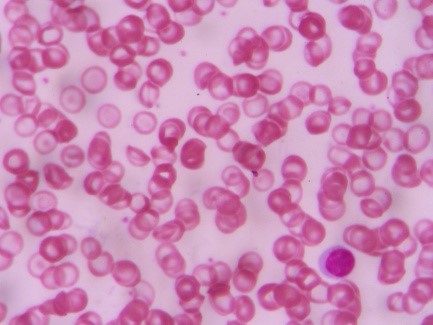
Sickle cell disease is a group of disorders that affects hemoglobin, the molecule in red blood cells that delivers oxygen to cells throughout the body. People with this disease have atypical hemoglobin molecules called hemoglobin S, which can distort red blood cells into a sickle or crescent shape.
Selecciones de videos para Condiciones genéticasBiblioteca de videos
Descripción
Sickle cell disease is a group of disorders that affects hemoglobin, the molecule in red blood cells that delivers oxygen to cells throughout the body. People with this disease have atypical hemoglobin molecules called hemoglobin S, which can distort red blood cells into a sickle or crescent shape.
Signs and symptoms of sickle cell disease usually begin in early childhood. Characteristic features of this disorder include a low number of red blood cells (anaemia), repeated infections, and periodic episodes of pain. The severity of signs and symptoms varies from person to person. Some people have mild health issues, while others are frequently hospitalized for more serious complications.
The signs and symptoms of sickle cell disease are caused by the sickling of red blood cells. When red blood cells sickle, they break down prematurely, which can lead to anaemia. Anaemia can cause shortness of breath, fatigue, and delayed growth and development in children. The rapid breakdown of red blood cells may also cause yellowing of the skin and whites of the eyes (jaundice). Painful episodes can occur when sickled red blood cells, which are stiff and inflexible, get stuck in small blood vessels. These episodes deprive tissues and organs, such as the lungs, kidneys, spleen, and brain, of oxygen-rich blood and can lead to organ damage. A particularly serious complication of sickle cell disease is high blood pressure in the blood vessels that supply the lungs (pulmonary hypertension), which can lead to heart failure. Pulmonary hypertension occurs in about 10 percent of adults with sickle cell disease.
There are currently a range of treatment options for people with sickle cell disease. Some treatments address the symptoms of the condition, while others address the genetic cause of sickle cell disease and effectively cure the condition. Without treatment, individuals with sickle cell disease often have lifelong health problems.
Patrones de herencia
The source lists the following possible inheritance patterns: Autosomal recessive. More than one pattern can apply in different cases.
Related genes
Otros nombres
HbS disease
Hemoglobin S disease
SCD
Sickle cell disorders
Sickling disorder due to hemoglobin S
Related patient information and medicines
Patient information leaflet
Enfermedad de células falciformes
Sickle cell disease (SCD) is a serious, inherited condition affecting the blood and various organs in the body. It affects the red blood cells, causing episodes of 'sickling', which produce episodes of pain and other symptoms. Sickle cell disease Sickle cell disease (SCD) is a serious group of conditions which are inherited (genetic). Sickle cell.

Patient information leaflet
Rasgo de células falciformes
If you inherit a gene from one of your parents, called a sickle cell gene, you have a cond... This causes a condition called sickle cell disease (SCD). Sickle cell trait means having one gene for a condition called sickle cell disease (SCD) Sickle cell disease. This in itself does not normally cause problems and sickle cell trait is not considered.

Patient information leaflet
Trasplante de células madre
A stem cell transplant is where blood stem cells (the cells produced by the bone marrow to turn into different types of blood cells) are put back into your body when your bone marrow has been destroyed and cannot make stem cells itself. T... For the treatment of diabetic foot ulcers Diabetic foot ulcers. In the management of sickle cell disease.

Patient information leaflet
enfermedad de Parkinson
El main symptoms de enfermedad de Parkinson are usually stiffness, shaking (tremor), and slowness of movement. People with Parkinson's may also develop other symptoms (listed below). What is Parkinson's disease. enfermedad de Parkinson es un progressive neurological degeneration of certain cells (called dopaminergic cells) within a specific part of the.

Patient information leaflet
Enfermedad renal poliquística
Polycystic kidney disease (PKD) causes many fluid-filled sacs (cysts) to develop in the kidneys. The most common type of PKD is an inherited condition called autosomal dominant polycystic kidney disease (ADPKD). With ADPKD, problems commonly do not develop until the age of 30-50, with some people never developing any problems. The two common.

Patient information leaflet
Enfermedad del hígado graso no alcohólico
Non-alcoholic enfermedad del hígado graso (NAFLD) describes a range of conditions caused by a build-up of fat within hígado cells. It is very common and in many cases is linked to being obese or overweight. Most people with NAFLD do not develop serious liver problems. The cause is not known. Symptoms include being enfermedad (vomiting), panza (abdominal) pain.
Lecturas adicionales y referencias
- Enfermedad de células falciformes; MedlinePlus, National Library of Medicine.
- Ashley-Koch A, Yang Q, Olney RS. Sickle hemoglobin (HbS) allele and sickle cell disease: a HuGE review. Am J Epidemiol. 2000 May 1;151(9):839-45. doi: 10.1093/oxfordjournals.aje.a010288.
- Cromer MK, Camarena J, Martin RM, Lesch BJ, Vakulskas CA, Bode NM, Kurgan G, Collingwood MA, Rettig GR, Behlke MA, Lemgart VT, Zhang Y, Goyal A, Zhao F, Ponce E, Srifa W, Bak RO, Uchida N, Majeti R, Sheehan VA, Tisdale JF, Dever DP, Porteus MH. Gene replacement of alpha-globin with beta-globin restores hemoglobin balance in beta-thalassemia-derived hematopoietic stem and progenitor cells. Nat Med. 2021 Apr;27(4):677-687. doi: 10.1038/s41591-021-01284-y. Epub 2021 Mar 18.
- Gladwin MT, Sachdev V, Jison ML, Shizukuda Y, Plehn JF, Minter K, Brown B, Coles WA, Nichols JS, Ernst I, Hunter LA, Blackwelder WC, Schechter AN, Rodgers GP, Castro O, Ognibene FP. Pulmonary hypertension as a risk factor for death in patients with sickle cell disease. N Engl J Med. 2004 Feb 26;350(9):886-95. doi: 10.1056/NEJMoa035477.
- Lattanzi A, Camarena J, Lahiri P, Segal H, Srifa W, Vakulskas CA, Frock RL, Kenrick J, Lee C, Talbott N, Skowronski J, Cromer MK, Charlesworth CT, Bak RO, Mantri S, Bao G, DiGiusto D, Tisdale J, Wright JF, Bhatia N, Roncarolo MG, Dever DP, Porteus MH. Development of beta-globin gene correction in human hematopoietic stem cells as a potential durable treatment for sickle cell disease. Sci Transl Med. 2021 Jun 16;13(598):eabf2444. doi: 10.1126/scitranslmed.abf2444.
- Powars DR, Chan LS, Hiti A, Ramicone E, Johnson C. Outcome of sickle cell anemia: a 4-decade observational study of 1056 patients. Medicine (Baltimore). 2005 Nov;84(6):363-376. doi: 10.1097/01.md.0000189089.45003.52.
- Schnog JB, Duits AJ, Muskiet FA, ten Cate H, Rojer RA, Brandjes DP. Sickle cell disease; a general overview. Neth J Med. 2004 Nov;62(10):364-74.
- Serjeant GR. The emerging understanding of sickle cell disease. Br J Haematol. 2001 Jan;112(1):3-18. doi: 10.1046/j.1365-2141.2001.02557.x. No abstract available.
- Stuart MJ, Nagel RL. Sickle-cell disease. Lancet. 2004 Oct 9-15;364(9442):1343-60. doi: 10.1016/S0140-6736(04)17192-4.
- Vichinsky E. New therapies in sickle cell disease. Lancet. 2002 Aug 24;360(9333):629-31. doi: 10.1016/S0140-6736(02)09776-3.
- Vichinsky EP. Pulmonary hypertension in sickle cell disease. N Engl J Med. 2004 Feb 26;350(9):857-9. doi: 10.1056/NEJMp038250. No abstract available.
Comparte tus pensamientos o experiencias con otros en nuestro comunidades de pacientes.
Acceso sencillo a tratamientos y servicios de salud confiables en línea.
Common conditions
Get help with common conditions through the NHS, without a GP appointment.
 Sinusitis aguda
 Amigdalitis bacteriana
 Impetigo
 Picaduras de insectos
 Herpes zósterInfección del tracto urinario (ITU)
Suscríbete al boletín de Patient
Tu dosis semanal de consejos de salud claros y confiables, escritos para ayudarte a sentirte informado, seguro y en control.
Al suscribirte aceptas nuestros Política de Privacidad. Puedes darte de baja en cualquier momento. Nunca vendemos tus datos.