Gota
Última actualización 29 Sept 2020
Cumple con las directrices editoriales
- DescargarDescargar
- Compartir
- Language
- Discusión
- Ask Patient
- Versión en audio
- Agregar a fuentes preferidas en Google
Gout is a type of arthritis, which is a group of related disorders caused by episodes of abnormal inflammation in the joints. People with gout have high levels of a substance called urate in the blood (hyperuricemia). Gout develops when hyperuricemia leads to the formation of urate crystals in joints, triggering an inflammatory response from the immune system.
Selecciones de videos para Condiciones genéticasBiblioteca de videos
Descripción
Gout is a type of arthritis, which is a group of related disorders caused by episodes of abnormal inflammation in the joints. People with gout have high levels of a substance called urate in the blood (hyperuricemia). Gout develops when hyperuricemia leads to the formation of urate crystals in joints, triggering an inflammatory response from the immune system.
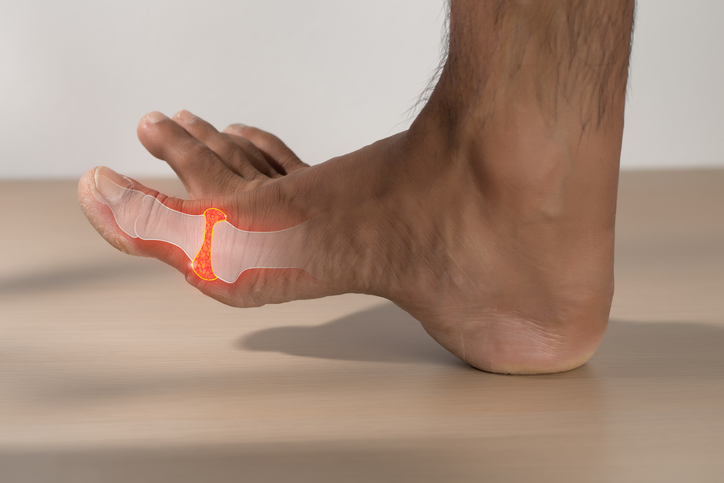
In people with gout, the first episode of inflammation (called a flare) usually affects the big toe or other joints in the foot or ankle. If urate levels remain high, flares can recur, affecting additional joints throughout the body. The time between flares varies among affected individuals; however, most people who experience multiple flares have their second one within a year of their first.
Flares usually begin at night and can last several days. It is unclear what causes a flare to stop; the body likely turns off the inflammation response after a certain period of time. During a flare, individuals can experience throbbing or burning pain, swelling, warmth, redness, and difficulty moving the affected joint. Fevers may occur, after which the skin over the affected joint can begin to peel. Without treatment, people with gout can experience frequent flares and joint pain and damage, which can limit mobility and decrease quality of life.
In about 15 percent of people with gout, urate accumulates in the kidneys and forms kidney stones. As the condition worsens, urate crystals can also be deposited under the skin or in other soft tissue, forming a nodule called a tophus (plural: tophi). These tophi often form in the hands, elbows, or feet. Tophi do not typically cause pain, but they can become inflamed, infected, or ooze fluid. Depending on their location, tophi can interfere with movements such as walking or gripping objects.
Many people with gout also have other health conditions. Most affected individuals have high blood pressure (hypertension), chronic kidney disease, or obesity. Some also have diabetes, heart disease, or a history of stroke. It is unclear whether gout is the cause of a person's increased risk for these conditions, or whether the conditions cause the development of gout, or whether both of these situations occur to influence disease.
Patrones de herencia
The source lists the following possible inheritance patterns: Pattern unknown. More than one pattern can apply in different cases.
Related genes
Otros nombres
Arthritis, gouty
Articular gout
Gouty arthritis
Gouty arthropathy
Related patient information and medicines
Patient information leaflet
Gota
Gout causes attacks of pain and swelling in one or more joints. What is gout? | Patient Explainers Gout causes attacks of pain and swelling in one or more joints. Find out more: [/health/gout-leaflet](https://patient.info/health/gout-leaflet) Follow Patient: Website: [/](https://patient.info/) Facebook:.
Patient information leaflet
Artritis
Arthritis means inflammation in a joint (like your knee, hip, elbow or fingers). This leaflet will explain a bit about how joints work and then go through the main causes of arthritis in easy-to-read language. Gout Gout Gout causes attacks of pain and swelling when uric acid in the body crystalises in one or more joints. An anti-inflammatory.

Patient information leaflet
Dolor articular
See also the separate leaflet called Arthritis. Arthritis Joint pain may affect just one joint or it may affect many different joints. Reactive arthritis Gout. Gout Fibromyalgia. Fibromyalgia Ankylos... See the separate leaflet called Reactive arthritis. Gout Causes attacks of painful inflammation in one or more joints. The pain of a gout attack.

Patient information leaflet
Policitemia vera
What is polycythaemia rubra vera. Polycythaemia rubra vera (PRV) is a myeloproliferative disorder, which means the bone marrow makes too many blood cells. Also, about 1 in 10 people with PRV develop gout. Gout Myelofibrosis There is a chance that, after about 15 years, PRV can develop into a condition known as myelofibrosis. With myelofibrosis,.

Patient information leaflet
Metatarsalgia
Freiberg's disease This is a rare disease characterised by death of some bone (osteonecrosis) in the second metatarsal, most commonly seen in teenage girls. Artritis o gota This can cause inflammation of the joints in the ball of the foot or of the big toe and can be a cause of metatarsalgia. See the separate leaflet called Gout Gout and those.

Patient information leaflet
¿Puedo tomar Amlodipina y Nustendi juntos?
Taking amlodipine and Nustendi ( ezetimibe ) together can increase the amount of one of the ingredients i... This may aumentar el risk of side effects from Nustendi, como high levels of uric acid in the sangre (which can cause gout) or, in rare cases, tendon problems. Gout Nustendi can increase the levels of uric acid in your blood, which may.
Lecturas adicionales y referencias
- Gota; MedlinePlus, National Library of Medicine.
- Dalbeth N, Merriman TR, Stamp LK. Gout. Lancet. 2016 Oct 22;388(10055):2039-2052. doi: 10.1016/S0140-6736(16)00346-9. Epub 2016 Apr 21.
- Dalbeth N, Stamp LK, Merriman TR. The genetics of gout: towards personalised medicine? BMC Med. 2017 May 31;15(1):108. doi: 10.1186/s12916-017-0878-5.
- Ichida K, Matsuo H, Takada T, Nakayama A, Murakami K, Shimizu T, Yamanashi Y, Kasuga H, Nakashima H, Nakamura T, Takada Y, Kawamura Y, Inoue H, Okada C, Utsumi Y, Ikebuchi Y, Ito K, Nakamura M, Shinohara Y, Hosoyamada M, Sakurai Y, Shinomiya N, Hosoya T, Suzuki H. Decreased extra-renal urate excretion is a common cause of hyperuricemia. Nat Commun. 2012 Apr 3;3:764. doi: 10.1038/ncomms1756.
- Khanna D, Fitzgerald JD, Khanna PP, Bae S, Singh MK, Neogi T, Pillinger MH, Merill J, Lee S, Prakash S, Kaldas M, Gogia M, Perez-Ruiz F, Taylor W, Liote F, Choi H, Singh JA, Dalbeth N, Kaplan S, Niyyar V, Jones D, Yarows SA, Roessler B, Kerr G, King C, Levy G, Furst DE, Edwards NL, Mandell B, Schumacher HR, Robbins M, Wenger N, Terkeltaub R; American College of Rheumatology. 2012 American College of Rheumatology guidelines for management of gout. Part 1: systematic nonpharmacologic and pharmacologic therapeutic approaches to hyperuricemia. Arthritis Care Res (Hoboken). 2012 Oct;64(10):1431-46. doi: 10.1002/acr.21772. No abstract available.
- Khanna D, Khanna PP, Fitzgerald JD, Singh MK, Bae S, Neogi T, Pillinger MH, Merill J, Lee S, Prakash S, Kaldas M, Gogia M, Perez-Ruiz F, Taylor W, Liote F, Choi H, Singh JA, Dalbeth N, Kaplan S, Niyyar V, Jones D, Yarows SA, Roessler B, Kerr G, King C, Levy G, Furst DE, Edwards NL, Mandell B, Schumacher HR, Robbins M, Wenger N, Terkeltaub R; American College of Rheumatology. 2012 American College of Rheumatology guidelines for management of gout. Part 2: therapy and antiinflammatory prophylaxis of acute gouty arthritis. Arthritis Care Res (Hoboken). 2012 Oct;64(10):1447-61. doi: 10.1002/acr.21773. No abstract available.
- Kottgen A, Albrecht E, Teumer A, Vitart V, Krumsiek J, Hundertmark C, Pistis G, Ruggiero D, O'Seaghdha CM, Haller T, Yang Q, Tanaka T, Johnson AD, Kutalik Z, Smith AV, Shi J, Struchalin M, Middelberg RP, Brown MJ, Gaffo AL, Pirastu N, Li G, Hayward C, Zemunik T, Huffman J, Yengo L, Zhao JH, Demirkan A, Feitosa MF, Liu X, Malerba G, Lopez LM, van der Harst P, Li X, Kleber ME, Hicks AA, Nolte IM, Johansson A, Murgia F, Wild SH, Bakker SJ, Peden JF, Dehghan A, Steri M, Tenesa A, Lagou V, Salo P, Mangino M, Rose LM, Lehtimaki T, Woodward OM, Okada Y, Tin A, Muller C, Oldmeadow C, Putku M, Czamara D, Kraft P, Frogheri L, Thun GA, Grotevendt A, Gislason GK, Harris TB, Launer LJ, McArdle P, Shuldiner AR, Boerwinkle E, Coresh J, Schmidt H, Schallert M, Martin NG, Montgomery GW, Kubo M, Nakamura Y, Tanaka T, Munroe PB, Samani NJ, Jacobs DR Jr, Liu K, D'Adamo P, Ulivi S, Rotter JI, Psaty BM, Vollenweider P, Waeber G, Campbell S, Devuyst O, Navarro P, Kolcic I, Hastie N, Balkau B, Froguel P, Esko T, Salumets A, Khaw KT, Langenberg C, Wareham NJ, Isaacs A, Kraja A, Zhang Q, Wild PS, Scott RJ, Holliday EG, Org E, Viigimaa M, Bandinelli S, Metter JE, Lupo A, Trabetti E, Sorice R, Doring A, Lattka E, Strauch K, Theis F, Waldenberger M, Wichmann HE, Davies G, Gow AJ, Bruinenberg M; LifeLines Cohort Study; Stolk RP, Kooner JS, Zhang W, Winkelmann BR, Boehm BO, Lucae S, Penninx BW, Smit JH, Curhan G, Mudgal P, Plenge RM, Portas L, Persico I, Kirin M, Wilson JF, Mateo Leach I, van Gilst WH, Goel A, Ongen H, Hofman A, Rivadeneira F, Uitterlinden AG, Imboden M, von Eckardstein A, Cucca F, Nagaraja R, Piras MG, Nauck M, Schurmann C, Budde K, Ernst F, Farrington SM, Theodoratou E, Prokopenko I, Stumvoll M, Jula A, Perola M, Salomaa V, Shin SY, Spector TD, Sala C, Ridker PM, Kahonen M, Viikari J, Hengstenberg C, Nelson CP; CARDIoGRAM Consortium; DIAGRAM Consortium; ICBP Consortium; MAGIC Consortium; Meschia JF, Nalls MA, Sharma P, Singleton AB, Kamatani N, Zeller T, Burnier M, Attia J, Laan M, Klopp N, Hillege HL, Kloiber S, Choi H, Pirastu M, Tore S, Probst-Hensch NM, Volzke H, Gudnason V, Parsa A, Schmidt R, Whitfield JB, Fornage M, Gasparini P, Siscovick DS, Polasek O, Campbell H, Rudan I, Bouatia-Naji N, Metspalu A, Loos RJ, van Duijn CM, Borecki IB, Ferrucci L, Gambaro G, Deary IJ, Wolffenbuttel BH, Chambers JC, Marz W, Pramstaller PP, Snieder H, Gyllensten U, Wright AF, Navis G, Watkins H, Witteman JC, Sanna S, Schipf S, Dunlop MG, Tonjes A, Ripatti S, Soranzo N, Toniolo D, Chasman DI, Raitakari O, Kao WH, Ciullo M, Fox CS, Caulfield M, Bochud M, Gieger C. Genome-wide association analyses identify 18 new loci associated with serum urate concentrations. Nat Genet. 2013 Feb;45(2):145-54. doi: 10.1038/ng.2500. Epub 2012 Dec 23.
- Merriman T. Genomic Influences on Hyperuricemia and Gout. Rheum Dis Clin North Am. 2017 Aug;43(3):389-399. doi: 10.1016/j.rdc.2017.04.004.
- Newberry SJ, FitzGerald JD, Motala A, Booth M, Maglione MA, Han D, Tariq A, O'Hanlon CE, Shanman R, Dudley W, Shekelle PG. Diagnosis of Gout: A Systematic Review in Support of an American College of Physicians Clinical Practice Guideline. Ann Intern Med. 2017 Jan 3;166(1):27-36. doi: 10.7326/M16-0462. Epub 2016 Nov 1.
- Richette P, Doherty M, Pascual E, Barskova V, Becce F, Castaneda-Sanabria J, Coyfish M, Guillo S, Jansen TL, Janssens H, Liote F, Mallen C, Nuki G, Perez-Ruiz F, Pimentao J, Punzi L, Pywell T, So A, Tausche AK, Uhlig T, Zavada J, Zhang W, Tubach F, Bardin T. 2016 updated EULAR evidence-based recommendations for the management of gout. Ann Rheum Dis. 2017 Jan;76(1):29-42. doi: 10.1136/annrheumdis-2016-209707. Epub 2016 Jul 25.
- Shekelle PG, Newberry SJ, FitzGerald JD, Motala A, O'Hanlon CE, Tariq A, Okunogbe A, Han D, Shanman R. Management of Gout: A Systematic Review in Support of an American College of Physicians Clinical Practice Guideline. Ann Intern Med. 2017 Jan 3;166(1):37-51. doi: 10.7326/M16-0461. Epub 2016 Nov 1.
- Wei WH, Guo Y, Kindt AS, Merriman TR, Semple CA, Wang K, Haley CS. Abundant local interactions in the 4p16.1 region suggest functional mechanisms underlying SLC2A9 associations with human serum uric acid. Hum Mol Genet. 2014 Oct 1;23(19):5061-8. doi: 10.1093/hmg/ddu227. Epub 2014 May 12.
Comparte tus pensamientos o experiencias con otros en nuestro comunidades de pacientes.
Acceso sencillo a tratamientos y servicios de salud confiables en línea.
Common conditions
Get help with common conditions through the NHS, without a GP appointment.
 Sinusitis aguda
 Amigdalitis bacteriana
 Impetigo
 Picaduras de insectos
 Herpes zósterInfección del tracto urinario (ITU)
Suscríbete al boletín de Patient
Tu dosis semanal de consejos de salud claros y confiables, escritos para ayudarte a sentirte informado, seguro y en control.
Al suscribirte aceptas nuestros Política de Privacidad. Puedes darte de baja en cualquier momento. Nunca vendemos tus datos.