Metatarsalgia
Metatarsal injury
Peer reviewed by Dr Toni Hazell, FRCGPLast updated by Dr Philippa Vincent, MRCGPLast updated 3 Jul 2024
Meets Patient’s editorial guidelines
- DownloadDownload
- Share
- Language
- Discussion
- Audio Version
- Add to preferred sources on Google
In this series:Plantar fasciitisAchilles tendinopathyAchilles tendon ruptureMetatarsal fracturesMorton's neuromaFlat feet and fallen arches
Metatarsalgia is the name given to pain in the front part of the foot under the heads of the metatarsal bones, also known as the ball of the foot. Metatarsalgia can be caused by a number of different conditions affecting the foot. Treatment will depend on the underlying cause. Measures such as changes to footwear, rest and losing weight can sometimes help.
At a glance
Metatarsalgia is pain in the ball of your foot under the metatarsal bones.
It is a symptom caused by various foot problems, not a disease itself.
Common causes include overuse, high heels, being overweight, or stiff ankles.
Symptoms often include pain when standing, walking, or running, and tenderness.
Treatment includes rest, appropriate footwear, weight loss, and painkillers.
A doctor may suggest blood tests or X-rays to find the cause.
Metatarsal pads or orthotics can help relieve pressure and pain.
What is metatarsalgia?
Metatarsalgia is a general name given to pain in the front part of the foot under the heads of the metatarsal bones. This is the area on the sole of the foot sometimes called the ball of the foot. Metatarsalgia can be caused by a number of different conditions affecting the foot. It is really a symptom of other problems rather than a specific disease itself.
Anatomy of your foot
There are many bones in each foot and these can briefly be divided into the tarsal bones, the metatarsal bones and the phalanges. (See the image on this page.) The tarsal bones are the larger bones that form the back section of the foot, with the heel bone (calcaneum) being the largest. There are five metatarsal bones. The first metatarsal bone is the largest and is the bone that joins to the big toe. Each toe has three phalanges, except the big toe which only has two. Therefore, there are three joints in most toes and two joints in the big toe.
Metatarsalgia
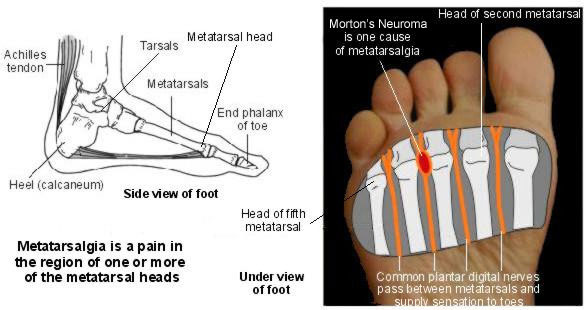
There are also many muscles, tendons and ligaments within the foot. The bones, ligaments and tendons within the foot form the foot arches, called the longitudinal and transverse arches. It is the foot arches that allow your foot to hold up the weight of the body. Nerves provide sensation to the skin of the foot.
What causes metatarsalgia?
Metatarsalgia can be caused by a number of different conditions. Common causes include:
Overuse
This is common in runners and athletes; overuse can cause some mild inflammation in the metatarsal heads and nearby joints. Other sports such as tennis or sports that involve jumping may also put extra stress on the metatarsal heads and lead to inflammation and pain.
Wearing high-heeled shoes
This can put extra stress on the metatarsal heads. Footwear that is poorly fitted or too tight may also be a cause.
Being overweight
This can put extra stress on the feet in general, but particularly on the metatarsal heads.
Having a stiff ankle or Achilles tendon (the tendon at the heel)
This can affect the way that pressure is distributed across the foot and may lead to extra stress on the metatarsal heads.
Morton's neuroma
This is sometimes called Morton's metatarsalgia. It is a condition that affects one of the nerves that run between the metatarsal bones in the foot (the plantar digital nerves). Symptoms include pain, burning, numbness and tingling between two of the toes of the foot. See the separate leaflet called Morton's neuroma for more detail.
Claw foot (pes cavus)
In pes cavus, the foot has a very high arch which does not flatten when weight is put on the foot. It happens because of an imbalance in the muscles of the foot. Pes cavus can run in families but it can also happen out of the blue. Most people with pes cavus also have a neurological problem such as cerebral palsy, spina bifida, muscular dystrophy or polio. Pes cavus can mean that extra stress is placed on the ball of the foot, which can lead to metatarsalgia.
Hammer toe or claw toe deformity
With a claw toe there is an abnormal position of all three of the joints in the toe. The joint with the metatarsal bone is bent upwards, the middle joint in the toe is bent downwards and the end joint in the toe may also be bent downwards. The toe resembles a claw. With a hammer toe, the toe is permanently bent at its middle joint so that it looks like a hammer. There are a number of conditions that can cause these toe deformities. These can include poorly fitted shoes, injury to the toes, bunions and rheumatoid arthritis. Hammer and claw toe can also occur in someone with pes cavus. They can also run in families. These toe deformities can mean that extra stress is placed on the ball of the foot, which can lead to metatarsalgia.
Bunion (hallux valgus)
A bunion is a deformity of the base joint of the big toe, causing the big toe to be angled towards the second toe. This causes a bump on the side of the foot at the base of the big toe. There is often thickening of the skin and tissues next to the affected joint. The thickened skin and tissues may become inflamed, swollen and painful. Because of the bunion, extra stress is put on the ball of the foot and this can lead to metatarsalgia. See the separate leaflet called Bunions for more detail.
Hallux valgus

Previous surgery to the foot
This can include, for example, previous surgery for bunions.
Stress crack (fracture) of a metatarsal
A stress fracture is a type of incomplete fracture in a bone. Stress fractures tend to occur as a result of overuse and are known as overuse injuries. A metatarsal stress fracture is a stress fracture in one of the metatarsal bones in the foot. See the separate leaflet called Metatarsal fractures for more detail, including metatarsal stress fractures.
Freiberg's disease
This is a rare disease characterised by death of some bone (osteonecrosis) in the second metatarsal, most commonly seen in teenage girls.
Arthritis or gout
This can cause inflammation of the joints in the ball of the foot or of the big toe and can be a cause of metatarsalgia. See the separate leaflet called Gout and those on arthritis for more detail.
Diabetes
This can cause damage to the nerves in the feet and can be a cause of metatarsalgia, usually if diabetes has been present for years and the blood sugars are not well controlled. See the separate leaflet called Diabetes (Diabetes mellitus).
Metatarsalgia symptoms
Metatarsalgia causes pain in the ball of the foot that can be made worse by standing, walking or running. Some people describe the pain as feeling as though they are walking on pebbles. Others describe more of a general aching pain. The pain can occur in one or both feet. In some people the pain is felt under one or two metatarsal heads; in others it is felt under all of them.
Metatarsalgia usually comes on gradually over some weeks rather than suddenly. The affected area of the foot may also feel tender when pressed.
Morton's neuroma has other specific symptoms and is explained further in the separate leaflet.
Do I need any investigations?
A medical professional may be able to identify the cause just by listening, asking questions and examining the foot. However, they may also suggest one or more of the following investigations:
Blood tests. These can check for diabetes control, arthritis and gout.
X-ray of the foot. This can show a problem with the bones or joints in the foot.
An ultrasound scan may be used to detect Morton's neuroma.
Other tests. Occasionally more detailed tests, such as a magnetic resonance imaging (MRI) scan of the foot, are needed. These would normally be organised by a physiotherapist or orthopaedic surgeon.
Metatarsalgia treatment
Basic measures can help to relieve the symptoms of metatarsalgia. These include:
Resting with the feet elevated where possible.
Losing weight if overweight.
Wearing shoes that are well fitted, low-heeled and have a wide toe area.
Physiotherapy may also be helpful. This may include exercises to help a stiff ankle or exercises to help stretch the Achilles tendon if these are problems for you.
Simple painkillers such as paracetamol and non-steroidal anti-inflammatory painkillers (NSAIDs) such as ibuprofen may help to relieve pain.
Seeing a podiatrist can help to see if there is hard skin (callus) build-up which is altering weight bearing. Podiatrists can also identify other problems with the feet which may be causing the pain.
Other treatment will depend on the underlying cause of the metatarsalgia. For example, if diabetes is the cause, it will be important to improve the control of the sugar levels. If gout or arthritis is the cause, treatment may be needed for these conditions.
Surgery is sometimes needed to treat metatarsalgia if other treatments have failed. This will depend on the underlying cause - for example, straightening of hammer or claw toes or surgery for Morton's neuroma.
Padding for metatarsalgia
Metatarsal pads and orthotic inserts for the shoes may help to relieve pain in the foot by reducing the pressure placed on the heads of the metatarsal bones. These can be bought online or following advice from a podiatrist.
Immediate relief for metatarsalgia
There are not many ways of immediately getting rid of pains in the metatarsals. Simple painkillers such as paracetamol or ibuprofen may help. Ice packs help some people. Resting the foot with it elevated can help. Pads or arch supports in the shoes may help reduce pain quickly.
How to prevent metatarsalgia
Some of the causes of metatarsalgia cannot be prevented - for example, metatarsalgia due to claw foot (pes cavus). However, there are some things that may help to prevent some of the other causes. These include:
Ensuring that shoes are well fitted, low-heeled and have a wide toe area. This may help to prevent some causes of metatarsalgia, including Morton's neuroma.
Ensuring that good, properly fitted footwear is worn when running or doing sports with high impact on the feet.
Losing weight if overweight.
Good control of diabetes will reduce the chance of developing some foot problems.
Patient picks for Heel and foot pain
Foot care
Morton's neuroma
Morton's neuroma is a condition that affects one of the nerves that run between the long bones (metatarsals) in the foot. The exact cause is not certain. Symptoms include pain, burning, numbness and tingling between two of the toes of the foot. About a third of cases resolve withd simple treatments including modification of footwear. Sometimes surgery is needed for long-standing (chronic) symptoms.
by Dr Philippa Vincent, MRCGP

Foot care
Plantar fasciitis
Heel and foot pain are very common. A common cause is plantar fasciitis which causes pain under the heel. It usually goes away with time but various treatments may help.
by Dr Surangi Mendis, MRCGP
Frequently asked questions
Can metatarsalgia be cured?
Metatarsalgia is a symptom of other underlying problems rather than a disease itself. Its resolution depends on successfully treating the specific condition causing the pain. For example, if it's due to ill-fitting shoes, changing footwear might resolve it. If it's caused by a more complex issue such as Freiberg's disease or a neurological problem, the approach to treatment will be different.
Is a metatarsal a toe?
No, a metatarsal is not a toe. There are five metatarsal bones in each foot, which are located in the main part of the foot between the ankle bones (tarsals) and the toe bones (phalanges). Each toe then has its own set of smaller bones called phalanges.
What is the ball of the foot?
The ball of the foot is the area on the sole of the foot located under the heads of the metatarsal bones, just before the toes begin. This is the region where metatarsalgia pain is typically felt.
Further reading and references
- Metatarsalgia; Wheeless' Textbook of Orthopaedics
- Besse JL; Metatarsalgia. Orthop Traumatol Surg Res. 2017 Feb;103(1S):S29-S39. doi: 10.1016/j.otsr.2016.06.020. Epub 2017 Jan 18.
- Munir U, Tafti D, Morgan S; Morton Neuroma.
About the authorView full bio
Updated by

Dr Philippa Vincent, MRCGP
General Practitioner, Medical Author
MB BS, Bsc, MRCGP (2000), DCH, DFSRH, DRCOG
Dr Philippa Vincent is an NHS GP working in North London.
About the reviewerView full bio

Dr Toni Hazell, FRCGP
MBBS, BSc, FRCGP, DFSRH, Dip GU med, DRCOG, DCH (London, UK, 2000)
Dr. Toni Hazell qualified from St. Mary’s Hospital Medical School and did her VTS at Northwick Park Hospital.
Join the conversation
Share your thoughts or experiences with others in our patient communities.

Ask, share, connect.
Browse discussions, ask questions, and share experiences across hundreds of health topics.

Feeling unwell?
Assess your symptoms online for free
Sign up to the Patient newsletter
Your weekly dose of clear, trustworthy health advice - written to help you feel informed, confident and in control.
By subscribing you accept our Privacy Policy. You can unsubscribe at any time. We never sell your data.