Miocardiopatía arritmogénica del ventrículo derecho
Última actualización 18 Aug 2020
Cumple con las directrices editoriales
- DescargarDescargar
- Compartir
- Language
- Discusión
- Versión en audio
- Agregar a fuentes preferidas en Google
Arrhythmogenic right ventricular cardiomyopathy (ARVC) is a form of heart disease that usually appears in adulthood. ARVC is a disorder of the myocardium, which is the muscular wall of the heart. This condition causes part of the myocardium to break down over time, increasing the risk of an abnormal heartbeat (arrhythmia) and sudden death.
Descripción
Arrhythmogenic right ventricular cardiomyopathy (ARVC) is a form of heart disease that usually appears in adulthood. ARVC is a disorder of the myocardium, which is the muscular wall of the heart. This condition causes part of the myocardium to break down over time, increasing the risk of an abnormal heartbeat (arrhythmia) and sudden death.
ARVC may not cause any symptoms in its early stages. However, affected individuals may still be at risk of sudden death, especially during strenuous exercise. When symptoms occur, they most commonly include a sensation of fluttering or pounding in the chest (palpitations), light-headedness, and fainting (syncope). Over time, ARVC can also cause shortness of breath and abnormal swelling in the legs or abdomen. If the myocardium becomes severely damaged in the later stages of the disease, it can lead to heart failure.
Patrones de herencia
The source lists the following possible inheritance patterns: Autosomal dominant; Autosomal recessive. More than one pattern can apply in different cases.
Related genes
Otros nombres
Arrhythmogenic right ventricular cardiomyopathy-dysplasia
Arrhythmogenic right ventricular dysplasia
Arrhythmogenic right ventricular dysplasia/cardiomyopathy
ARVC
ARVD
ARVD/C
Right ventricular dysplasia, arrhythmogenic
Ventricular dysplasia, right, arrhythmogenic
Related patient information and medicines
Patient information leaflet
Enfermedad del corazón
Heart rhythm problems See the separate leaflet calle... Cardiomyopathy Cardiomyopathies are diseases that affect the heart muscle. There are several types: Hypertrophic cardiomyopathy. Restrictive cardiomyopathy: this is a rare form of cardiomyopathy in which the heart muscle is not able to relax completely between heartbeats. Arrhythmogenic right.
Patient information leaflet
Cardiomiopatía dilatada
Dilated cardiomyopathy is a condition where the heart muscle becomes stretched and thin. The heart becomes enlarged (dilates) and pumps blood less well. These change... Dilated cardiomyopathy is uncommon, pero it is the most common type of cardiomyopathy. One estimate is that between 1 in every 2,500, to 1 in every 1,250 people have it; however,.
Patient information leaflet
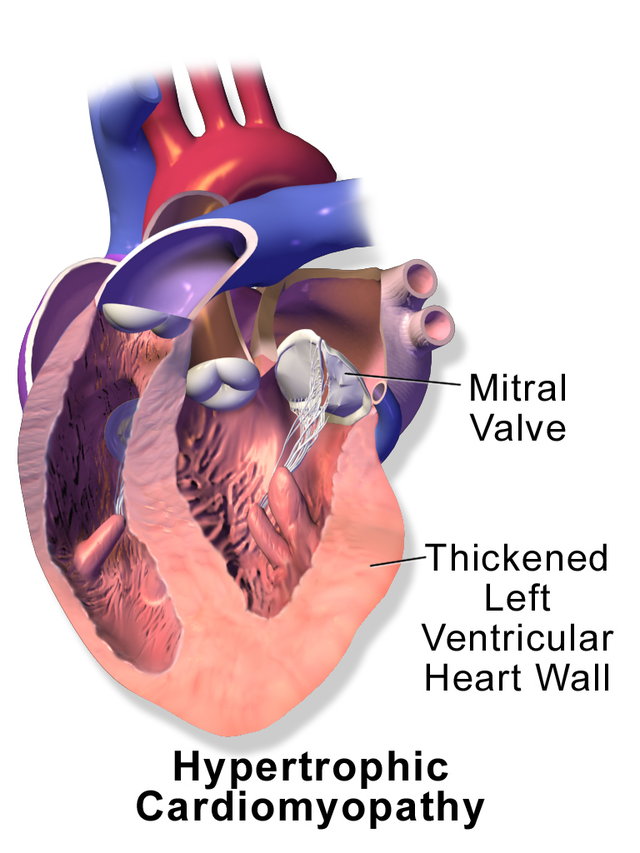
Cardiomiopatía hipertrófica
En cardiomiopatía hipertrófica el heart muscle becomes thickened (hypertrophies) in parts of the heart. In the normal heart, the muscle cells are regular and patterned. What is hypertrophic cardiomyopathy. Hypertrophic cardiomyopathy is a disease in which the heart muscle becomes thickened. The muscle surrounding the left ventricle is the area.
Patient information leaflet
Ritmos cardíacos anormales
An arrhythmia is an abnormal rate and/or rhythm of the heartbeat due to some problem with the electrical conducting system of the heart. What is an arrhythmia. An arrhythmia is an abnormal rate and/or rhythm of the heartbeat. There are various types but all are due to some problem with the electrical conducting system of the heart. Some.
Patient information leaflet
injerto de derivación de la arteria coronaria
This means stopping smoking , lowering blood pressure and cholesterol levels and controlling diabetes mellitus. Complications Heart attack (myocardial infarction). Acute kidney injury - kidney problems. Ventricular arrhythmias - ritmos cardíacos anormales which can sometimes be serious. Blood clots developing in the legs ( deep vein thrombosis ) or.
Patient information leaflet
Sarcoidosis
Some doctors call this chronic sarcoidosis. Symptoms can become worse over time and often treatment is needed. Damage to your lungs, caused by sarcoidosis, may also cause changes in the right si... This is known as cor pulmonale and can lead to heart failure if left untreated. Your heart can also become generally enlarged en sarcoidosis, known as.
Lecturas adicionales y referencias
- Miocardiopatía arritmogénica del ventrículo derecho; MedlinePlus, National Library of Medicine.
- Corrado D, Link MS, Calkins H. Arrhythmogenic Right Ventricular Cardiomyopathy. N Engl J Med. 2017 Jan 5;376(1):61-72. doi: 10.1056/NEJMra1509267. No abstract available.
- Corrado D, Wichter T, Link MS, Hauer RN, Marchlinski FE, Anastasakis A, Bauce B, Basso C, Brunckhorst C, Tsatsopoulou A, Tandri H, Paul M, Schmied C, Pelliccia A, Duru F, Protonotarios N, Estes NM 3rd, McKenna WJ, Thiene G, Marcus FI, Calkins H. Treatment of Arrhythmogenic Right Ventricular Cardiomyopathy/Dysplasia: An International Task Force Consensus Statement. Circulation. 2015 Aug 4;132(5):441-53. doi: 10.1161/CIRCULATIONAHA.115.017944. Epub 2015 Jul 27.
- Marcus FI, McKenna WJ, Sherrill D, Basso C, Bauce B, Bluemke DA, Calkins H, Corrado D, Cox MG, Daubert JP, Fontaine G, Gear K, Hauer R, Nava A, Picard MH, Protonotarios N, Saffitz JE, Sanborn DM, Steinberg JS, Tandri H, Thiene G, Towbin JA, Tsatsopoulou A, Wichter T, Zareba W. Diagnosis of arrhythmogenic right ventricular cardiomyopathy/dysplasia: proposed modification of the task force criteria. Circulation. 2010 Apr 6;121(13):1533-41. doi: 10.1161/CIRCULATIONAHA.108.840827. Epub 2010 Feb 19.
- McNally E, MacLeod H, Dellefave-Castillo L. Arrhythmogenic Right Ventricular Cardiomyopathy Overview. 2005 Apr 18 [updated 2023 May 11]. In: Adam MP, Bick S, Mirzaa GM, Wallace SE, Amemiya A, editors. GeneReviews(R) [Internet]. Seattle (WA): University of Washington, Seattle; 1993-2026. Available from http://www.ncbi.nlm.nih.gov/books/NBK1131/
- Poloni G, De Bortoli M, Calore M, Rampazzo A, Lorenzon A. Arrhythmogenic right-ventricular cardiomyopathy: molecular genetics into clinical practice in the era of next generation sequencing. J Cardiovasc Med (Hagerstown). 2016 Jun;17(6):399-407. doi: 10.2459/JCM.0000000000000385.
- Quarta G, Syrris P, Ashworth M, Jenkins S, Zuborne Alapi K, Morgan J, Muir A, Pantazis A, McKenna WJ, Elliott PM. Mutations in the Lamin A/C gene mimic arrhythmogenic right ventricular cardiomyopathy. Eur Heart J. 2012 May;33(9):1128-36. doi: 10.1093/eurheartj/ehr451. Epub 2011 Dec 23.
- Taylor M, Graw S, Sinagra G, Barnes C, Slavov D, Brun F, Pinamonti B, Salcedo EE, Sauer W, Pyxaras S, Anderson B, Simon B, Bogomolovas J, Labeit S, Granzier H, Mestroni L. Genetic variation in titin in arrhythmogenic right ventricular cardiomyopathy-overlap syndromes. Circulation. 2011 Aug 23;124(8):876-85. doi: 10.1161/CIRCULATIONAHA.110.005405. Epub 2011 Aug 1.
- Te Riele AS, Hauer RN. Arrhythmogenic right ventricular dysplasia/cardiomyopathy: clinical challenges in a changing disease spectrum. Trends Cardiovasc Med. 2015 Apr;25(3):191-8. doi: 10.1016/j.tcm.2014.11.003. Epub 2014 Nov 15.
- van der Zwaag PA, van Rijsingen IA, Asimaki A, Jongbloed JD, van Veldhuisen DJ, Wiesfeld AC, Cox MG, van Lochem LT, de Boer RA, Hofstra RM, Christiaans I, van Spaendonck-Zwarts KY, Lekanne dit Deprez RH, Judge DP, Calkins H, Suurmeijer AJ, Hauer RN, Saffitz JE, Wilde AA, van den Berg MP, van Tintelen JP. Phospholamban R14del mutation in patients diagnosed with dilated cardiomyopathy or arrhythmogenic right ventricular cardiomyopathy: evidence supporting the concept of arrhythmogenic cardiomyopathy. Eur J Heart Fail. 2012 Nov;14(11):1199-207. doi: 10.1093/eurjhf/hfs119. Epub 2012 Jul 20.
Únete a la conversación
Comparte tus pensamientos o experiencias con otros en nuestro comunidades de pacientes.

Pregunta, comparte, conecta.
Navega por discusiones, haz preguntas y comparte experiencias en cientos de temas de salud.
Suscríbete al boletín de Patient
Tu dosis semanal de consejos de salud claros y confiables, escritos para ayudarte a sentirte informado, seguro y en control.
Al suscribirte aceptas nuestros Política de Privacidad. Puedes darte de baja en cualquier momento. Nunca vendemos tus datos.