PDGFRB-associated chronic eosinophilic leukemia
Última actualización 2 Oct 2024
Cumple con las directrices editoriales
- DescargarDescargar
- Compartir
- Language
- Discusión
- Versión en audio
- Agregar a fuentes preferidas en Google
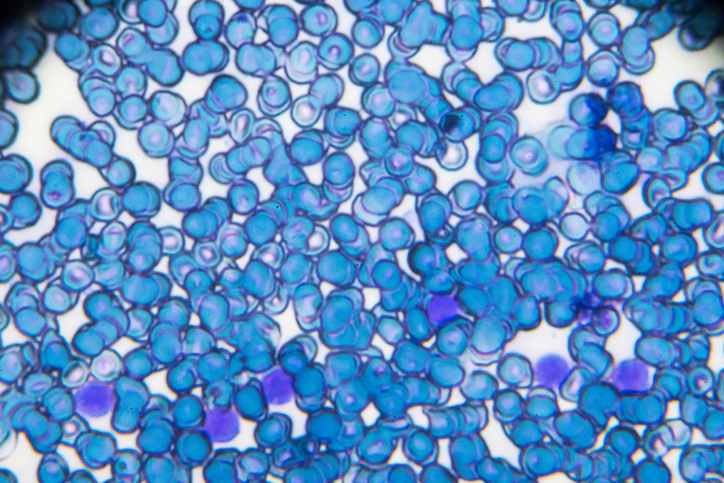
PDGFRB-associated chronic eosinophilic leukemia is a type of cancer of blood-forming cells. It is characterised by an elevated number of white blood cells called eosinophils in the blood. These cells help fight infections by certain parasites and are involved in the inflammation associated with allergic reactions. However, these circumstances do not account for the increased number of eosinophils in PDGFRB-associated chronic eosinophilic leukemia. Some people with this condition have an increased number of other types of white blood cells, such as neutrophils or mast cells, in addition to eosinophils. People with this condition can have an enlarged spleen (splenomegaly) or enlarged liver (hepatomegaly). Some affected individuals develop skin rashes, likely as a result of an abnormal immune response due to the increased number of eosinophils.
Descripción
PDGFRB-associated chronic eosinophilic leukemia is a type of cancer of blood-forming cells. It is characterised by an elevated number of white blood cells called eosinophils in the blood. These cells help fight infections by certain parasites and are involved in the inflammation associated with allergic reactions. However, these circumstances do not account for the increased number of eosinophils in PDGFRB-associated chronic eosinophilic leukemia. Some people with this condition have an increased number of other types of white blood cells, such as neutrophils or mast cells, in addition to eosinophils. People with this condition can have an enlarged spleen (splenomegaly) or enlarged liver (hepatomegaly). Some affected individuals develop skin rashes, likely as a result of an abnormal immune response due to the increased number of eosinophils.
Patrones de herencia
The source lists the following possible inheritance patterns: Pattern unknown. More than one pattern can apply in different cases.
Related genes
Otros nombres
Chronic myelomonocytic leukemia with eosinophilia associated with t(5;12)
Myeloid neoplasms associated with PDGFRB rearrangement
Myeloid neoplasms with PDGFRB rearrangement
Myeloid/lymphoid neoplasms with PDGFRB rearrangement
Related patient information and medicines

Patient information leaflet
Leucemia mieloide crónica
Chronic myeloid leukaemia (CML) is sometimes called chronic myelogenous leukaemia, chronic granulocytic leukaemia, or chronic myelocytic leukaemia. What is chronic myeloid leukaemia. CML develo... The abnormal stem cell multiplies and the cells that are made from the abnormal stem cells mature and develop into near-normal white cells - mainly.

Patient information leaflet
Leucemias infantiles
This bind... White cells (leukocytes). There are different types of white cells, which are called neutrophils (polymorphs), lymphocytes, eosinophils, monocytes and basophils. They are part of the immune system. Their main role is to defend the body against infection. Acute myeloid leukaemia (AML). Chronic myeloid leukaemia (CML) can occur in.

Patient information leaflet
Policitemia vera
You may also have an abnormally high number of platelets and white blood cells. What is normal blood made up of. Blood cells, which can be seen under a microscope, make up... This binds to oxygen and takes oxygen from the lungs to all parts of the body. White cells (leukocytes). There are different types of white cells, which are called.

Patient information leaflet
Inmunosupresión
Millions of bacteria, viruses and other germs (microbes) surround all of us all of the time. Some are actively helpful - for instance, it would be impossible to digest food without ' friendly' gut bacteria which live in everyone's gastrointestinal tract. Most are harmless unless they get into part of the body they are not designed to be in - and.
Patient information leaflet
Leucemia
Leucemia es a cancer of blood-forming cells. There are different types of leukaemia. If you develop leukaemia it is important to know what type it is. This is because the outlook (prognosis) and treatments vary for the different types. What is leukaemia. Leukaemia is a cancer of cells in the bone marrow (the cells which develop into white blood.

Patient information leaflet
Trasplante de células madre
A trasplante de células madre is where blood stem cells (the cells produced by the bone marrow to turn into different types of blood cells) are put back into your body when your bone marrow has been destroyed and cannot make stem cells itself. The bone marrow can be destroyed by diseases such as cancer, chemotherapy or radiotherapy. When is a stem cell.
Lecturas adicionales y referencias
- PDGFRB-associated chronic eosinophilic leukemia; MedlinePlus, National Library of Medicine.
- Apperley JF, Gardembas M, Melo JV, Russell-Jones R, Bain BJ, Baxter EJ, Chase A, Chessells JM, Colombat M, Dearden CE, Dimitrijevic S, Mahon FX, Marin D, Nikolova Z, Olavarria E, Silberman S, Schultheis B, Cross NC, Goldman JM. Response to imatinib mesylate in patients with chronic myeloproliferative diseases with rearrangements of the platelet-derived growth factor receptor beta. N Engl J Med. 2002 Aug 15;347(7):481-7. doi: 10.1056/NEJMoa020150.
- Arefi M, Garcia JL, Penarrubia MJ, Queizan JA, Hermosin L, Lopez-Corral L, Megido M, Giraldo P, de las Heras N, Vanegas RJ, Gutierrez NC, Hernandez-Rivas JM. Incidence and clinical characteristics of myeloproliferative neoplasms displaying a PDGFRB rearrangement. Eur J Haematol. 2012 Jul;89(1):37-41. doi: 10.1111/j.1600-0609.2012.01799.x.
- Chang H, Chuang WY, Sun CF, Barnard MR. Concurrent acute myeloid leukemia and T lymphoblastic lymphoma in a patient with rearranged PDGFRB genes. Diagn Pathol. 2012 Feb 22;7:19. doi: 10.1186/1746-1596-7-19.
- Cross NC, Reiter A. Fibroblast growth factor receptor and platelet-derived growth factor receptor abnormalities in eosinophilic myeloproliferative disorders. Acta Haematol. 2008;119(4):199-206. doi: 10.1159/000140631. Epub 2008 Jun 20.
- Galimberti S, Ferreri MI, Simi P, Azzara A, Barate C, Fazzi R, Cecconi N, Cervetti G, Guerrini F, Petrini M. Platelet-derived growth factor beta receptor (PDGFRB) gene is rearranged in a significant percentage of myelodysplastic syndromes with normal karyotype. Br J Haematol. 2009 Dec;147(5):763-6. doi: 10.1111/j.1365-2141.2009.07878.x. Epub 2009 Sep 16. No abstract available.
- Gotlib J. Eosinophilic myeloid disorders: new classification and novel therapeutic strategies. Curr Opin Hematol. 2010 Mar;17(2):117-24. doi: 10.1097/MOH.0b013e3283366c70.
- Gotlib J. World Health Organization-defined eosinophilic disorders: 2012 update on diagnosis, risk stratification, and management. Am J Hematol. 2012 Sep;87(9):903-14. doi: 10.1002/ajh.23293.
- Haferlach C, Bacher U, Schnittger S, Alpermann T, Zenger M, Kern W, Haferlach T. ETV6 rearrangements are recurrent in myeloid malignancies and are frequently associated with other genetic events. Genes Chromosomes Cancer. 2012 Apr;51(4):328-37. doi: 10.1002/gcc.21918. Epub 2011 Dec 8.
- Noel P. Eosinophilic myeloid disorders. Semin Hematol. 2012 Apr;49(2):120-7. doi: 10.1053/j.seminhematol.2012.01.008.
- Zhou MH, Gao L, Jing Y, Xu YY, Ding Y, Wang N, Wang W, Li MY, Han XP, Sun JZ, Wang LL, Yu L. Detection of ETV6 gene rearrangements in adult acute lymphoblastic leukemia. Ann Hematol. 2012 Aug;91(8):1235-43. doi: 10.1007/s00277-012-1431-4. Epub 2012 Feb 29.
Únete a la conversación
Comparte tus pensamientos o experiencias con otros en nuestro comunidades de pacientes.

Pregunta, comparte, conecta.
Navega por discusiones, haz preguntas y comparte experiencias en cientos de temas de salud.
Suscríbete al boletín de Patient
Tu dosis semanal de consejos de salud claros y confiables, escritos para ayudarte a sentirte informado, seguro y en control.
Al suscribirte aceptas nuestros Política de Privacidad. Puedes darte de baja en cualquier momento. Nunca vendemos tus datos.