Hypomyelination with brainstem and spinal cord involvement and leg spasticity
Última actualización 18 Aug 2023
Cumple con las directrices editoriales
- DescargarDescargar
- Compartir
- Language
- Discusión
- Ask Patient
- Versión en audio
- Agregar a fuentes preferidas en Google
Hypomyelination with brainstem and spinal cord involvement and leg spasticity (HBSL) is a condition that affects the brain and spinal cord (central nervous system). In particular, the condition affects nerves in specific regions (called tracts) within the spinal cord and the brainstem, which is the part of the brain that connects to the spinal cord. HBSL is a form of leukodystrophy, which is a group of conditions that involve abnormalities of the nervous system's white matter. The white matter consists of nerve fibers covered by a fatty substance, called myelin, that insulates the fibers and promotes the rapid transmission of nerve impulses. In HBSL, the nervous system has a reduced ability to form myelin (hypomyelination).
Selecciones de videos para Condiciones genéticasBiblioteca de videos
Descripción
Hypomyelination with brainstem and spinal cord involvement and leg spasticity (HBSL) is a condition that affects the brain and spinal cord (central nervous system). In particular, the condition affects nerves in specific regions (called tracts) within the spinal cord and the brainstem, which is the part of the brain that connects to the spinal cord. HBSL is a form of leukodystrophy, which is a group of conditions that involve abnormalities of the nervous system's white matter. The white matter consists of nerve fibers covered by a fatty substance, called myelin, that insulates the fibers and promotes the rapid transmission of nerve impulses. In HBSL, the nervous system has a reduced ability to form myelin (hypomyelination).
In HBSL, early development of motor skills (such as rolling over and sitting) may be normal, but movement problems typically begin within the infant's first year. However, in some individuals, these problems do not appear until adolescence. The characteristic feature of HBSL is muscle stiffness (spasticity) in the legs that worsens over time. Most people with HBSL are unable to walk independently. Other neurological problems in affected individuals can include abnormal side-to-side movements of the eyes (nystagmus), weak muscle tone (hypotonia) in the torso, and mild intellectual disability.
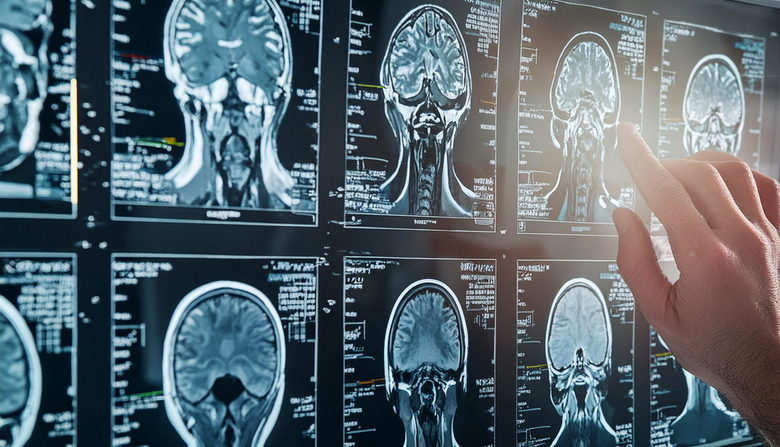
Distinct changes in the brains of people with HBSL can be seen using magnetic resonance imaging (MRI). These characteristic abnormalities typically involve specific regions (called tracts) within the brainstem and spinal cord, especially the pyramidal tract, lateral corticospinal tract, and the dorsal column.
Patrones de herencia
The source lists the following possible inheritance patterns: Autosomal recessive. More than one pattern can apply in different cases.
Related genes
Otros nombres
Aspartyl-tRNA synthetase deficiency
HBSL
Hypomyelination with brain stem and spinal cord involvement and leg spasticity
Related patient information and medicines
Patient information leaflet
Esclerosis múltiple
Multiple sclerosis is a disorder of the brain and spinal cord. In most cases, episodes of symptoms come and go for several years. Although there is no cure for multiple sclerosis, various medicines and therapies may reduce the number of flare-ups and can help to ease symptoms and disability. Multiple sclerosis (MS) is a disease where patches of.
Patient information leaflet
Relajantes musculares
Baclofen, diazepam, methocarbamol and tizanidine act on the central nervous system (brain and spinal cord). Cannabis extract works on the brain and spinal cord as well as the muscles. In most cases it i... Motor neurone disease Baclofen, tizanidine, dantrolene, and gabapentin are sometimes used for muscle stiffness or spasticity in people with.
Patient information leaflet
Espondilosis cervical
This leaflet is aimed at people who have been told they have espondilosis cervical as a cause of their neck symptoms. Cervical spondylosis is a 'wear and tear' of the vertebrae and discs in the neck. It is a normal part of ageing and does not cause symptoms in many people. The spinal cord, which contains nervous tissue carrying messages to and from.
Patient information leaflet
Neuropatía diabética
Diabetic neuropathy is a type of nerve damage that can occur if you have type 1 diabetes Type 1 diabetes or type 2 diabetes Type 2 diabetes. Your peripheral nervous system is a network of nerves called peripheral nerves. These transmit information between your central nervous system (your brain and spinal cord) and all the other parts of your.
Patient information leaflet
Calambres en las piernas
Leg cramps are common and most common in the calf muscles. They can occur in any muscle group. The cause is not known in most cases. However, some medications and diseases... Quinine tablets may be advised as a last resort if the cramps occur regularly. What are leg cramps. A leg cramp is a pain that comes from a leg muscle. It is a muscle spasm,.

Patient information leaflet
Hernia de disco
A slipped disc es un old-fashioned term and does not truly describe what happens in this condition. It is more common to refer to it as a "disc prolapse", "disc herniation" or "disc bulge". All the discs are the same - they have a stronger fibrous outer part a... The spinal cord contains the nerves that come from the brain. Nerves from the spinal.
Lecturas adicionales y referencias
- Hypomyelination with brainstem and spinal cord involvement and leg spasticity; MedlinePlus, National Library of Medicine.
- Frohlich D, Suchowerska AK, Spencer ZH, von Jonquieres G, Klugmann CB, Bongers A, Delerue F, Stefen H, Ittner LM, Fath T, Housley GD, Klugmann M. In vivocharacterization of the aspartyl-tRNA synthetase DARS: Homing in on the leukodystrophy HBSL. Neurobiol Dis. 2017 Jan;97(Pt A):24-35. doi: 10.1016/j.nbd.2016.10.008. Epub 2016 Nov 2.
- Frohlich D, Suchowerska AK, Voss C, He R, Wolvetang E, von Jonquieres G, Simons C, Fath T, Housley GD, Klugmann M. Expression Pattern of the Aspartyl-tRNA Synthetase DARS in the Human Brain. Front Mol Neurosci. 2018 Mar 20;11:81. doi: 10.3389/fnmol.2018.00081. eCollection 2018.
- Taft RJ, Vanderver A, Leventer RJ, Damiani SA, Simons C, Grimmond SM, Miller D, Schmidt J, Lockhart PJ, Pope K, Ru K, Crawford J, Rosser T, de Coo IF, Juneja M, Verma IC, Prabhakar P, Blaser S, Raiman J, Pouwels PJ, Bevova MR, Abbink TE, van der Knaap MS, Wolf NI. Mutations in DARS cause hypomyelination with brain stem and spinal cord involvement and leg spasticity. Am J Hum Genet. 2013 May 2;92(5):774-80. doi: 10.1016/j.ajhg.2013.04.006.
- Wolf NI, Toro C, Kister I, Latif KA, Leventer R, Pizzino A, Simons C, Abbink TE, Taft RJ, van der Knaap MS, Vanderver A. DARS-associated leukoencephalopathy can mimic a steroid-responsive neuroinflammatory disorder. Neurology. 2015 Jan 20;84(3):226-30. doi: 10.1212/WNL.0000000000001157. Epub 2014 Dec 19.
Comparte tus pensamientos o experiencias con otros en nuestro comunidades de pacientes.
Acceso sencillo a tratamientos y servicios de salud confiables en línea.
Common conditions
Get help with common conditions through the NHS, without a GP appointment.
 Sinusitis aguda
 Amigdalitis bacteriana
 Impetigo
 Picaduras de insectos
 Herpes zósterInfección del tracto urinario (ITU)
Suscríbete al boletín de Patient
Tu dosis semanal de consejos de salud claros y confiables, escritos para ayudarte a sentirte informado, seguro y en control.
Al suscribirte aceptas nuestros Política de Privacidad. Puedes darte de baja en cualquier momento. Nunca vendemos tus datos.