Familial acute myeloid leukemia with mutated CEBPA
Última actualización 18 Aug 2020
Cumple con las directrices editoriales
- DescargarDescargar
- Compartir
- Language
- Discusión
- Versión en audio
- Agregar a fuentes preferidas en Google
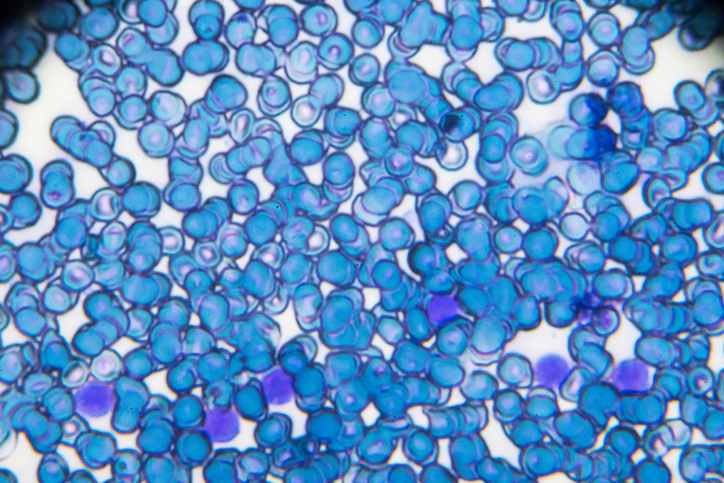
Familial acute myeloid leukemia with mutated CEBPA is one form of a cancer of the blood-forming tissue (bone marrow) called acute myeloid leukemia. In normal bone marrow, early blood cells called hematopoietic stem cells develop into several types of blood cells: white blood cells (leukocytes) that protect the body from infection; red blood cells (erythrocytes) that carry oxygen; and platelets (thrombocytes), which are involved in blood clotting. In acute myeloid leukemia, the bone marrow makes large numbers of abnormal, immature white blood cells called myeloid blasts. Instead of developing into normal white blood cells, the myeloid blasts develop into cancerous leukemia cells. The large number of abnormal cells in the bone marrow interferes with the production of functional white blood cells, red blood cells, and platelets.
Descripción
Familial acute myeloid leukemia with mutated CEBPA is one form of a cancer of the blood-forming tissue (bone marrow) called acute myeloid leukemia. In normal bone marrow, early blood cells called hematopoietic stem cells develop into several types of blood cells: white blood cells (leukocytes) that protect the body from infection; red blood cells (erythrocytes) that carry oxygen; and platelets (thrombocytes), which are involved in blood clotting. In acute myeloid leukemia, the bone marrow makes large numbers of abnormal, immature white blood cells called myeloid blasts. Instead of developing into normal white blood cells, the myeloid blasts develop into cancerous leukemia cells. The large number of abnormal cells in the bone marrow interferes with the production of functional white blood cells, red blood cells, and platelets.
People with familial acute myeloid leukemia with mutated CEBPA have a shortage of white blood cells (leukopenia), leading to increased susceptibility to infections. A low number of red blood cells (anaemia) also occurs in this disorder, resulting in fatigue and weakness. Affected individuals also have a reduction in the amount of platelets (thrombocytopenia), which can result in easy bruising and abnormal bleeding. Other symptoms of familial acute myeloid leukemia with mutated CEBPA may include fever and weight loss.
While acute myeloid leukemia is generally a disease of older adults, familial acute myeloid leukemia with mutated CEBPA often begins earlier in life, and it has been reported to occur as early as age 4. Between 50 and 65 percent of affected individuals survive their disease, compared with 25 to 40 percent of those with other forms of acute myeloid leukemia. However, people with familial acute myeloid leukemia with mutated CEBPA have a higher risk of having a new primary occurrence of this disorder after successful treatment of the initial occurrence.
Patrones de herencia
The source lists the following possible inheritance patterns: Autosomal dominant. More than one pattern can apply in different cases.
Related genes
Otros nombres
CEBPA-dependent familial acute myeloid leukemia
Familial acute myeloid leukaemia
Related patient information and medicines

Patient information leaflet
Leucemia mieloide aguda
Leucemia mieloide aguda es where the bone marrow makes large numbers of abnormal immature white blood cells which are derived from a myeloid stem cell. What is acute myeloid leukaemia. Acute myeloid leukaemia (AML) is a condition where the bone marrow makes large numbers of abnormal immature white blood cells which are derived from a myeloid stem.

Patient information leaflet
Leucemias infantiles
Leucemia es un cáncer of the cells which develop into blood cells. There are different types of leukaemia. The outlook (prognosis) for children with leukaemia is usually very good and most children are cured. This leaflet gives a general overview of childhood leukaemias. Leukaemia is a cancer of cells in the bone marrow (the cells which develop.
Patient information leaflet
Leucemia
Leucemia es a cancer of blood-forming cells. There are different types of leukaemia. If you develop leukaemia it is important to know what type it is. This is because the outlook (prognosis) and treatments vary for the different types. The main types of leukaemia Acute lymphoblastic leukaemia (ALL). Chronic lymphocytic leukaemia (CLL). Acute.

Patient information leaflet
Cánceres infantiles
There are many different tipo de cáncer that can affect children and childhood cancers can cause many different symptoms. Therefore, any child should be seen by a GP or other healthcare professional if you are ... It is the most common type of childhood cancer. There are two main types of childhood leukaemia - acute lymphoblastic leukaemia and.

Patient information leaflet
Trasplante de células madre
A trasplante de células madre is where blood stem cells (the cells produced by the bone marrow to turn into different types of blood cells) are put back into your body when your bone marrow has been destroyed and cannot make stem cells itself. The bone marrow can be destroyed by diseases such as ... Stem cells Stem cells are immature (primitive) cells..

Patient information leaflet
Myelofibrosis
Myelofibrosis es a condition affecting the bone marrow and its blood cell production. What is myelofibrosis. Myelofibrosis belongs to a group of diseases called myeloproliferative disorders. Myelofibrosis is a serious bone marrow disorder that disrupts your body's normal production of blood cells. This leads to reduced levels of: Red blood cells.
Lecturas adicionales y referencias
- Familial acute myeloid leukemia with mutated CEBPA; MedlinePlus, National Library of Medicine.
- Carmichael CL, Wilkins EJ, Bengtsson H, Horwitz MS, Speed TP, Vincent PC, Young G, Hahn CN, Escher R, Scott HS. Poor prognosis in familial acute myeloid leukaemia with combined biallelic CEBPA mutations and downstream events affecting the ATM, FLT3 and CDX2 genes. Br J Haematol. 2010 Aug;150(3):382-5. doi: 10.1111/j.1365-2141.2010.08204.x. Epub 2010 Apr 29. No abstract available.
- Drazer M, Tawana K. CEBPA-Associated Familial Acute Myeloid Leukemia. 2010 Oct 21 [updated 2026 Sep 3]. In: Adam MP, Bick S, Mirzaa GM, Wallace SE, Amemiya A, editors. GeneReviews(R) [Internet]. Seattle (WA): University of Washington, Seattle; 1993-2026. Available from http://www.ncbi.nlm.nih.gov/books/NBK47457/
- Godley LA. Inherited predisposition to acute myeloid leukemia. Semin Hematol. 2014 Oct;51(4):306-21. doi: 10.1053/j.seminhematol.2014.08.001. Epub 2014 Aug 12.
- Nanri T, Uike N, Kawakita T, Iwanaga E, Mitsuya H, Asou N. A family harboring a germ-line N-terminal C/EBPalpha mutation and development of acute myeloid leukemia with an additional somatic C-terminal C/EBPalpha mutation. Genes Chromosomes Cancer. 2010 Mar;49(3):237-41. doi: 10.1002/gcc.20734.
- Nickels EM, Soodalter J, Churpek JE, Godley LA. Recognizing familial myeloid leukemia in adults. Ther Adv Hematol. 2013 Aug;4(4):254-69. doi: 10.1177/2040620713487399.
- Owen C, Barnett M, Fitzgibbon J. Familial myelodysplasia and acute myeloid leukaemia--a review. Br J Haematol. 2008 Jan;140(2):123-32. doi: 10.1111/j.1365-2141.2007.06909.x.
- Pabst T, Eyholzer M, Haefliger S, Schardt J, Mueller BU. Somatic CEBPA mutations are a frequent second event in families with germline CEBPA mutations and familial acute myeloid leukemia. J Clin Oncol. 2008 Nov 1;26(31):5088-93. doi: 10.1200/JCO.2008.16.5563. Epub 2008 Sep 2.
- Pabst T, Mueller BU, Zhang P, Radomska HS, Narravula S, Schnittger S, Behre G, Hiddemann W, Tenen DG. Dominant-negative mutations of CEBPA, encoding CCAAT/enhancer binding protein-alpha (C/EBPalpha), in acute myeloid leukemia. Nat Genet. 2001 Mar;27(3):263-70. doi: 10.1038/85820.
- Renneville A, Mialou V, Philippe N, Kagialis-Girard S, Biggio V, Zabot MT, Thomas X, Bertrand Y, Preudhomme C. Another pedigree with familial acute myeloid leukemia and germline CEBPA mutation. Leukemia. 2009 Apr;23(4):804-6. doi: 10.1038/leu.2008.294. Epub 2008 Oct 23. No abstract available.
- Smith ML, Cavenagh JD, Lister TA, Fitzgibbon J. Mutation of CEBPA in familial acute myeloid leukemia. N Engl J Med. 2004 Dec 2;351(23):2403-7. doi: 10.1056/NEJMoa041331.
- West AH, Godley LA, Churpek JE. Familial myelodysplastic syndrome/acute leukemia syndromes: a review and utility for translational investigations. Ann N Y Acad Sci. 2014 Mar;1310(1):111-8. doi: 10.1111/nyas.12346. Epub 2014 Jan 27.
Únete a la conversación
Comparte tus pensamientos o experiencias con otros en nuestro comunidades de pacientes.

Pregunta, comparte, conecta.
Navega por discusiones, haz preguntas y comparte experiencias en cientos de temas de salud.
Suscríbete al boletín de Patient
Tu dosis semanal de consejos de salud claros y confiables, escritos para ayudarte a sentirte informado, seguro y en control.
Al suscribirte aceptas nuestros Política de Privacidad. Puedes darte de baja en cualquier momento. Nunca vendemos tus datos.